
The Right Message Mirage
"Right Message, Right Person, Right Time" is marketing's favorite myth—an impossible optimization target that wastes time, money, and effort while distorting how advertising actually works.

I was asked the other day how things were going in my professional life as a marketing influencer. Well, I hate to say it, but I told this imaginary person that I think it’s going poorly, not because I’m not having a good time or making tens of dollars, but because of a fundamental disconnect in how people think ads work (see an ad, buy the thing) and how they actually work (see an ad, live life, buy the thing when they have a mind to).
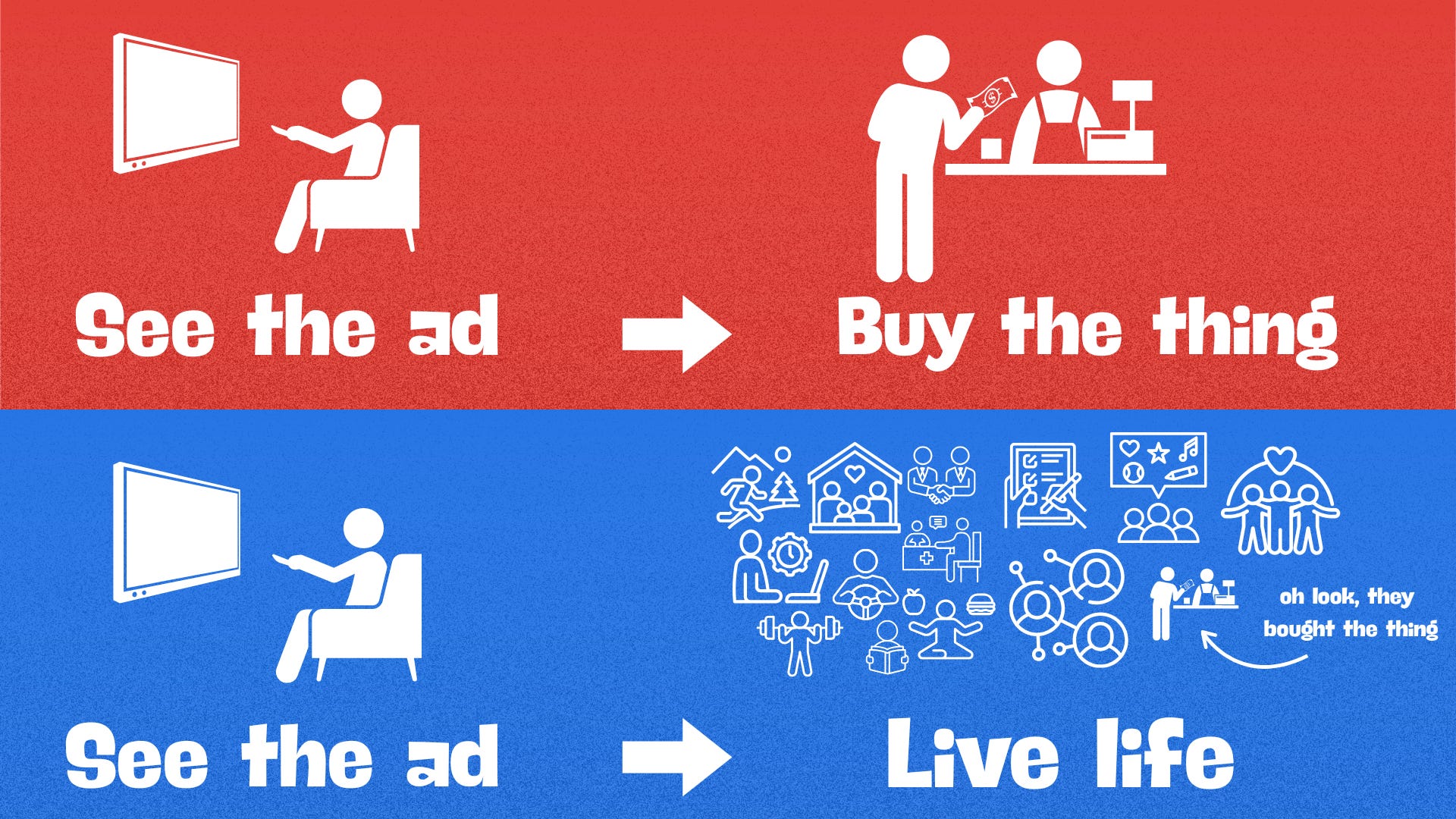
The “Right” Myth We Built for Ourselves
The big issue I’m having recently is how to appropriately respond to and deal with the virulent strain of magical thinking behind the idea of “Right Message, Right Person, Right Time” (RMRPRT) that pervades advertising and business brains.
Search “RMRPRT” in Google and you get +2 million hits, claiming that RMRPRT is “the gold standard” for effective marketing communications and relationship building. I’ve been in marketing for 12 years now, and I’ve heard it since day one.
And it feels like a “truth” - people see an ad at the right moment, take the right action, maybe that’s how this all works? I’m not in marketing, I’m some kinda eagle-eyed communications sniper…
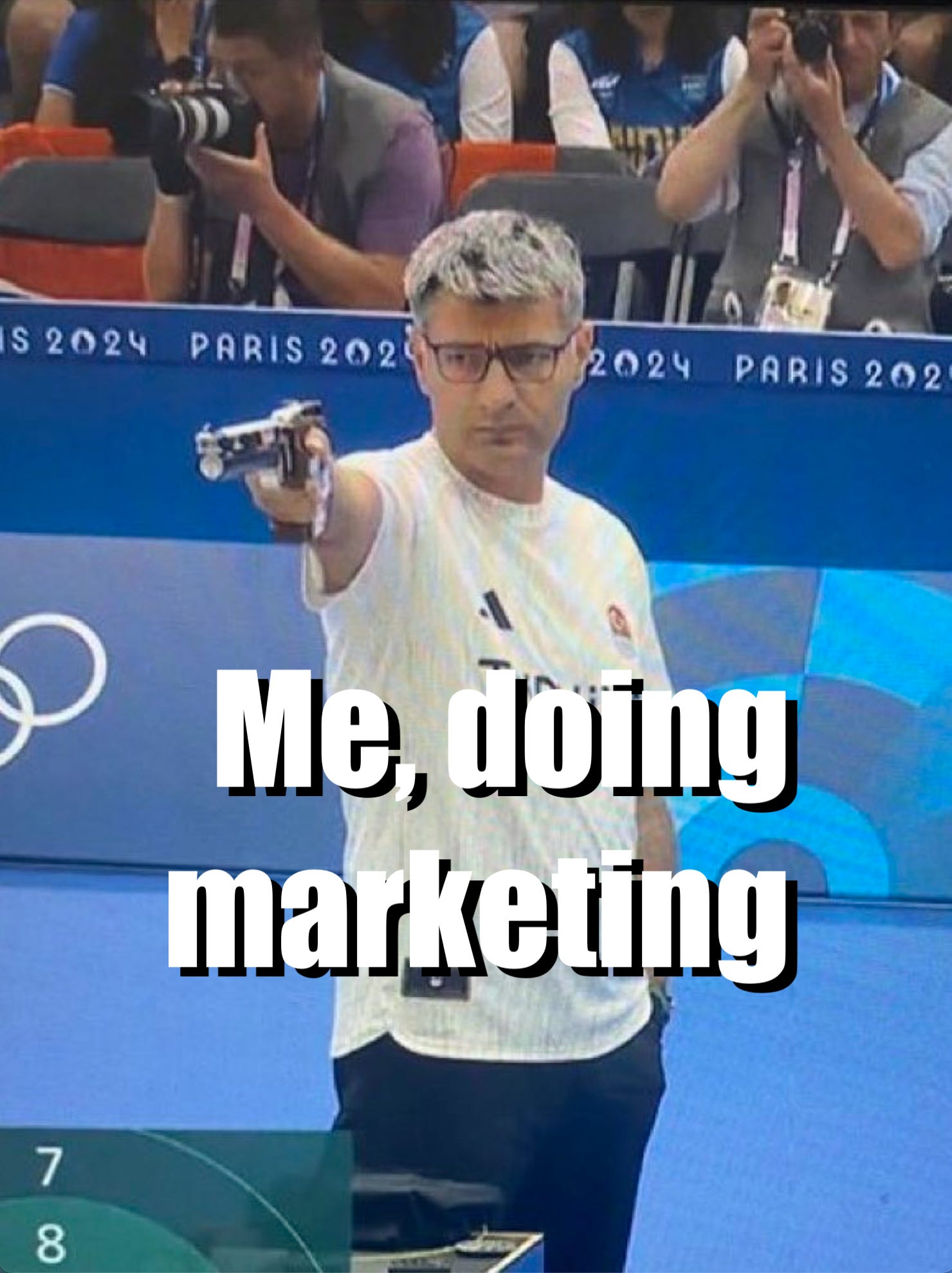
It’s something the marketing/advertising community almost has to believe in, or else, why are we doing this?
We have to believe that we can/will/must craft the right message that will hit the right person at the right time. I know when I started as a marketer, I was convinced that RMPRT was the way, because all of the tech must be here to do just that.
Let’s look a little deeper at the inferences behind RMRPRT….
The Data Doesn’t Prove the Doctrine
It’s easy to think that with AI and better data access, this targeting is solved/possible/happening, but I’m suss on this, not because I’m a hater, but based on experience.
Consumer data profiles (and yes, even intent data in B2B), right now, are riddled with probabilistic inferences, outdated attributes, competing identity graphs, and inferred interests, not objective truth. When I downloaded my own profiles from major data brokers, they contained incorrect demographics, outdated locations, and interests that simply weren’t mine. This is the data layer for RMRPRT.
Meanwhile, due to the digital ad impression delusion, the industry still debates what it even means for an ad to be “seen,” with an impression often counted after only a fraction of a second on screen. This is how we prove RMRPRT.
If we can’t reliably identify the person, confidently describe the person, or even confirm that the message was actually noticed, then claiming we’ve mastered “right message, right person, right time” is an act of collective delusion, not a solved-for engineering achievement.
None of this means targeted campaigns or account-based marketing doesn’t work. I’ve run ABM campaigns that produced solid results. But success is not proof of the mechanism.
It’s an annoying truth in this industry, but one we all have to admit to; a sale after an ad doesn’t prove the ad created the sale, let alone prove it was the “right message” delivered at the “right time.” The ad may have accelerated a decision, reinforced an existing preference, or simply received attribution for a purchase that was already underway.
In a Rumsfeldian way, it’s the unknown-unknowns that are missing, we can’t observe the counterfactuals, what that buyer would have done had they never seen the ad. This is why attribution remains one of marketing’s longest-running debates, and why RMRPRT can never be conclusively proven or disproven.
But that’s not stopping me…
Consumers Don’t Experience Life One Ad at a Time
To the average person in the marketplace, the concept of RMRPRT is non-existent, invisible.
I can’t imagine anyone in our busy modern world sets aside any portion of their time or brainspace to wonder if the ads they’re seeing are properly aligned to their context, or hold out hope for such a holy alignment to occur.
“Thank Jesus, the ad I’ve been waiting for is here!” isn’t something you hear outside of bible sales.
The upsetting, near-religious/mythical part is, RMRPRT assumes that there is a “right person” out there, a divine match that’s just hankering for the right message at the right moment…..
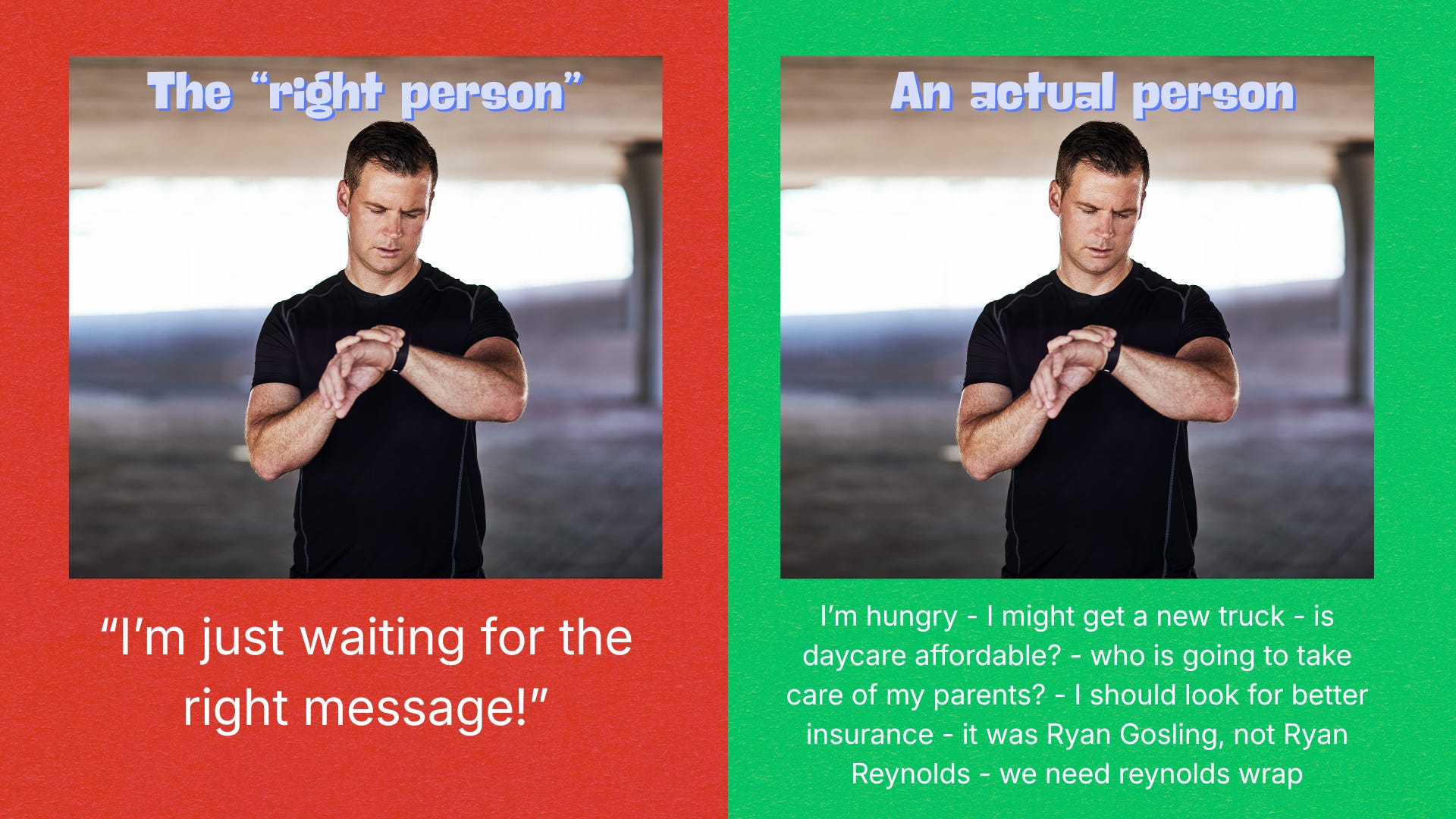
I don’t want to speak for normal people, because again, I’m in marketing, I mean I’m the Jason Bourne of lazer-targeted marketing, but I don’t think actual people are thinking about ads at all.
No actual person is experiencing life, “one targeted ad at a time.”
No one sees an advertisement and then drops everything and adjusts their whole life around purchasing that thing.
No one wakes up thinking, “I’m finally the right person at the right time,” and goes a-courting for some right sized marketing message to fill that hole in their soul.

What is this “Seven Brands for Seven Brothers” marketing match-maker financial fantasy?
You don’t ever hear marriage proposals characterized as “Right message, right person, right time.” Thoughtful, well deliberated, long term commitment decisions between parties that are overly familiar with one another, are rarely thought of as the 1-1 result of properly engineered kismet.
More likely, the acceptance of the proposal from the proposed is what confirms the proper alignment of the proposition, not solely how/when the proposer proposed….
What Would RMRPRT Actually Look Like?
After I took stock and personally reflected on how almost none of the advertising that was addressing me throughout my day could ever be characterized as “the right message, right time,” I decided to run a poll on LinkedIn…
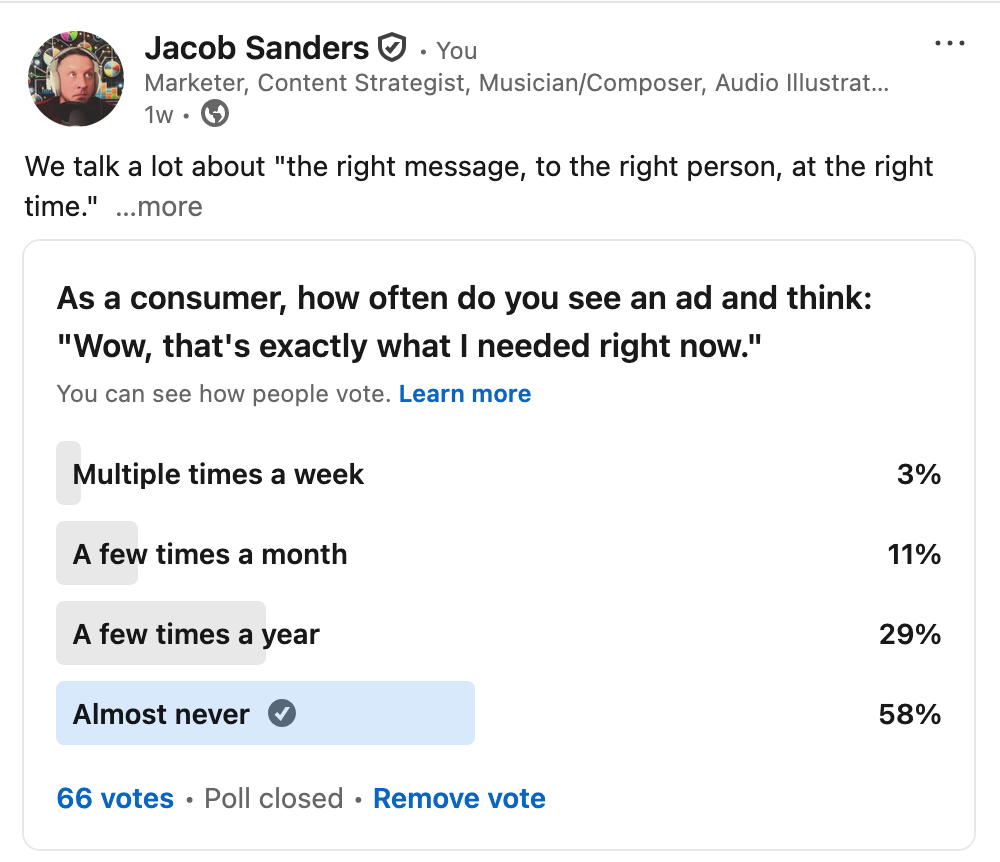
With the amount of search hits for RMRPRT, counting all the number of times I’ve heard the phrase leave client, staff, teammates, non-marketers mouths, tallying up every single webinar and whitepaper ever released on how to dial RMRPRT in and win big; these poll numbers should be drastically different.
Why aren’t we ALL seeing the right messages constantly in our rightest moments?
I’ll ask again, because it seems everyone believes the exact opposite - does RMRPRT actually exist?
If RMRPRT exists in marketing and advertising, then we’d have to question a few wonky things about decision making...
Someone ALREADY wants to buy a thing - is that 100% RMRPRT?
Someone wants you but changes to cheaper competition - their RMRPRT beat yours?
Are you, personally and currently, being assailed by the right messages at the right time because you are the right person? If so, how are you handling it? That sounds terrifying!

Why Do I Care So Much? Why Am I Rambling? Why Did I Capitalize This Sentence Like This?
Right now, I bet you’re wondering, “Okay…even if you’re right…who cares?” I guess I’m off on a tangent, because not only do I think RMRPRT is imaginary bullshit, it’s real-world harmful in four distinct ways.
1. Creates endless, low-value work
If we accept RMRPRT as true (we already do), then any and every ad campaign, strategy & tactic, every line of marketing copy, every color, shape, design or layout must be treated as fungible; it has to be for another audience, persona, variation, timing trigger, optimization layer. Instead of asking “what’s the best story we can tell?” teams are asking, “what are the next batch of 700 variations?” Production over strategy, endless optimization over authentic communication. Nothing stays, everything goes, forever. What’s memorable about the constantly new kid on the block?
2. Mistakes precision for effectiveness
A perfectly targeted message isn’t necessarily a memorable message. Advertising rarely works because it found someone in exactly the right five-minute window. It works because it builds familiarity until a buying situation eventually arrives. Memory lasts longer than targeting. Read “The Advertised Mind” by Erik DuPlessis for the research, or just look at your own life; is a targeted ad with your name on it more memorable than Flo from Progressive or the Oscar Mayer jingle?
3. Encourages tactical thinking instead of pondering probabilities
Marketers will gladly flatten their fellow humans into consumer behavior categories and data silos; but if someone told us data, brands, and consumption patterns define our lives, we’d reject them outright as dismissing our complex nature.
People are not moving through life as a stable dataset. The right person changes faster than the data pinpointing them. The right moment changes faster than any model update. Our “right” message is chasing a moving target. Brands that consistently say one memorable thing, rather than 1,000 “right” ones, often win despite less precision. Marketing isn’t a real-time Rubiks Cube. Marketing comms has always been, and will always be, a memory game.
4. Fundamentally alters the perception & purpose of marketing
If all marketing is, is just engineering the infrastructure of RMRPRT (this is how it is), then our professional purpose tectonically shifts from working the crowd and establishing durable meaning, to working machinery and intercepting temporary intent.
We don’t have to be meaningful or memorable to anyone without intent, we don’t have to touch anyone without a hand up, we don’t ever have to wastefully remind anyone about us because with enough surveillance, we’ll know exactly when we’re in their mind and then we’ll strike….isn’t that neat?
The Person Moves. The Moment Moves. Marketing Shouldn’t.
Brands, marketing agencies, and businesses have thousands of versions of the right message and make more daily, hundreds of the exact right people have been identified, and you got 24 hours and 365 days to get the right time - just one of these “right” metrics being wrong, can throw the whole game off - so, you’ll HAVE to make guesses, which is what this is anyway....or it isn’t because....like we said at the top….
AI and data (which isn’t ever in real-time) and access to more measurements of messages, times, and people will help us find more messages and times and people; but by the time you find the perfect RMRPRT, the TIME and the PERSON have changed, so now your MESSAGE has to change as much as they do, and now, no one can remember you because you never stood still yelling one thing well to the room, but whispering a million personalized and perfect messages into the corners.....

And, the result of someone seeing an ad and remembering it at the point of decision (and that could be hours to months later), is not RMRPRT, it’s called HOW ADS WORK ANYWAY.
A chain of perfect RMRPRT wins isn’t a charm bracelet of perfectly timed tactics, but the result of planning & strategy; if a group of the right people saw the right message at the right time, that’s called media planning...
“The consumer is in control” is a marketing philosophy *not* created by consumers, nor is it one they adhere to. It’s safe to say that RMRPRT is the same thing, something we created that isn’t reflected in reality or how consumers operate, but is nonetheless treated as an operational reality and guiding principle.
Maybe I just hate targeted ads because they are too good and I just have an ax to grind about super efficient advertising that is the best; that sounds like me.
Or maybe, RMRPRT deserves its time in the barrel as a wasteful and hopeless task that saps our energy, budgets, and mental acuity.
Whatever, hand me that grindstone…
Remembered Beats Targeted
Instead of
Right Message, Right Person, Right Time,
I’d propose something like,
The remembered message, at the buying moment.
The goal of marketing and advertising isn’t to tactically deliver the perfect message at the perfect instant. The goal is to strategically create something memorable enough that, when the moment eventually arrives, whether hours, weeks, or months later, the buyer retrieves you.
This is a fundamentally different model of advertising/marketing than we’re currently experiencing. It’s a shift away from defining success as ever-finer interception and back toward memory, consistency, and long-term brand building.
Making RMRPRT Right
The real constraint in all of this is MARKETING BUDGET, as in, no one ever has it. So if you say RMRPRT is bullshit, which is true, you now have to explain the “brand building” alternative. And when anyone in business sees the words, ‘brand building’ they read; EXPENSIVE.
I can hear the counterargument; “Memory is nice, but I have $20k, not $2m, I can’t afford brand campaigns, I have to target.”
This argument is CORRECT. We can’t expect a regional HVAC company or B2B SaaS startup to go and become Coca-Cola. The answer isn’t “stop targeting” but, stop pretending that a chain of 15,746 personalized ads replaces the singular task of brand building.
Targeting in ads determines who gets exposed, but the branding determines what gets remembered.
If you only have enough money to do one thing, don’t spend it making 700 versions of an ad. Put your resources into making one version worth remembering. Then use targeting to help more of the right people encounter that same memory, not 700 different ones.
Targeting can improve the efficiency of distribution, maybe get you the RMRPRT, but it can’t continue to operate as an excuse for never standing for one thing, or a substitute for not even having something memorable to distribute in the first place.
Every dollar you spend making your targeting smarter is a dollar you aren’t spending making your company easier to remember. One compounds. The other resets every campaign.
Hopefully this message hit you at the right time, because time is the one resource we are in complete control of; don’t waste yours trying to find and target Mr./Mrs. Right, do the “right” and memorable thing which allows more of the right people to find you.
Easy to find, easy to buy, and easily thought worth it.
Better get it right….
One of the things I value most is agency. I want the freedom to make decisions on my terms. I want autonomy. Good marketing respects that. Too much marketing today treats people as variables in a conversion model instead of human beings with lives that don’t revolve around brands.
To be fair, this isn’t entirely marketers’ fault. Many are working under unrealistic expectations from executives and investors who expect every campaign to produce immediate, measurable returns. When capital demands instant growth, marketing becomes less about helping people make good decisions and more about forcing outcomes that don’t exist.
That pressure creates desperate tactics like more retargeting, more interruptions, more personalization, more urgency, more surveillance, and more attempts to manufacture demand on command.
Ironically, those tactics often produce the opposite result. People don’t like being treated like targets in a shooting range. They don’t like feeling hunted across the internet until they finally give in. Respect isn’t a soft metric. It’s one of the foundations of long-term brand growth.
The brands that win aren’t the ones that pressure people into buying. They’re the ones that are remembered when people are ready to buy..
This is a scathing, necessary takedown of the "Right Message, Right Person, Right Time" (RMRPRT) dogma. You’ve hit on the central irony of modern marketing: in our frantic pursuit of algorithmic precision, we’ve abandoned the one thing that actually drives business—memory.
By chasing the "perfect" interception, we’ve traded durability for fragmentation. We aren't building brands anymore; we're just managing "machinery" that generates disposable content. As you rightly pointed out, marketing isn't a real-time puzzle; it’s a memory game. If you aren't remembered when the buyer finally decides to move, the accuracy of your targeting becomes a moot point.
The transition from "Right Message, Right Person, Right Time" to "The remembered message at the buying moment" is the most important strategic pivot a brand can make today.
If you are interested in exploring how to shift your resources away from "endless variation" toward building the kind of brand assets that actually stick, I would love for you to check out my space: https://www.google.com/search?q=https://nicolocaiti.substack.com/