

During a Senate Homeland Security Committee hearing, bluntly titled “Reforming the U.S. Postal Service’s Broken Business Model,” lawmakers lined up to chastise Postmaster General David Steiner, expressing intense frustration with operational spending, putting the postal head in an impossible vice grip.
The USPS is legally bound to a strict Universal Service Obligation—a mandate requiring it to deliver physical mail to more than 167 million addresses, six days a week, regardless of how remote or resource-intensive those routes are. They are forcing a 1970s operating structure onto a modern reality. Postmaster General Steiner laid out this mandate clearly during his testimony:
“The Postal Service has a broken business model. In a normal business model, if 70% of routes are losing money, you would adjust the routes. In a normal business model, if 60% of the stores you had were losing money, you’d close them. We’re not allowed to do either.”
But as accountability advocates, we have to ask the hardest, most fundamental question:
When was the last time you opened your mailbox and found something you actually valued?
The Reality of the Modern Mailbox
In marketing, we frequently call out brands that measure success by “vanity metrics”—empty clicks, impressions, and rapid, surface-level engagement data that don’t build real value or long-term trust. The USPS network has become the ultimate physical manifestation of a vanity metric ecosystem.
According to congressional testimony, mail volume has plummeted from a historic peak of 213 billion pieces per year to just 109 billion pieces—an annual collapse of over 104 billion pieces of mail. Yet the system continues to add over 1 million new delivery points every year. We are forcing carriers to drive more miles to deliver less content.
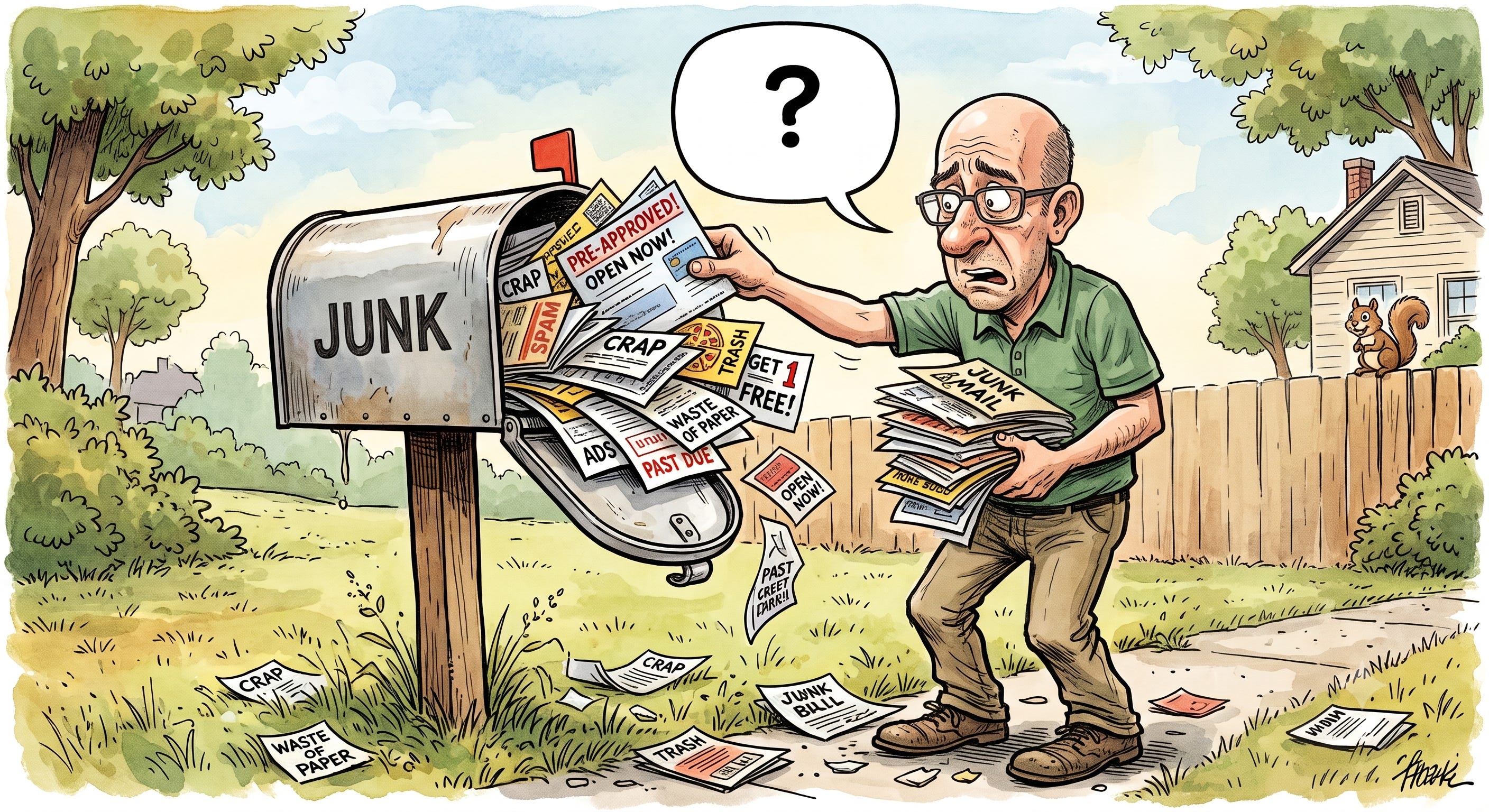
Think about your own daily routine. For the vast majority of Americans, the mailbox has transitioned into a physical spam folder. It is an accumulation of paper bills you’ve already paid online, grocery flyers for stores you don’t visit, and junk mail solicitations.
I recently heard a story about a woman who insisted on mailing a physical letter because she explicitly “didn’t want it to be online.” It was a deliberate act of digital evasion. But that sentiment is a rare anomaly. For most of us, it has been years since we received a handwritten letter, postcard, or meaningful piece of correspondence from another human being.
The 6-Day Delivery Illusion
If the commercial ecosystem has evolved, why are we still pretending we need a person walking up to our doorstep six days a week?
I believe we no longer need daily mail delivery PERIOD. The rigid adherence to a six-day schedule is a relic of a time when the mailbox was our primary link to the outside world. Today, if physical mail is needed at all, one to three times a week is perfectly fine. By forcing a six-day delivery mandate for a product that has largely lost its utility, Congress is widening the “Trust Gap” between public institutions and real people. They are spending billions of dollars to enforce “control” over an inefficient network rather than adapting to human behavior. While massive logistics operations like FedEx, UPS, or independent couriers use highly efficient, data-driven networks to handle essential high-value deliveries, the USPS is forced to drag an incredibly complex, 110-billion-piece legacy network behind it simply to keep delivering paper that consumers throw away instantly.
A Systemic Relevance Problem
At MAC, we believe that when a system breaks down, it’s usually because the system stopped seeing people for who they actually are and how they actually live. The USPS doesn’t just have an operational problem or a funding problem. It has a relevance problem. If the content waiting inside America’s mailboxes isn’t worth the walk down the driveway, demanding that a Postmaster General deliver it six times a week is an exercise in futility.
It is time to stop measuring success by the sheer volume of paper we can move, and start measuring it by actual consumer utility. Until Congress stops clinging to the illusion of daily delivery and shrinks the schedule to match modern necessity, no amount of political theater will save the mailbox from the recycling bin of history.
I agree with the spirit of this, though there have been some studies about the number of people who receive important medicine and checks by mail but sounds like that can be managed with fewer days than six. It's really a choice of paths someone has to choose: 1. Growth, maybe keeping six days but adding the banking services and other opportunities that voices have been screaming for (France and other countries have this) and identifying; OR 2. Optimize to the size needed by existing services, which means shrink as you say, and probably consolidate some locations too and modernize what's there.
Seems like a good consulting assignment and a hellish implementation;-0