

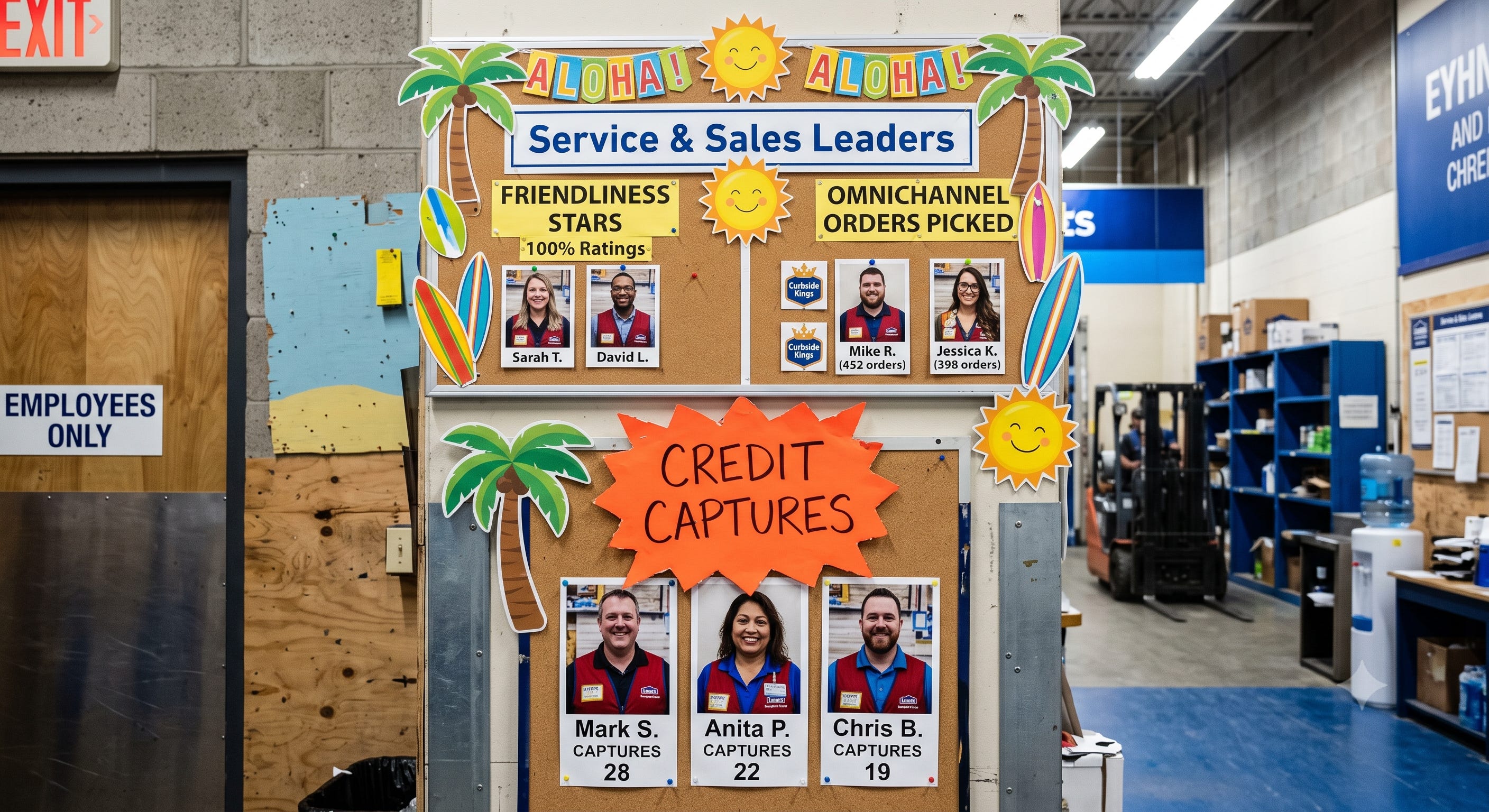
Walking to the public-facing order pickup Lowe’s retail location in Yonkers, NY, one is greeted by a brightly decorated internal dashboard celebrating the store’s “Service & Sales Leaders.” Adorned with cheerful beach-themed cutouts and smiling employee photos, the board tracks localized key performance indicators (KPIs).
At the top tier, the metrics reflect sound, value-generative marketing principles.
Front-line personnel are publicly praised for achieving 100% Friendliness Ratings on post-purchase surveys.
Others are commended for operational efficiency, successfully picking hundreds of omnichannel orders for curbside pickup.
In these dimensions, the business-to-consumer relationship operates as a transparent, mutually beneficial exchange. The employee takes pride in seamless execution, the store optimizes throughput, and the consumer leaves satisfied.
But as your eyes travel down the board, the corporate utopian image completely shatters.
Right alongside the accolades for empathy and efficiency hangs a bright orange starburst loudly celebrating an aggressive transaction metric:
“Credit Captures.”
The Linguistics of the Trap
From an institutional accountability perspective, the terminology alone drops all corporate pretense. Retailers do not use sanitized phrases like “financial partnership” or “loyalty optimization” on their internal walls; they call it a capture.
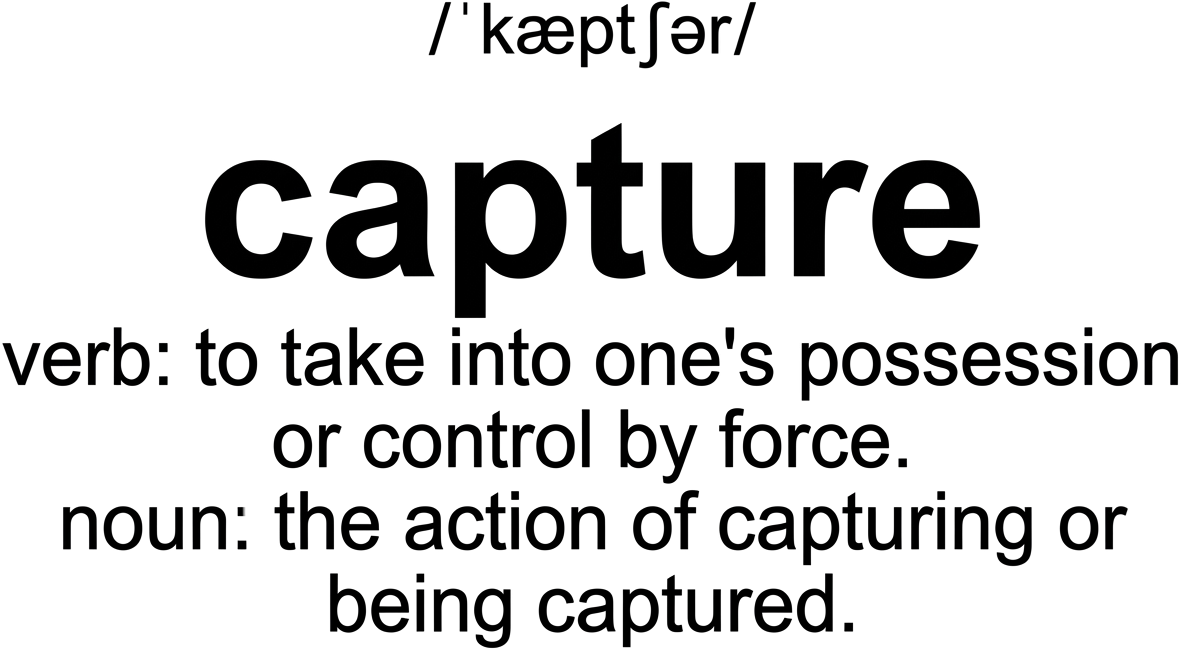
The language treats the target demographic not as a valued patron to be retained, but as prey to be trapped at the point of sale. The checkout lane is transformed into a financial net, and the consumer is the asset to be captured before they can exit the front door.
Once a shopper is successfully captured, the product's financial architecture shifts entirely toward extraction. The consumer is enticed by a minor, highly visible transactional inducement—such as a one-time 20% off and a 5% discount every day. To the consumer, caught in a moment of behavioral bias at the register, it feels like a short-term win.

The mathematical reality, however, is devastatingly one-sided. With ongoing purchase Annual Percentage Rates (APRs) sitting at an astronomical 31.99%, there is virtually zero long-term benefit for the consumer. If a homeowner maintains a balance on a major appliance or raw materials, that compounding interest aggressively neutralizes the initial discount within a highly compressed time horizon. The fleeting, single-store perk is entirely eclipsed by subprime liability.
Why Capital and the Consumer Are Misaligned
This zero-sum game mirrors the exact same extractive logic seen across the gig economy and the data brokerage market. Corporate capital extracts the immediate financial margin and the long-term interest portfolio, while the human element absorbs 100% of the operational and economic risk.
For a specialized big-box retailer whose enterprise value depends on recurring, high-capital-project financing, introducing high-interest friction at the register is incredibly counterproductive. Driving everyday families into compounding debt cycles heavily interrupts their long-term purchasing power. It breeds post-purchase dissonance, degrades the store’s broader customer experience (CX) indices, and severely dilutes systemic brand trust.
Furthermore, this extraction weaponizes human capital. Frontline retail employees, typically compensated at standard hourly rates, are effectively forced to act as aggressive, uncredentialed loan officers. When internal performance systems link shift allocations, job security, or weekly scheduling to “credit capture” quotas, the organizational culture shifts from genuine service delivery to forced financial compliance.
What If Everyone Actually Won?
True market leadership requires rejecting the premise that a consumer must be financially compromised for a retail marketplace to thrive. Shifting from an extractive model to a positive-sum framework yields measurable dividends across the entire corporate structure:
Consumers win: When an enterprise respects the financial well-being of its demographic, it builds authentic loyalty. Eliminating predatory register traps protects consumer purchasing power, giving them a structural reason to return for future high-capital projects.
Frontline talent wins: Employees are energized when their metrics align with authentic service. Removing the coercive pressure of credit quotas allows floor staff to focus on operational velocity and genuine engagement, driving down employee turnover.
Corporate boards win: Ethics are not an obstacle to margin—they are the mechanism for long-term equity valuation. Aligning enterprise success with consumer financial health secures higher lifetime value (CLV) and isolates the brand from regulatory interventions and negative word-of-mouth.
The Accountability Standard
A transaction should never be weaponized against the person who initiated it. Ethical operational architecture is not altruism; it is long-term market survival. Celebrating friendliness and fulfillment velocity drives authentic market share. Conversely, gamifying consumer debt under the banner of “Credit Captures” erodes the foundational trust upon which sustainable enterprises are built. Corporate governance must retire extractive, predatory metrics and return to accountability frameworks where enterprise victory does not require the literal capture and financial deficit of the consumer.