

On July 9, 2026, TIME and Statista dropped their annual ranking of America’s Best Companies. It’s a list measuring exactly what Wall Street and job hunters care about: financial muscle, employee satisfaction, and ESG disclosures.
But there’s a massive blind spot. A company can have a legendary workplace culture, robust margins, and pristine sustainability reports—while simultaneously burying sneaky subscription traps, hiding fees in the fine print, and utilizing predatory marketing tactics.
To prove this, the Marketing Accountability Council (MAC) took the top of TIME’s list and ran them through TrustGap—an independent accountability framework that pits homepage promises directly against what is written in the legalese. The results show a glaring divide between being a “best company” according to TIME, and being an honest one.
How to Build a “Credible” List When You’re a Legacy Magazine
Let’s be honest: TIME’s “America’s Best Companies” is a brand-new listicle. It takes an incredible amount of chutzpah for a legacy magazine to act as the ultimate judge of corporate America. Once a dominant weekly force, TIME has spent the last decade sliding into digital obscurity—now mostly existing as a website trying to recapture its glory days.
Once upon a time, newsmagazines reported the news. Today, they survive by inventing awards and selling shiny digital badges to corporate PR departments. To turn a print-adjacent relic into an arbiter of corporate truth, you only need three things:
A Big-Name Data Partner: You team up with Statista to look “scientific”. If you throw 217,000 employee surveys and complex ESG algorithms into a blender, no one will notice that the actual definition of “best” is incredibly slippery.
A Billionaire Tech Owner: It certainly doesn’t hurt when your owner, Marc Benioff, also happens to run Salesforce—which magically cruised right into the #3 spot on the very list his magazine published.
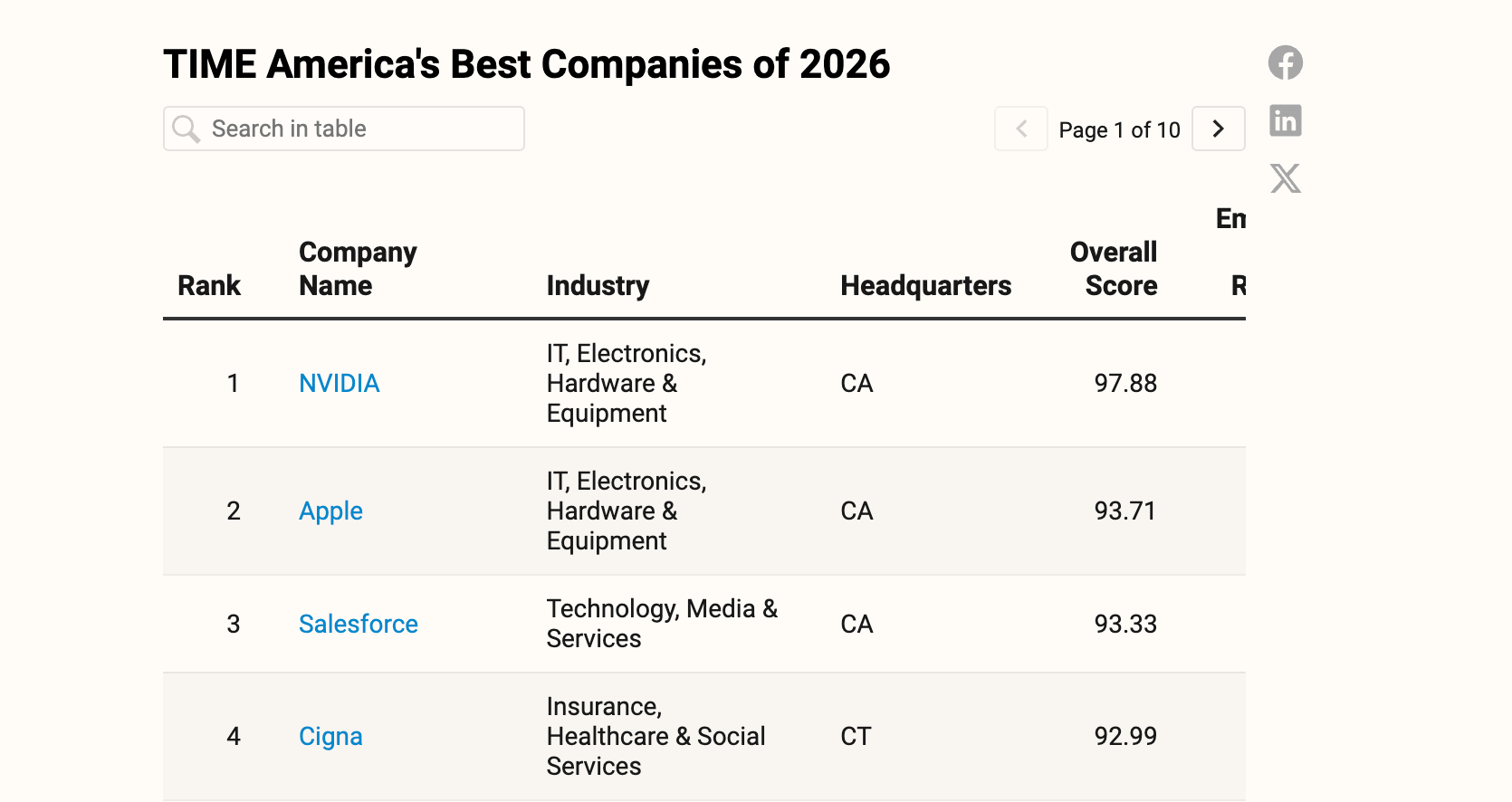
An Insatiable Corporate Appetite for Bragging Rights: Companies love trophies. Within five minutes of the list dropping, hundreds of corporate LinkedIn accounts had already posted about being “humbled and honored”.
And just like that, instant credibility.
At least they aren’t U.S. News & World Report. If you think TIME’s ranking system is a bit of a stretch, let us bow our heads in solemn appreciation for U.S. News, the supreme rulers of the “We Rank Everything” business model. They’ve spent decades pitting colleges, hospitals, and even countries against each other using metric systems so notoriously volatile and easily gamed that even the universities playing the game have started staging mass revolts. Compared to U.S. News’ arbitrary popularity contests, TIME’s freshman attempt at a corporate leaderboard looks almost respectable. But let’s not lose sight of the real issue: a flashy award from a media brand does not mean a company plays fair with your wallet.
Exhibit A: The “Graphic Design Is My Passion” Header Art
If you needed any more proof that this list is an amateur-hour cash grab rather than a prestigious, deeply cared-about editorial project, look no further than the absolutely chaotic banner graphic TIME splashed at the top of their announcement:
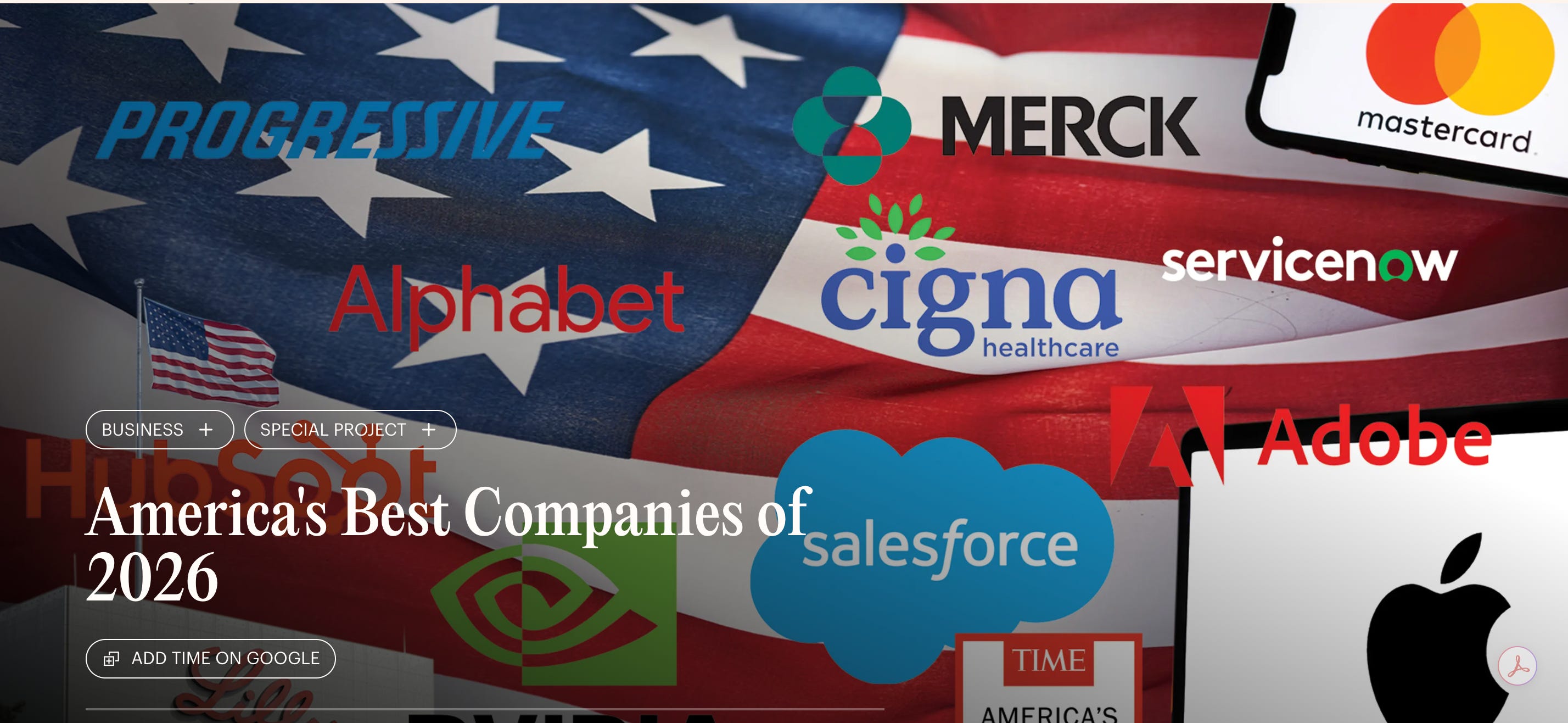
This image looks like it was mocked up by a high school intern using a trial version of Photoshop, ten minutes before the deadline, while desperately fighting a caffeine crash.
Where do we even begin with what is wrong with this?
The Complete Lack of Hierarchy: It’s just a random, cluttered collage of corporate logos slapped haphazardly over a stock image of a waving American flag. The logos aren’t even sized relative to their ranking; they’re just violently competing for your eyeballs.
Bad Cropping and Awkward Overlaps: Look at the bottom right. Apple’s sleek logo is pasted over what appears to be a vector illustration of an iMac, which in turn overlaps an Adobe logo. Above that, a Mastercard logo is awkwardly crammed into a cropped smartphone outline.
The Hilarious “HubSpot” Ghosting: On the left side, the text “America’s Best Companies of 2026” is overlaid directly on a massive, low-opacity HubSpot logo, making the list title nearly unreadable.
The Clashing Colors: Red, blue, green, orange, black—all pasted with zero color correction or unified aesthetic. It’s a visual assault that looks less like a prestigious publication’s special project and more like a spammy banner ad from 2004.
This is the banner art they chose to represent the “best” of American industry. If this is the level of care and precision they put into the visual presentation, it makes you wonder how rigorous the QA was on the actual data.
The Side-by-Side Comparison
The contrast comes down to what is being measured. TIME is evaluating corporate success and investor metrics; MAC is measuring consumer reality and the honesty of their marketing. When you put these metrics next to actual consumer-facing integrity, the truth gets messy.
The Unicorn: Costco
TIME Rank: #5
MAC Accountability Score: 82/100
The Rare Double-Win: If you want proof that a company can dominate Wall Street’s metrics and still treat its customers like actual human beings, Costco is the ultimate gold standard. They score brilliantly on both lists because their business model doesn’t rely on tricking you. The membership fee is stated upfront, prices are kept low on purpose rather than padded with sneaky, hidden markups, and returns are genuinely hassle-free. Shoppers rarely, if ever, feel like they’ve been conned at the register. Honesty is actually their business model.
Premium Ticket, Economy Truths: Delta Air Lines
TIME Rank: #6
MAC Accountability Score: 49/100
The Disconnect: TIME has Delta near the absolute top as a premium airline darling. But MAC’s score exposes how much of that “premium” feel is built on fine-print quicksand. Delta spends millions on branding its loyalty rewards program, but then quietly changes how many points a flight costs whenever it feels like it—effectively devaluing the “currency” you earned. Worse, that advertised, clean ticket price magically inflates at checkout once baggage fees, seat selection, and other unavoidable add-ons are tacked on.
Just (Pretend to) Do It: Nike
TIME Rank: #15
MAC Accountability Score: 57/100
The Disconnect: Nike wins massive points on TIME’s list for sustainability disclosures and employee empowerment messaging. In the real world, outside investigators routinely flag Nike’s overseas factories for underpaying workers in unsafe conditions. Meanwhile, the Nike membership app—marketed as a fun community hub that unlocks exclusive discounts—is actually a massive data-harvesting machine designed to track your exact shopping habits and real-time location.
The Maze-Maker: Amazon
TIME Rank: #47
MAC Accountability Score: 52/100
The Disconnect: Amazon claims to be “the most customer-obsessed company on Earth.” But as federal regulators famously pointed out in their lawsuits, Amazon’s “obsession” seemed to end the moment you wanted to cancel your Prime membership. Signing up took one accidental click; escaping was a deliberately designed psychological maze of dark patterns, confirmation pages, and “Are you sure?” screens meant to wear you down until you gave up and stayed subscribed.
The Dystopian Care-Denial Factory: Cigna
TIME Rank: #4
MAC Accountability Score: 34/100
The Disconnect: Cigna is the absolute poster child for corporate hypocrisy. According to TIME, they are a top-five American business—financially flawless and an investor’s dream. According to MAC’s accountability metrics, they are a toxic disaster.
The Brutal Reality:
While Cigna’s multi-million dollar ad campaigns coo that “your health is our priority,” their actual system treats sick people like errors on a spreadsheet. Under their infamous PxDx (”procedure-to-diagnosis”) system, Cigna has been dragged into major class-action lawsuits for using automated software to reject medical claims in massive, automated batches.How fast do they deny these claims? Internal spreadsheets and legal complaints revealed that Cigna’s medical directors sign off on bulk rejections spending an average of just 1.2 seconds per claim. In what universe does a doctor thoroughly review a complex medical file, verify a patient’s history, and render a life-altering medical necessity decision in one point two seconds? They don’t. In fact, former medical directors admit they literally just “click and submit”. It takes all of 10 seconds to rubber-stamp 50 denials at a time, entirely bypassing the human review process required by law.
In a single two-month window, Cigna used this automated shortcut to reject over 300,000 claims. One single medical director signed off on 60,000 denials in a single month. Cigna’s entire financial strategy relies on the statistical reality that less than 0.2% of people will actually go through the grueling process of appealing a denial. They know you will either get tired, get confused, or just suffer in silence and pay out of pocket. For a top-five “Best Company” to run a system this ruthlessly indifferent to human suffering is the ultimate proof that TIME’s metric of “best” has absolutely nothing to do with basic decency.
Keep Them Honest: Try It Yourself
If you’re tired of “unlimited” plans with strict limits, “free” trials that secretly auto-renew, and “price lock” guarantees that still go up, you can take matters into your own hands.
The Marketing Accountability Council (MAC) is an independent organization dedicated to exposing deceptive marketing practices. We built TrustGap, a free public tool that lets you pull back the curtain on any company.
What you can do at accountability.marketing:
Run any company through TrustGap to get a real-time accountability score.
Compare claims vs. fine print and see a breakdown of the brand’s primary deceptions.
Verify the receipts with cited, manually checkable evidence before you hand over your credit card.
“Best company” and “most honest company” are two completely different sentences. Don’t let a brand’s stock price, shiny PR campaigns, or media ownership dictate whether they deserve your trust.