

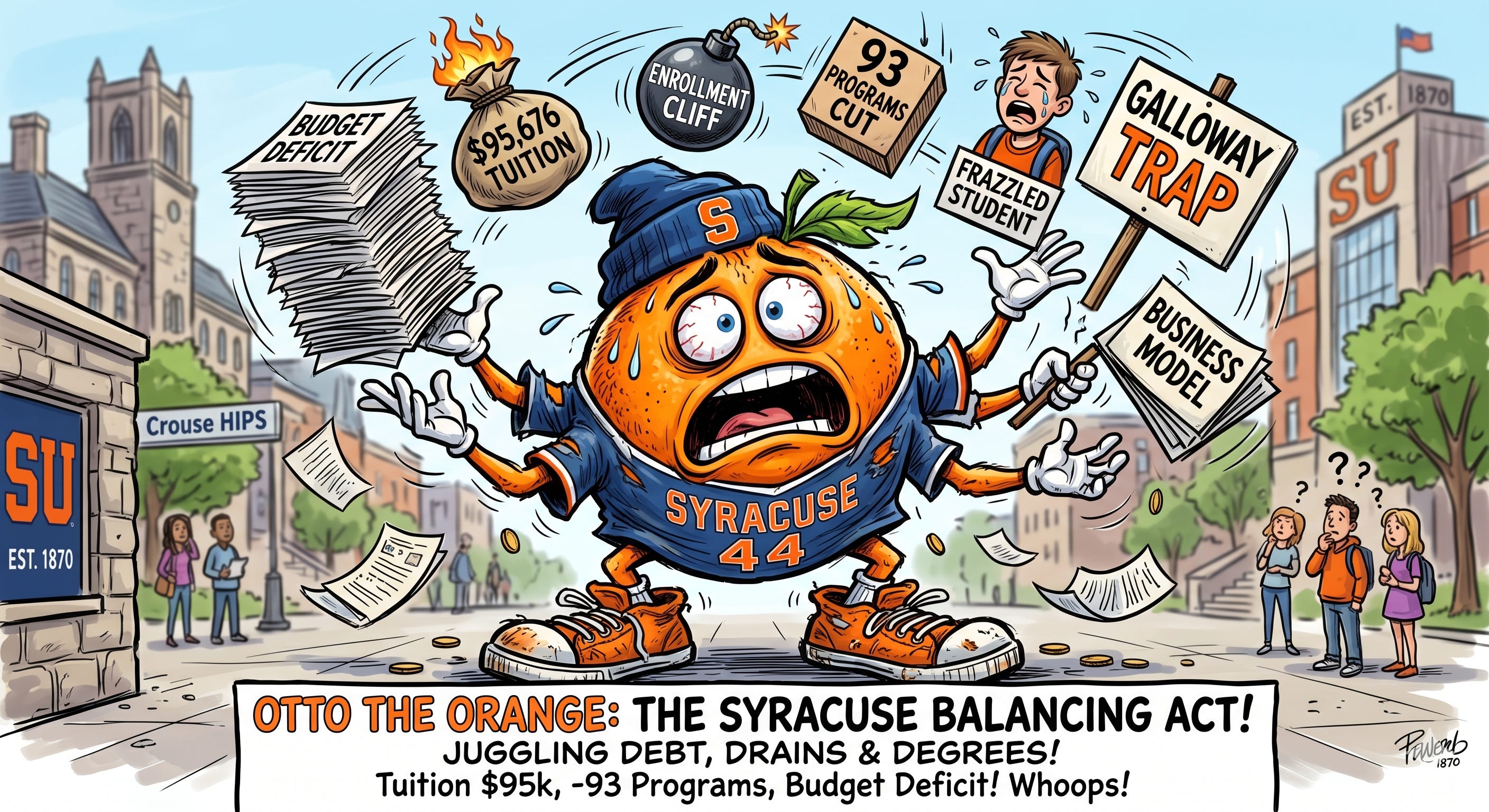
My alma mater, Syracuse University, simultaneously purged 93 academic programs, hiked total annual student costs to a staggering $95,676, and then admitted to faculty and staff that it had missed its enrollment targets and entered a formal budget deficit.
NYU Stern professor Scott Galloway predicted this long before it happened, warning that mid- to high-tier private universities were trapped in a luxury-brand paradox. During the pandemic, he highlighted how these institutions inflated tuition to fund massive operational costs while relying on volatile international pipelines and aggressive digital marketing to fill seats. Now, as those pipelines dwindle, demographics decline, and the business model falters, his foresight proves to be prescient.
I know Syracuse University well; it's a beautiful campus where I met some remarkable, diligent, and authentic individuals. Yet, if I assess its culture, it has long been trapped inside an out-of-touch money bubble. Sitting on a hill, the university stands in grotesque contrast to the city of Syracuse below—a municipal hellhole of poverty and industrial decay. While students flaunt wealth, the city registered nearly 29% poverty, with child poverty over 40%, making it one of the worst cities for children. Decades of deindustrialization left Syracuse hollow, with a median household income of just $47,819—half of what a student pays yearly in tuition. On campus, an elite few treated luxury as normal, oblivious to living in an insulated playground over an economic wasteland. That out-of-touch bubble wasn’t just a flaw in student culture; it was the core business model of the institution.
As a kid, I believed good grades led to better colleges, which would ensure a stable career and more options. This is the American bargain, justifying every dollar from families like mine. Today, we’re told that nearly $100,000 a year for private university is necessary for the future. But a college degree no longer guarantees economic security. Industries once employing educated youth are shrinking, automating, and restructuring, making credentials insufficient. I know this from my own career, which no longer exists as I trained for. Families are forced into a system of hyper-capitalist extraction—liquidating futures and destroying safety nets—to buy into a middle-class economy that no longer exists. The system demands total financial surrender today for a promise the modern economy has already broken.
First, consider the illusion of their pricing. To maintain the illusion of luxury prestige that appeals to the wealth bubble, Syracuse pushes its sticker price to the absolute ceiling. But to actually fill the freshman class, they had to pump their financial aid budget to an unprecedented $436 million, heavily discounting tuition just to get families to sign on the line. When an institution has to run massive, opaque discounting schemes behind the scenes just to get people to buy its product, the underlying economic value proposition is fundamentally broken.
Second, look at where they chose to gamble. For years, universities avoided internal structural reform by relying on a highly predictable, full-paying international and master’s student pipeline to subsidize their administrative expansion. The moment that human pipeline hit geopolitical and visa friction, the house of cards collapsed. Syracuse watched its international undergraduate enrollment density plummet from 12% to 5% over a two-year period, plunging the entire institution into a deficit.
Finally, Syracuse was offering 460 distinct degrees and certificates—an absurd level of hyper-fragmentation designed for corporate marketing rather than human utility. Cutting 93 programs in one breath and offering early retirement to 175 long-tenured faculty members isn’t strategic evolution; it is a frantic, lagging correction.
The market is screaming for streamlined, high-relevance paths built on trust. Higher education responded by building an empire of overhead, and then sent families the bill.
I do not say this to diminish the good that schooling does for my children. The right environment changes them; it strengthens their confidence, capacity to learn, and ability to connect with others. These are, in fact, the things that matter most, and no economic argument can fully account for them.
What is not worth fighting for is a bloated, legacy infrastructure that demands we destroy every financial resource a family possesses, compounded by the predatory conduct of automated enrollment systems and the professionals hired to help.
The scale of extraction has become disproportionate to any honest accounting of what is actually being secured on the other side.
Syracuse University shows us what happens when a predatory business model finally hits reality. A system that demands this much financial and emotional surrender from families should, at a minimum, be honest about what it is—and what it is no longer capable of guaranteeing.