

The dyslexia of danger is
when you're born
relaxing under a klaxon,
alarms aren’t disarming
but charming,
signs are to be interpreted
warnings are conditional
the horizon’s never fixed,
it’s quantum super-positional
hazards are happenstance
a gamble with bad odds
wrongly estimated values
rather than underestimated gods
Is it Marketing, or Malicious Compliance?
Ireland has just announced its fourth and fifth investigations into large social media platforms in six months, this time around ‘dark patterns’ of manipulation in the UX. Meta is accused of malicious compliance (the act of technically following the rules while intentionally undermining their purpose or spirit) with EU regulations.
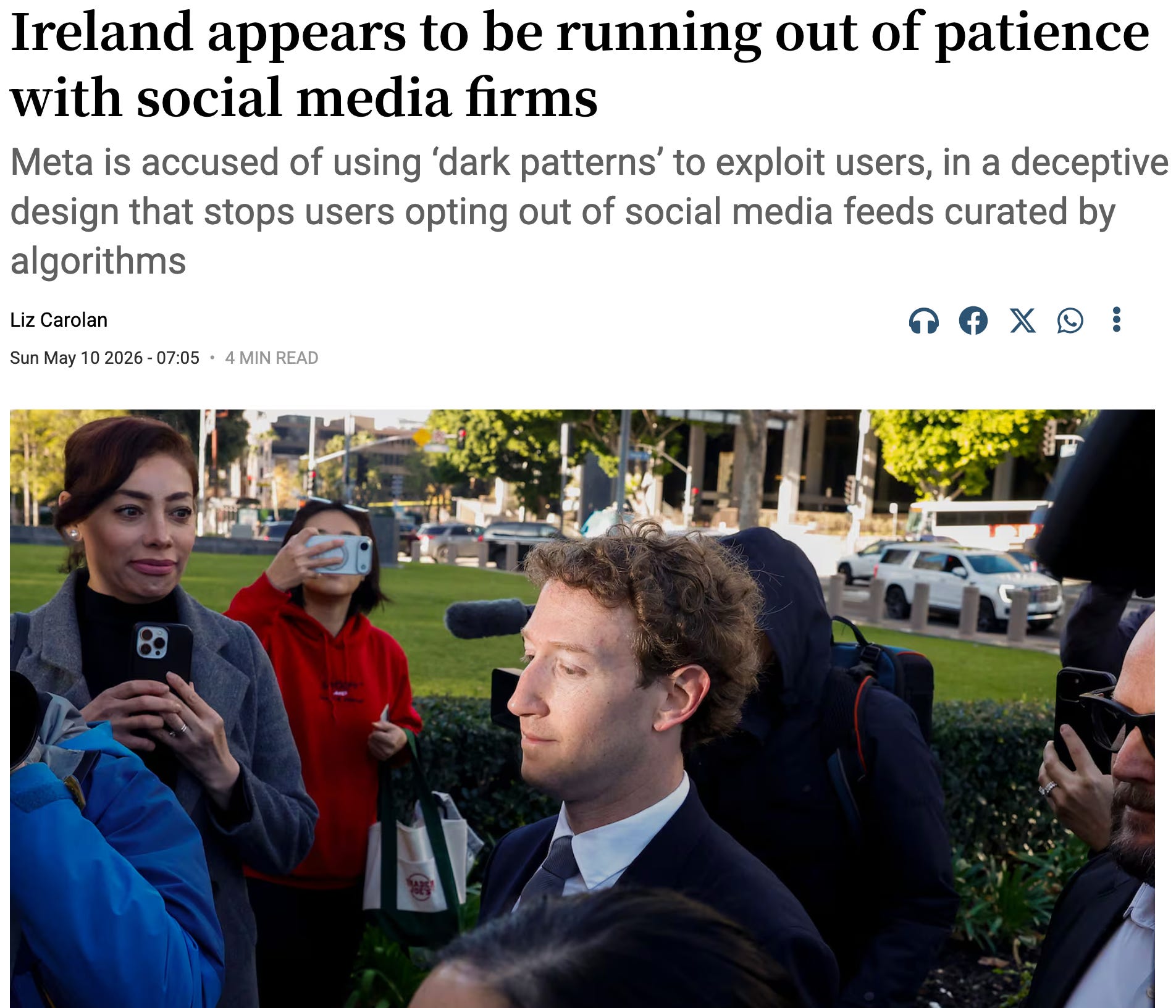
After nearly two decades of gushing market growth in the digital era, you don’t need a divining rod to know that the current state of social media and technology is going through some rough, dry spots.
Mark Zuckerberg is trying to arrange it so he only has to testify ONCE in 2,400 unique lawsuits that claim Meta (a collection of platforms that are 98% funded by advertising and marketing budgets) is harmful to kids and designed to be addictive.
If it goes anything like the two recent successful lawsuits against social media platforms out of New Mexico and California, where it was definitively revealed (through their own internal comms) that these platforms are indeed engineered and known to be addictive and harmful; it’s not going to go well.
One of the biggest contributing factors that’s shaped the current state of media and technology, for good and bad, is advertising and marketing. Since many major verticals and platforms ultimately embrace ad revenue, advertising and marketing are not tangential but central to the furtherance of the popularity and proliferation of these platforms and the harms therein.
So like…what does the joe and jane marketer out there do with this information? Does the knowledge of proven harms change our behavior? Here’s the result from a recent MAC poll where we asked this very question:
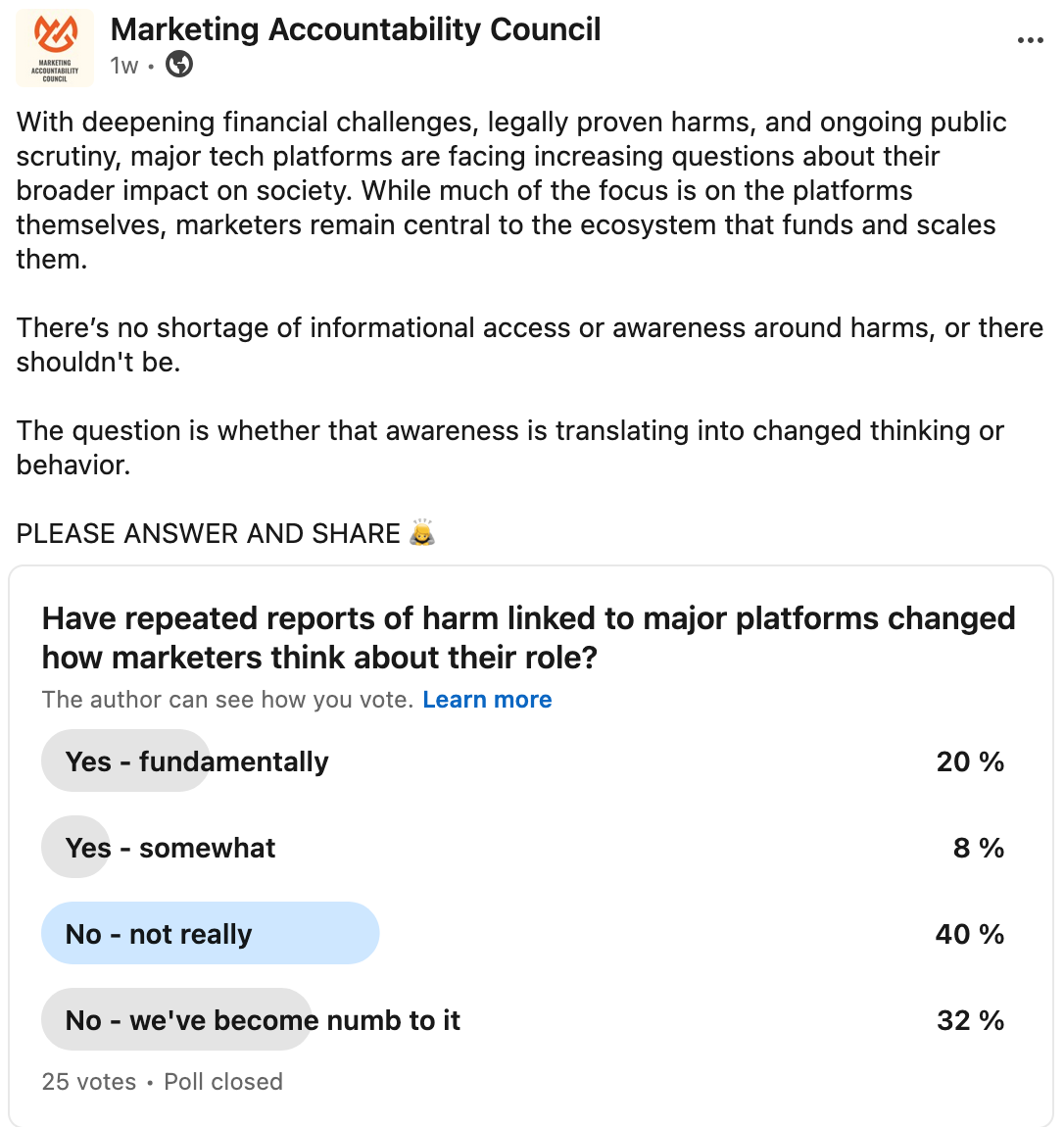
You don’t need a statistics degree to see the stark difference here. Nearly 2/3rds of respondents don’t see our behaviors changing in reaction to proven harms. While 1/3rd thinks there has been a change.
Given that there are thousands of lawsuits in motion against Meta alone, and a ton of momentum in regulatory bodies around the world, we do have to admit there has been a general change in the popular reaction to the news about harms on these platforms - if not, these lawsuits wouldn’t even be here.
But for the professionals in the industry, and in our day-to-day interactions, we are extremely mum and numb about this paradigm shift and we are not making any big shifts to our behaviors.
The problem is, marketers don’t abjectly reject the nonsense because, 1) what are we really gonna do about it? and 2) we kinda help make it happen. Kinda want it to happen for a client, right?
Were we ‘maliciously compliant’ or were we just doing some design improvements, making a page more sticky, rounding up a number, tweaking the copy, dancing the algorithm’s dance? But at what scale and to whose benefit/detriment?
The concept of ‘malicious compliance’ in the EU investigation is interesting because it potentially illustrates how the “everyday business” angle got us to this point; how harms can invisibly stack up when we ignore everything and “just do our jobs.”
Given that we hear a new story about harms, breaches, oversights, and whoopsie-doodle security and privacy gaffes DAILY, maybe we are numb to it all, maybe we don’t know how to properly respond/react to alarms any more?
Which makes you think about sirens, which might get you thinking about the Sirens….from the Odyssey…
The Songs That Lead to Shipwreck
In one of the many epic sections of Homer’s “The Odyssey,” Odysseus has to tie himself to the mast of his ship to avoid steering toward the beguiling sound of the Sirens, fatally crashing into the island rocks where countless ships lay wrecked, having been unable to resist the temptation of the Siren song.
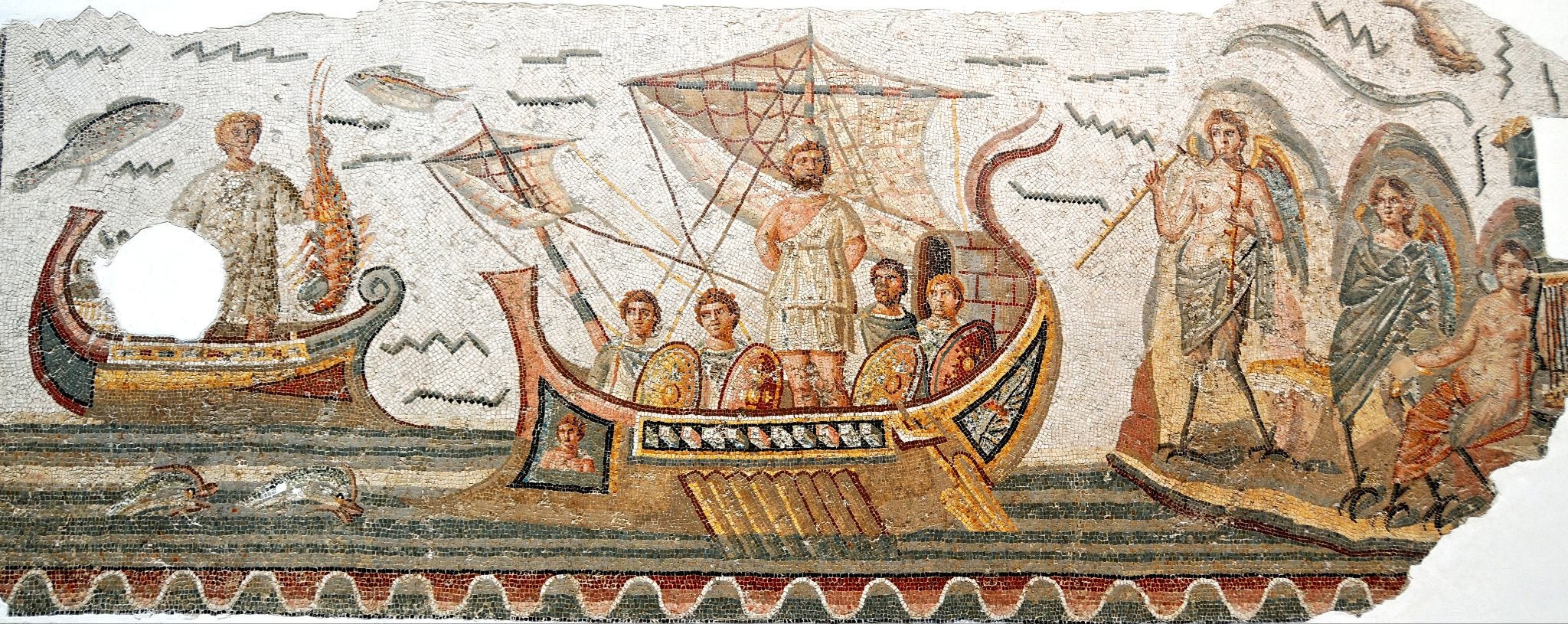
Everyone in Homer’s universe knew the Sirens were deadly. Every captain warned his crew. They all knew that following that sound meant certain death. That knowledge should have been enough. But it wasn’t. Ship after ship crashed on those rocks. Sailor after sailor couldn’t help themselves.
What made Odysseus different wasn’t that he had more willpower or discipline than other captains. It was that he was wise enough to know he didn’t. He understood that in the moment, with those beautiful voices calling, he’d be just as weak as everyone else. So he came up with a way to protect himself from himself.
While it might seem that the most teachable aspect of this part in the story is Odysseus’ willpower, self-restraint, and resistance - we could/should Stoically find a way to securely handle temptation as individuals in the modern world - I think the Sirens deserve a closer look.
The Sirens of Marketing
The Sirens demonstrate an instance where the lure of danger is so veiled but intense, so indescribable and inescapable, that there’s no heroic choice but to get through it.
But that’s only if you can properly identify the threat in time, which seems to be the real skill to sharpen. The danger is lack of self-awareness and knowledge of action in the face of seduction, along with not knowing if you’re being seduced in the first place.
If we use this metaphor professionally, the marketing Sirens pull individuals and organizations toward harmful behavior while making it feel rational, necessary, or even successful. They do not appear as obvious corruption.
Marketing Sirens sing the songs of impressions, delusional growth targets, optimization opportunities, engagement metrics, competitive pressure, industry standards and “best practices.” They melodiously convince us that dark patterns are merely persuasion, surveillance is personalization, and addiction means retention.
Marketers might be aware of the risks, the harms, and the ethical compromises involved at certain turns in the journey, but the Siren-centric incentives are designed to overpower caution. The threat is thinking it’s possible to honorably navigate a system where short-term rewards easily drift actions, little by little, toward practices that would once have felt unacceptable.
The marketer who hides the unsubscribe button more carefully might not be thinking about going corrupt. They’re most likely thinking about reducing/inflating/controlling/couching KPIs before quarterly review.
Tying Ourselves to the Mast
Odysseus survived the Sirens through disciplined structure, not willpower.
The mast metaphorically represents his unwavering precommitments, a philosophical grounding around decisions made before temptation arrived, about what he would and would not allow himself to do.
The rope is discipline and accountability in action, the mechanism that physically restrains him when his judgment can no longer be trusted. The crew with their ears plugged, aimed at limiting exposure to corrupting influence altogether, a refusal to even entertain the seductive pull of the Sirens’ song.
Together, this forms a powerful metaphor for the near impossible goal of accountability and the failure of modern marketing ethics: when incentives are strong enough, good intentions are insufficient without systems designed to hold people in place when pressure, profit, and optimization begin pulling them off course.
The Bunk Ethics of “Just Doing the Job” in Marketing
According to the recent lawsuits out of Ireland against dark patterns, researchers found that, “83% of websites, apps and AI agents contain digital manipulation today.” A number that high means digital manipulation isn’t the one-off choice of a handful of sick & twisted designers/engineers, but part of the industry. What counts as a ‘dark pattern?’ From the article:
“If you have ever found yourself accidentally paying for something you did not need, or stuck in a doom loop when trying to amend your settings, or noticing too late that there were other options than the one you clicked, then you have been subjected to dark patterns.”
Marketers are not flatly engaging in dark pattern creation, but they definitely have a mission that doesn’t mind them. To sneak some extra cash out of pockets, extra clicks or dwell time out of someone’s day, to classify and prioritize certain information in a report to elicit a positive response; all of these are within the bounds of business but skirt an ethical line.
A reason we don’t notice the ethical edge might be on account of responses to perceived pressures. The pressure to outperform baseline metrics and hit KPIs, pressure of keeping up with the reward mechanisms of platforms, pressure to copy and crush competitors, pressure to hit the numbers leadership wants to see.
On Ethical Drift
It would be too easy to say the ethical drift in marketing is a problem because of the pressure applied by THEM, the others, the boss, the system, the man. What about the US? What pressure are we feeling and responding to personally in marketing?
The pressure to stay employable in an unstable industry. To outperform benchmarks and justify budgets. To prove intelligence through optimization. The pressure to hit numbers tied to mortgages, promotions, layoffs, status, and survival.
The Sirens of modern marketing don’t merely sing about business affairs, they dig deeper. They sing of insecurity, ambition and fear. They harmonize with the deeply human desire to matter, succeed, and remain valuable in systems increasingly designed to quantify personal worth through professional performance.
Which is why ethical drift rarely feels like corruption while it’s happening; it feels like adaptation.
Ethical drift is not driven solely by bad intentions. It’s driven by ordinary people adapting their identities to systems that desensitize danger and reward compromise. When metrics become proof of personal worth, and any tactic which questions the metrics starts feeling emotionally defensible, the ethics drift.
Because ethical drift is also about ego protection. Nobody wants to be the person saying: “Maybe we shouldn’t optimize this.” Especially when optimization itself has become synonymous with competence.
So marketers learn to rationalize manipulation as sophistication, corruption as adaptation, exploitation becomes growth hacking, the inability to stop becomes scalability, and ethical compromise becomes pragmatism. They ignore the Sirens and steer right into them.
We’re Sailing Through The Sirens Right Now

Having been born in alarming times under warning-signs-o-plenty and blaring klaxons, perhaps we can’t recognize danger anymore. When’s the last time, metaphorically, that you saw someone tying themselves to any mast? Staying in the metaphor, do we know what our ropes look like or what restraint means? Do we recognize the shipwrecks of others as omens for ourselves?
The danger of modern marketing is not that people don’t know better. It’s that knowing better is often insufficient against systems engineered to reward harmful behavior. The marketers who drift into manipulation are rarely uninformed. Often they are highly educated, highly analytical, and fully aware of the harms.
Modern marketing culture assumes intelligence protects people from manipulation. But often this “intelligence” is manipulatively compliant, letting harms off the hook and simply creating better rationalizations. We are in the midst of decades of rationalized manipulation.
So the real question is: What are the masts we’re capable of building in the midst of the Siren song? What are the structures strong enough to hold us in place as the music is playing? Is it even possible to contemplate this question as the sirens blare, is it even a conscious consideration without having silence from the Sirens?
You don’t have to think or postulate on what you might do in this metaphorical Odyssey, we are reacting right now to the Sirens, we are currently sailing by the shipwrecks, we are facing this crisis in real time, oars in hand; how do we stop hitting the snooze button on the alarms?
How are we gonna collectively write this next section of our Odyssey?
Thanks for this. Always love a good Greek reference.
made my one a while back on strategy and the Odysseus. https://petervw.substack.com/p/the-sirens-are-still-singing