

Yesterday’s deep-dive into StubHub’s corporate ticket-scalping ecosystem got me thinking. StubHub is simply following a mandatory corporate lifecycle that has systematically infected the modern internet. If you want to see the absolute worst offenders of this model, we need to look at how the early promise of Priceline.com and Kayak.com was quietly hollowed out to build a duopoly that weaponizes the illusion of choice.
Phase 1: The Era of Radical Novelty and Useful Disruption
Two decades ago, the internet promised a golden era of information symmetry. For generations, booking travel meant dealing with opaque legacy travel agents who held all the keys to pricing. The first generation of travel tech platforms were genuine consumer heroes because they broke that gatekeeping wide open.
Priceline’s Bidding Revolution: Launched in the late ’90s, Priceline.com introduced its famous “Name Your Own Price” bidding system. It was an incredibly useful, consumer-first utility. Because an unbooked airline seat or an empty hotel room is a highly perishable asset, Priceline gave budget-conscious travelers the power to bid on distressed inventory. It forced hospitality giants to unlock massive, unadvertised discounts for everyday people.

Kayak’s Transparency Crusade: Arriving in 2004, Kayak.com took a completely different but equally noble approach. Instead of acting as an agency, Kayak pioneered metasearch. It didn’t sell anything. It crawled hundreds of airlines, hotels, and booking engines simultaneously, compiling a clean dashboard of the absolute lowest prices on the web. It was an aggregator built explicitly to act as a neutral consumer ally.
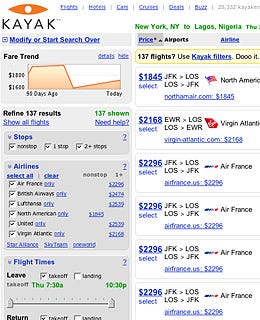
In this initial phase, these platforms generated immense consumer goodwill because they were genuinely useful, fiercely independent, and fundamentally rebalanced market power back to the individual.
Phase 2: The Monopoly Consolidation
The shift from an open, helpful marketplace to an extractive tollbooth occurs when growth demands pleasing Wall Street rather than serving the end-user.
In 2005, Priceline bought Amsterdam-based Booking.com, eventually rebranding the entire parent conglomerate as Booking Holdings. To protect its territory and maximize margins, Booking Holdings began quietly swallowing the very tools consumers used to cross-reference prices. They bought up Agoda, and in 2013, they acquired Kayak.com for a staggering $1.8 billion.
Simultaneously, its only true global rival, Expedia Group, went on its own buying spree, scooping up Orbitz, Travelocity, Hotels.com, and Vrbo.
The original, diverse web of independent travel engines was funneled into two corporate cash registers:
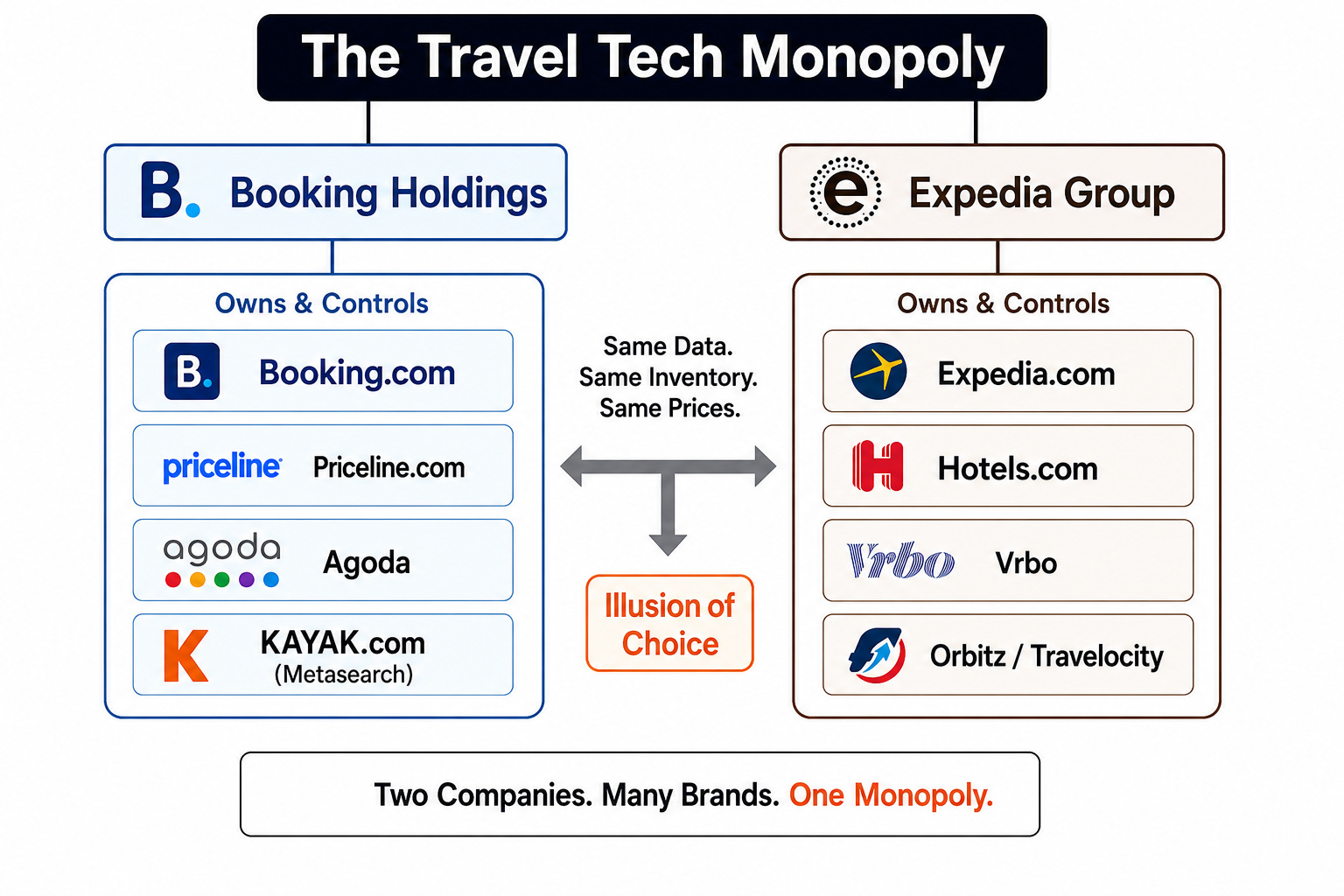
The underlying infrastructure changed completely. The free market was replaced by a highly consolidated duopoly.
Phase 3: The Extractive Turn (How it Became Anti-Consumer)
Once a duopoly captures a market, the corporate incentive to maintain a high-quality consumer experience evaporates. Optimization parameters shift entirely toward squeezing value out of captive users.
1. The Death of Metasearch Neutrality
When a traveler visits Kayak.com to “compare prices,” they believe they are using an independent referee. They are not. Kayak is owned by Booking Holdings. The prominent results displayed on your dashboard are heavily populated by its own sister subsidiaries—Priceline, Agoda, and Booking.com. If you try to avoid them, the remaining options are almost entirely owned by Expedia. The dashboard is pure corporate theater; you are comparing Booking Holdings against Expedia Group while standing inside a Booking Holdings building.
2. Squeezing the Supply Chain
Because independent boutique hotels and local accommodations have nowhere else to look for digital traffic, the duopoly leverages its total dominance. They impose aggressive commission rates (often 15% to 30%) on small hotel operators. To survive these massive margins, hotels are forced to artificially inflate their baseline room rates or face algorithmic demotion—buried on page 10 of the search results where no consumer will ever look.
3. Deceptive “Drip Pricing”
The clean, upfront pricing of the early internet has been replaced by predatory dark patterns. Opaque “resort fees,” service charges, and platform fees are intentionally hidden until the absolute final screen of a multi-step checkout process, relying on consumer fatigue to push the transaction through.
Phase 4: The Captive Audience and the Phantom Belief
The most insidious part of this lifecycle is the behavioral lock-in: consumers still use these sites religiously because they believe a myth that is no longer true.
We carry a deep psychological hangover from 2005. We remember when Kayak was the scrappy underdog fighting the travel establishment. When a modern traveler opens Kayak, clicks a Priceline link, and books a room, their brain experiences the dopamine hit of “smart shopping.” They genuinely believe they just beat the system by out-smarting the market.
They are completely blind to the fact that they are browsing inside a tightly controlled walled garden. The massive, multi-billion-dollar marketing budgets of the duopoly have starved out independent discovery infrastructure, leaving consumers with no viable alternative.
Just like StubHub, the travel tech giants are cashing in on a dead, fan-friendly reputation to harvest wealth from a captive audience that still thinks it’s getting a deal. The platform no longer works for you; your attention and your trust have simply become the assets to be systematically extracted for the quarterly earnings report. And as long as we believe the illusion of choice, they will keep taking until there is nothing left.
If you are following the rapid-fire collapse of these digital monopolies as closely as I am, you’ll find these fast-moving, current-year legal updates highly relevant:
The Dutch Consumentenbond Onslaught: Just a few months ago, on February 18, 2026, the Consumer Competition Claims foundation (CCC) officially launched a massive, cross-border collective action against Booking.com right in its home court in the Netherlands. They are suing on behalf of hundreds of thousands of consumers over a decade of anti-competitive, price-hiking tactics stretching back to 2013, with estimated damages easily topping €1 billion.
Booking is currently trying to hide behind jurisdictional technicalities to dismiss global entities, but the trustbusters are aggressively holding their feet to the fire.
Proving it isn’t just a legacy duopoly issue, on July 2, 2026, the Federal Trade Commission announced a major $35 million settlement with the travel app Hopper. The FTC explicitly pinned Hopper for weaponizing the exact type of "extractive junk fees" and dark patterns we've been warning about—silently auto-selecting hidden "tips" on screens users had to scroll down to see, masking VIP support costs, and entirely deceiving users about the true restrictions of their "Price Freeze" features.
When an entire sector's legal defense shifts from "our tools are consumer-friendly" to defending massive enforcement actions and multi-billion dollar class-actions simultaneously across three different countries, the gig is officially up.
The tollbooth is crumbling in real-time. Keep the thoughts coming!
This is a sharp diagnosis.
One of the hardest systems to update is the one that used to deserve our trust.
We keep responding to the current version through memories formed by the earlier one. The institution changed. The business model changed. The incentives changed. But the internal model kept running.
That gap is where a lot of extraction hides.