

Memorial Day weekend has long been branded as the unofficial kickoff to summer shopping, promising deep discounts on everything from big-screen TVs to patio furniture. Media outlets eagerly capitalize on this shopping fever. Case in point: Mashable’s highly optimized shopping directory, Best Memorial Day Live Deals.
At first glance, the article reads like a curated public service announcement for your wallet, boasting massive slash-through prices like “Save $265” or “50% Off.” But if you peel back the layers of urgent marketing copy and look at the actual historical data of these items, a very different picture emerges.
Before you click “Get Deal” and surrender your credit card info, here is a critical reality check on what is actually happening behind the scenes of holiday media roundups.
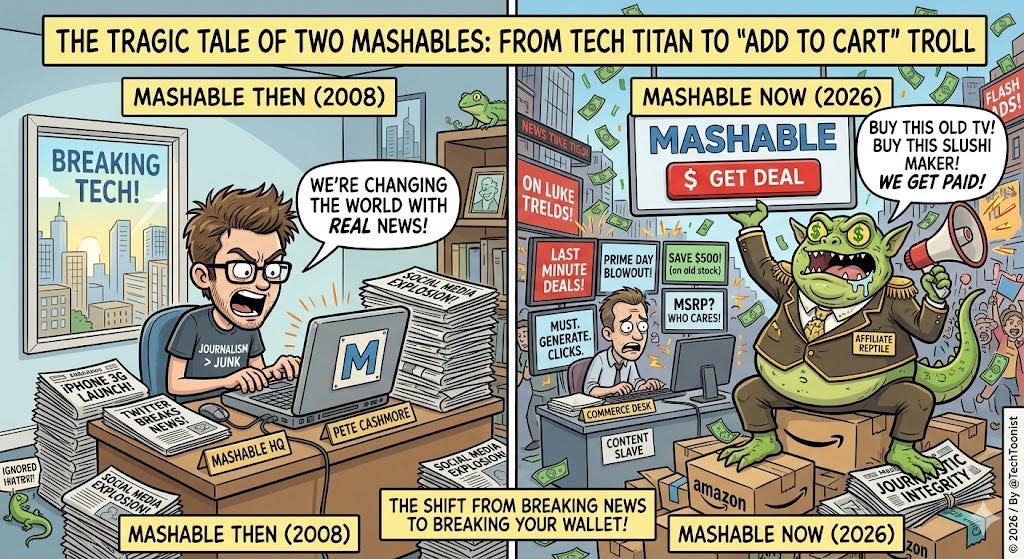
The Tragic Evolution of Mashable: From Tech Authority to Affiliate Machine
To truly understand why these “deals” look the way they do, it helps to look at the logo at the top of the webpage.
There was a time when Mashable was an absolute powerhouse of the digital age. Founded in 2005, it grew into an indispensable industry source for tech news, digital culture, and social media trends. It was a newsroom built on journalistic integrity, breaking stories, and offering sharp, independent analysis of the tech landscape. When Mashable reviewed a product or covered a trend, tech enthusiasts trusted it implicitly because it felt like authentic journalism.
Fast forward through a series of corporate acquisitions, fire sales, and pivots, and Mashable today is a shadow of its former self. Like many legacy digital brands, it shifted its business model from premium reporting to high-volume traffic extraction. Today, the site heavily prioritizes search-engine-optimized commerce content designed entirely to generate affiliate revenue. The fact that an iconic titan of tech journalism has been reduced to churning out endless, algorithm-pleasing holiday deal roundups tells you everything you need to know about its current priorities. They aren’t looking to inform you; they are looking to convert you into a commission.
The Anatomy of a “Deal” Guide: Anchoring and Affiliates
Because of this financial shift, Mashable’s modern shopping guides rely on a psychological phenomenon known as Anchoring Bias.
They calculate your “savings” by subtracting the current sale price from the original Manufacturer’s Suggested Retail Price (MSRP). Every time a reader clicks a link and buys a product, Mashable receives a financial kickback from retailers such as Amazon and Best Buy.
The problem? Almost nobody actually pays the MSRP anymore. Manufacturers deliberately inflate list prices so retailers can perpetually claim an item is on sale, making a standard, everyday price look like a limited-time miracle.
Fact-Checking the Headlines: Real Discount vs. Marketing Fluff
When we cross-reference Mashable’s featured highlights with independent historical price-tracking tools, the “deals” quickly split into two categories: genuine seasonal markdowns and manufactured illusions.
1. The Manufactured Illusion: Toshiba 65-inch C350 4K Fire TV
The Mashable Claim: On sale for $264.99, down from $529.99 (“Save $265” or 50% off).
The Buyer Beware Reality: This is classic MSRP anchoring. The Toshiba C350 is a lower-tier budget television. It has not actually sold for $529.99 in ages. For the past several months, its real-world “street price” across major retailers has hovered around $299 to $329. While dropping to $264.99 is technically a discount, you are realistically saving about $35 to $50—not the massive 50% windfall the article implies.
2. The Inflated MSRP: Ninja Slushi (88-ounce)
The Mashable Claim: On sale for $259, down from $349.99 (“Save $90.99”).
The Buyer Beware Reality: The Ninja Slushi is a genuinely popular kitchen gadget, and hitting $259 does match its lowest tracking price on Amazon. However, the claimed $349.99 baseline is artificially inflated. The standard retail price directly from SharkNinja sits closer to $299. It is still a decent buy if you want one for summer, but your actual savings are cut in half compared to the article’s math.
3. The Perpetual Sale: Mattress Discounts (Saatva, Casper, Helix)
The Mashable Claim: Promising massive seasonal price drops like “Save up to $1,000” or “35% off sitewide.”
The Buyer Beware Reality: The mattress industry is notorious for what consumer advocacy groups call the “perpetual sale.” It is nearly impossible to buy a mattress from these direct-to-consumer brands at “full price” because they rotate identical coupons 365 days a year. A 25% or 30% discount isn’t a special Memorial Day weekend miracle—it’s just Tuesday.
Where the Deals Are Actually Real
To fairness, not every link in the guide is smoke and mirrors. The article does hold genuine value when examining specific product categories that face cutthroat market competition or clear seasonal cycles.
Premium Audio: Mashable lists the Bose QuietComfort Headphones for $229 (claimed down from $349). Because premium audio brands heavily control their pricing, hitting $229 genuinely matches their historic Black Friday lows.
Portable Power Stations: The Jackery Explorer 1000 v2 listed at $428.99 (claimed down from $799) is a genuinely great seasonal drop. Power stations hit their pricing peaks in late summer during storm and camping seasons, making May a legitimate time to secure a real discount.
The Consumer’s Action Plan
Articles like Mashable’s are built to generate urgency, prompting you to act on FOMO (Fear of Missing Out) rather than logic. If you want to avoid falling into the holiday marketing trap, follow these three rules before buying:
Ignore the “Save $X” Figure: Treat the manufacturer’s crossed-out list price as if it doesn’t exist. Evaluate the item strictly based on whether the final checkout price is worth it to you.
Use Price Trackers: Never buy an item from a holiday roundup without running the URL through a price history tool like CamelCamelCamel (for Amazon) or the Keepa browser extension. These tools reveal the product’s true price timeline, showing you whether a price drop is unique or just business as usual.
Know the Category Cycles: Buy tech, appliances, and outdoor gear during holiday weekends if the data backs it up—but completely disregard the manufactured “urgency” surrounding mattresses, clothing, and older budget TVs.
The Bottom Line: Holiday roundups are designed to sell clicks first and save you money second. The trust we once had in Mashable as an independent journalistic authority belongs to the past. Today, shop with data, not enthusiasm, and remember that the best way to save 100% of your money is simply not buying things you didn’t need in the first place.