

Modern platforms like Uber Eats prioritize instant gratification, delivering items swiftly, boosting metrics like conversion rates and reducing costs. However, an audit of their real-world impact reveals that their value-extractive business models are fragile, emphasizing the need for a new alignment between labor and capital for true sustainability.
To understand where the current marketplace model breaks down, we can analyze a recent, real-world delivery sequence that serves as a perfect case study of operational inefficiency.
A logistics platform dispatched a provider on an initial $8 contract to source and deliver 12 heavy bags of wood mulch from a major retailer, spanning a 20-mile transit radius.


Upon reaching the target destination, the provider encountered a literal systemic wall: a severe storm the previous night had knocked down trees, completely blocking the street. With local law enforcement declaring the road impassable, the provider was forced to initiate a massive detour just to find an alternative approach.

The provider made multiple attempts to navigate a labyrinth of side streets to reach the destination from the back, but the storm damage had severed the route entirely. This unforeseen act of God added nearly an hour of unpaid, grueling operational time to the ticket, draining the transport vehicle’s fuel supply.
At the very least, the cargo was wood mulch. Had those 12 heavy, water-logged bags soaking in the vehicle been manure, the literal stench of the situation would have perfectly matched the operational execution.
When the provider escalated the crisis to customer support, the platform’s internal routing revealed its own awareness of the chaos. The system bypassed standard tier-one customer service teams in India and auto-routed the ticket to a more empowered tier-two support center in the Philippines to handle the complexity.
The platform’s solution? Instruct the provider to halt operations, drive 30 minutes back to the retail store, and manually unload and return the items. The final resolution for hours of physical labor, out-of-pocket refueling, and a locked application that blocked any other revenue streams? A final payout of roughly $12 and change (roughly $8 for the original delivery $4 for restocking!)

The Value Trap: Why Capital and Labor Are Misaligned
When we look at the sheer amount of time spent, the immense physical effort expended, and the premium-level care delivered under hazardous conditions, a poignant question emerges for modern enterprise builders:
Is twelve dollars and change what a partner’s time, effort, and compliance are worth?
The traditional gig economy algorithm says yes.
It views labor purely as an expense to be minimized and squeezed. In this zero-sum game, capital extracts all the value, leaving the human element to absorb 100% of the operational risk.
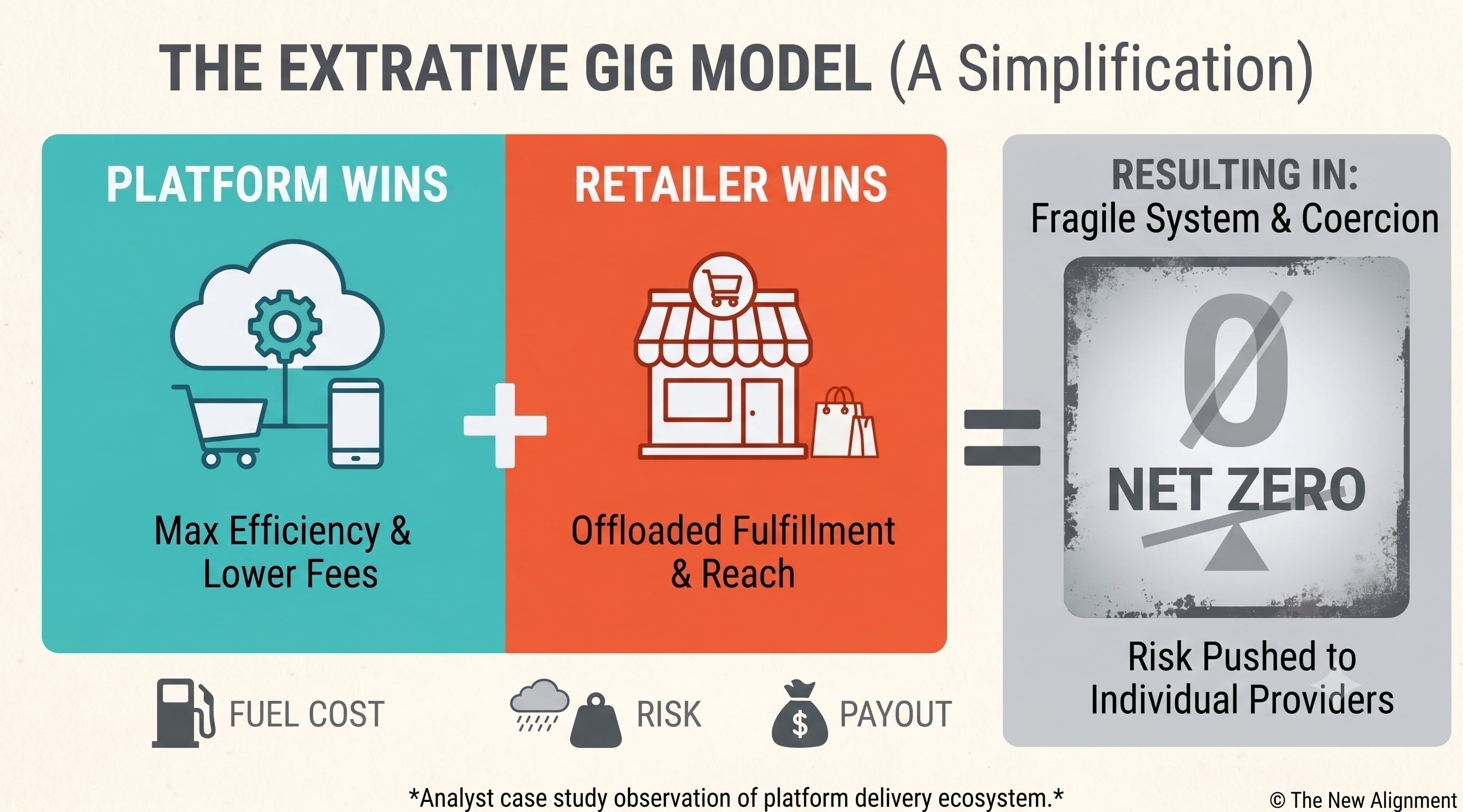
While an extractive model might satisfy short-term quarterly margins, it destroys long-term brand equity. It breeds deep-seated resentment, degrades data and service quality, and creates a highly volatile ecosystem.
Data Brokers Run the Same Playbook
This dynamic doesn’t just play out for gig workers. The exact same extractive logic runs every second in the global data brokerage market.
Traditional data brokers treat the people generating data the way that platform treated its driver: as a resource to be harvested, minimized, and squeezed. Corporate capital extracts the value; the human element absorbs all the privacy, security, and operational risk.
Just as a driver got $12 for a multi-hour ordeal, individuals, creators, and professionals have their digital footprints and behavioral data silently harvested, packaged into premium profiles, and sold to enterprise buyers for billions — while the people who actually generated that value get nothing. The result is a fragile ecosystem all around:
Buyers get low-fidelity, scraped, or ethically compromised data carrying real compliance risk.
Providers (the public) grow resentful and actively poison their own data trails with ad-blockers, privacy tools, and opt-outs.
Brokers end up playing cat-and-mouse against tightening regulation and deteriorating data quality.
What If Everyone Actually Won?
What if we rejected the premise that someone has to get cheated for a data marketplace to succeed and shifted from an extractive model to a positive-sum one, where value is co-created and shared?
Consumers win. In an economy where people usually feel like a line item to be squeezed, respecting data agency gives them a reason to participate. More trust leads to more (and better) data sharing.
The marketing and insights industry wins. A transparent ecosystem produces cleaner data. Buyers get real efficacy and higher returns because they’re no longer purchasing low-quality or manipulated datasets.
Employees and talent win. People are energized to work for an organization that respects data. That reputation attracts the developers, data scientists, and strategists who want to build something accountable.
Corporate boards win. Ethics aren’t an obstacle to profit — they’re the mechanism for it. This alignment yields greater efficiency, lower costs, and higher returns, thereby securing the long-term survival of the enterprise.
Reimagining Each Side of the Exchange
The buyer wins on fidelity, not just volume. Instead of fragmented, legally grey data scraped from the dark corners of the web, enterprise buyers get high-fidelity, explicitly consented insight — data that drives real results without the regulatory time bomb attached.
The provider wins through real digital autonomy. Imagine a data broker that treats the people powering its engine as true capital partners — compensating them transparently, through micro-payments or direct dividends, whenever their data trains a model, optimizes a supply chain, or targets an ad. When participants are respected and protected, trust deepens, accuracy improves, and retention becomes near-absolute.
The broker wins through velocity, not squeezing. Profitability shouldn’t come from sneaking data out the back door or burying opt-out buttons in fine print. It should come from the scale and health of the ecosystem itself — a transparent, ethical clearinghouse builds a far more defensible long-term position than one built on data no one can legally stand behind.
The Accountability Standard
Data should not be weaponized against the person who created it.
Ethical data architecture isn’t altruism — it’s long-term market survival. When the broker's success is directly tethered to the provider's prosperity and the buyer's satisfaction, you build something that lasts.
It’s time to stop designing algorithms that exploit human output, and start building ecosystems where everyone gets to win.
This is just plain crazy! What a waste - appreciate you reporting from the field. This ain't it man.