

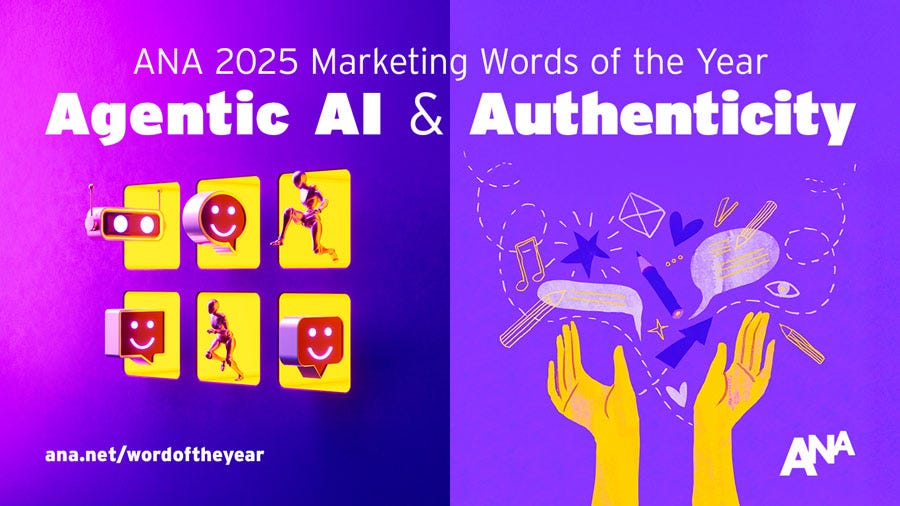
On December 4, the Association of National Advertisers did what it does every year: it announced its Marketing Word of the Year. This time, it chose two: “Agentic AI” and “Authenticity.” The pairing was meant to signal a nuanced understanding of where marketing is headed. It didn’t land. Trade publication, business media, and Culture didn’t notice. For an industry built on attention, the silence was the verdict. Which raises an uncomfortable question:
How does a marketing organization fail to market itself to marketers?
The answer is in the words themselves.“Agentic AI” and “Authenticity” weren’t chosen because they reinforce each other. They were chosen because they expose the industry’s anxiety. One admits what’s happening: decisions are being automated, systems scaled, people pushed out of the loop. The other asks for grace anyway: please still trust us. Together, they don’t describe a vision. They describe a fear. And fear isn’t a strategy.
This is how an industry that once shaped culture ends up issuing a press release that culture doesn’t even bother to mock. Authority remains, but credibility doesn’t. If there’s a word that defines this moment in marketing, it isn’t “Agentic AI” or “Authenticity.” It’s irrelevance; earned quietly, and noticed by no one at all.
This is where Bob Liodice enters the story. Liodice is the CEO of the ANA and, by definition, one of the most powerful figures in marketing. When the ANA speaks about the future of the industry, it claims to speak for marketers.
At the same time, Liodice chairs Privacy for America, a lobbying group that has spent years fighting the very data-privacy reforms consumers are demanding. Reforms that would curb surveillance advertising, rein in third-party data brokers, and dismantle systems people no longer trust. That isn’t a nuance. It’s a conflict.
And it explains everything.
You can’t preach “authenticity” while defending the machinery that depends on opacity.
You can’t lead an industry forward while lobbying to keep it unaccountable.
And you can’t expect attention, trust, or relevance when your own incentives point backward.
The silence wasn’t the market missing the message.
It was the market recognizing it.