

In January 2016, Jesse Cole’s bank account was overdrawn. He had launched the Savannah Bananas just three months earlier and had only sold a handful of tickets. He and his wife emptied their savings, moved into a converted garage, and bet everything on making baseball fun again.
Nine years later, in 2025, the Bananas played to more than 2.2 million fans across 17 MLB stadiums and four football stadiums. They have a waitlist of over 3 million people, tens of millions of social media followers, and they have sold out every single game they have ever played since opening night.
That is one of the most remarkable trajectories in the history of American sports entertainment, and it deserves to be understood clearly before it gets dismissed, which I am about to do!
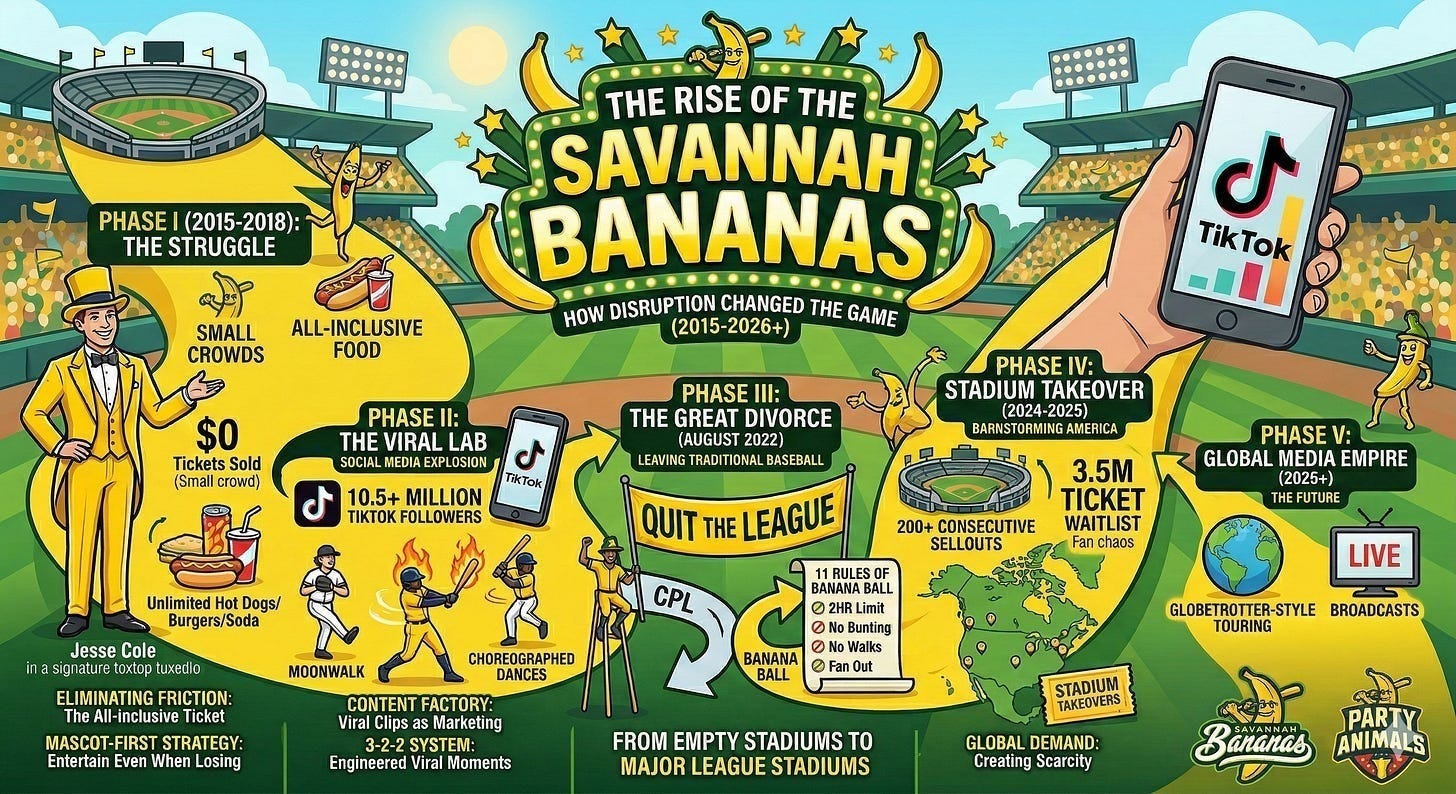
This week, my 14-year-old son put on the first two games of the 2026 season and their preseason cruise footage on YouTube, and I said it out loud, more than once: I’m over it! I know I’m not the target audience. But I also know I went from being genuinely excited about this concept to feeling hollow watching it, and that turn happened fast. That shift is worth examining, because I don’t think it’s really about the Bananas at all.
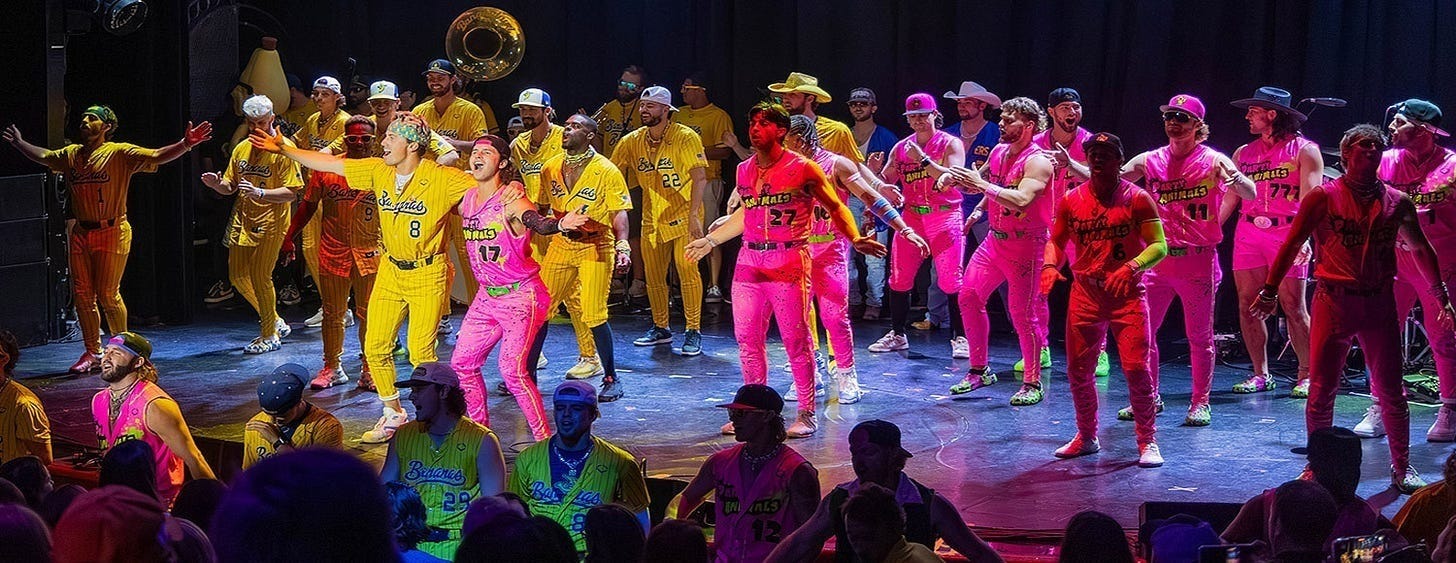
This is a photo of the Bananas Cruise. In a typical Savanah Bananas game, there are backflips between pitches, choreographed dances mid-game, lip-synced walk-ups, sing-alongs in the stands, and constant narration telling you how amazing everything is.
Let’s be honest; These are not elite MLB players. They are not leading Broadway voices or world-class dancers. I just went to a 100 year old circus the other week, and the baseball players reminded me of the traveling circus performers. They are capable, energetic, camera-friendly performers who didn’t quite have a market at the highest levels of their crafts, and they are extremely lucky that an entrepreneur built one for them. That’s not an insult; it’s a structural observation.
Jesse Cole saw stranded talent and built a system around it. He understood that attention is the currency. Package mid-tier skill with maximum spectacle and you can fill stadiums. From a marketing standpoint, it’s sharp. He created a scalable container that gives these athletes and performers relevance and income they likely wouldn’t have found elsewhere.
This isn’t really about baseball. It’s about what overstimulation does to us, and the Bananas are simply the live-action version of what the feed has been doing to us for a decade. Social media platforms trained us to expect constant escalation and the Bananas operate by exactly the same logic.
In “Dopamine Nation”, psychiatrist Dr. Anna Lembke writes that hedonism, the relentless pursuit of pleasure, paradoxically leads to anhedonia, the inability to feel it. Chase pleasure hard enough and you erode your capacity to experience it at all. The brain, overexposed to constant dopamine spikes, develops a new baseline. Ordinary experience stops registering, and you need more intensity just to feel normal.
The Bananas didn’t build this trap. They are operating inside it and delivering exactly what a dopamine-conditioned culture demands. The result is escalation without a ceiling, and escalation always has a ceiling. When every inning is a crescendo, the nervous system eventually fatigues.
Watching those games, I didn’t suddenly dislike the concept; I experienced over-saturation and stimulation. What once felt clever started to feel compulsory. The ubiquity of the Savannah Bananas dilutes its impact and intensity, collapsing into flatness.
This is true of everything. A special dinner feels special because it isn’t every night. A great performance moves you because most performances don’t. Even happiness requires a baseline of ordinary days to register as happiness. Without contrast, there is no signal; only stimulus.
We are living through a cultural moment that confuses intensity with value, volume with meaning, and novelty with depth, and we (and by we I mean I am also a part of this) are raising a generation that believes skill must be immediately obvious, reward must be immediate, and if something requires patience to appreciate, it probably isn’t worth appreciating. When everything is engineered to spike attention, we slowly lose our tolerance for the kind of depth that can’t be delivered in three seconds.
The Bananas didn’t create this, but their model is a mirror held up to a culture that can’t sit through a quiet inning without demanding a dance break; a society that equates noise with value and calls the monetization of hyper-stimulation progress.
Will average B2B email open rates fall below 25% industry-wide by the end of 2026 as AI-generated content floods inboxes?
(free to join, no money, no gambling)
The Bananas will keep selling tickets and fill stadiums. Their business will thrive. But the question worth sitting with (quietly, without a backflip) isn’t whether their model works. It’s what happens to us when it becomes the standard. That’s not a baseball problem. That’s a human one.