

Our major social media hubs all started out as communities.
Facebook was where you kept up with family and friends.
Twitter was where you kept up with people who shared your interests.
LinkedIn was where knowledge workers stayed plugged into the business world.
But today, no matter which social media channel you’re using, none of us feels plugged into anything.
We’re all alone now.
Our connections rarely see what we post. We rarely see what they post.
And our feeds are jammed with content-shaped noise designed to entrance us.
Keeping us engaged with the feed and disengaged from each other.
Let me put this another way.
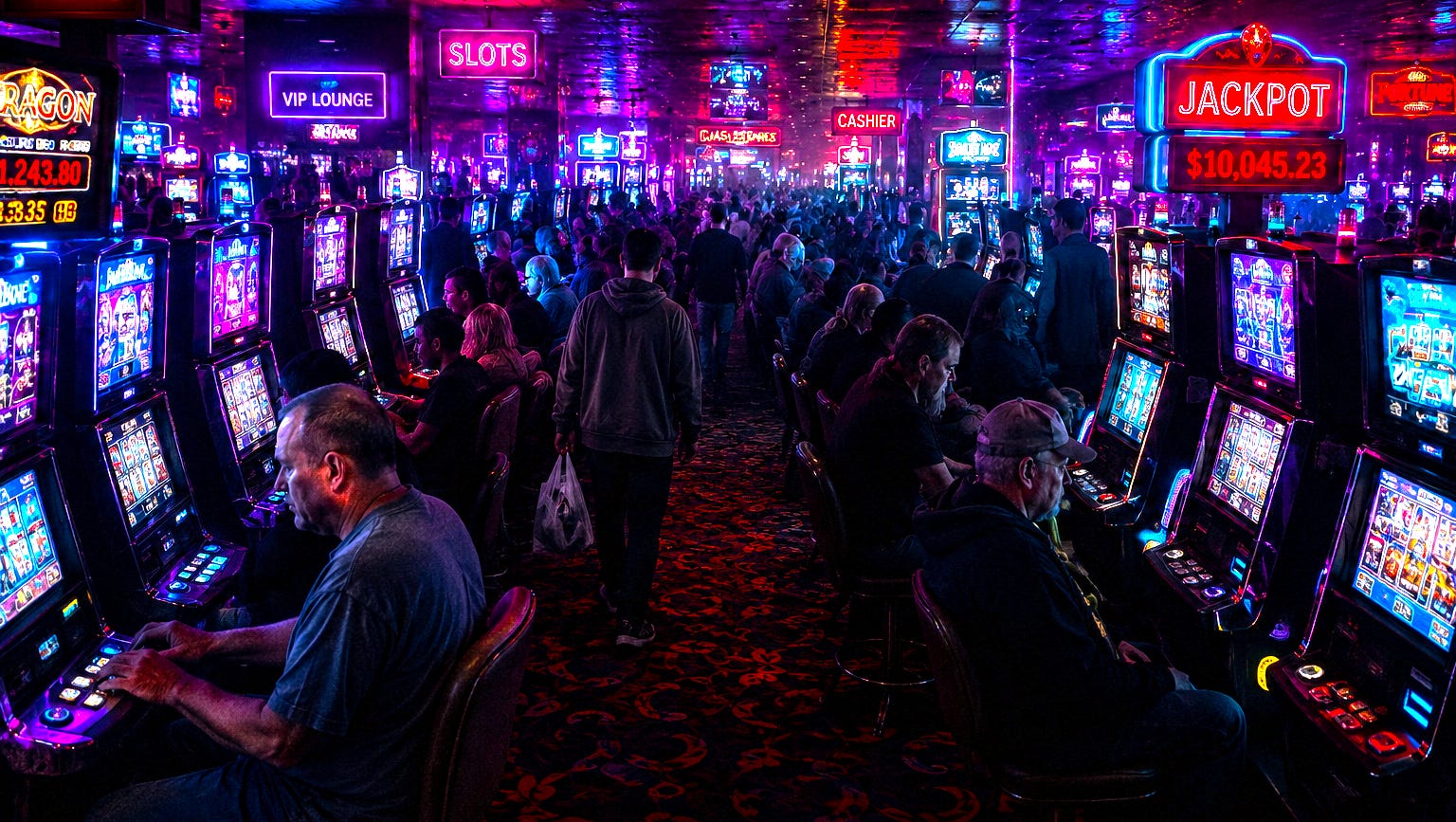
Social media channels have transformed into casinos.
The background noise is loud. The visual stimuli is overwhelming. It numbs our brains. It’s hard to talk or be heard. We all feel small and alone. It’s hard to leave.
And posting now resembles gambling.
The social media middle class has been purged (as it has so many other places).
It’s all or nothing now.
Social media posts either get two likes or two thousand; there’s nothing in between.
And since your best bet for getting two thousand likes is to post something outrageous, salacious, or triggering, that’s what’s happening.
Clickbait. Engagement bait. Every other kind of bait you can think of.
It’s proliferating and getting louder, even on channels once relatively quiet.
LinkedIn, once described as the Wall Street Journal of social media, has become a roaring bazaar of sales pitches, AI hype, and AI counterhype.
X, described as a smoking lounge for writers back when it was Twitter, has become a factory for manufacturing outrage.
Facebook, once a quirky community bulletin board, now feels like a dystopian TV channel, showing the sort of weaponized trash Paul Verhoeven’s films used to mock.
All the big social media channels now seem intent on overloading and suppressing our higher brain functions.
Casinos do this to empty your pockets.
Social media does this to empty advertisers’ pockets.
And if your business is posting or advertising there, it’s time to step back and ask “What’s the point?”
Imagine running an ad meant to be consumed on a casino floor.
Not in a quieter adjacent section like a lobby, lounge, or restaurant, I mean on the floor itself. Amid the slot machines and blackjack tables.
There are a lot of screens around, but your ad is only showing on one of them, among so much other audio and visual noise.
What are the odds of it getting noticed?
Or worse, getting remembered?
Your odds would probably be better trying your luck with one of the games.
I’m not saying abandon social media, or digital marketing and advertising.
I’m saying we must reconsider how we do it.
And the casino metaphor provides a useful model.
Advertising on a single screen in a busy environment full of screens is a bad idea.
But advertise on multiple screens simultaneously in the viewer’s field of vision (like what you see on some news websites), and, yeah, you’ve got a fighting chance.
Because then it’s not just noise, it’s a disruption. You’re breaking the trance.
Especially if the ad in question looks very different than what’s around it.
Too many ads try to look “social media native” by looking exactly like everything else being posted.
This made more sense back when social media felt more like a club.
But if you want to get noticed in a casino, you don’t show people more flicker and flash, you show them a tranquil outdoor scene from a national park a two-hour bus ride away.
If you want people to notice something in a windowless indoor space, you show them the outside.
You show them something they don’t presently have. Or somewhere they wish they were.
Showing them more of the house is how the house wins.

"showing them more of the house is how the house wins" is just too hot to handle! A scorcher mon ami!
If marketers cared about quality and not just quantity, and factored in long term effectiveness, social media would likely look very different from today.