

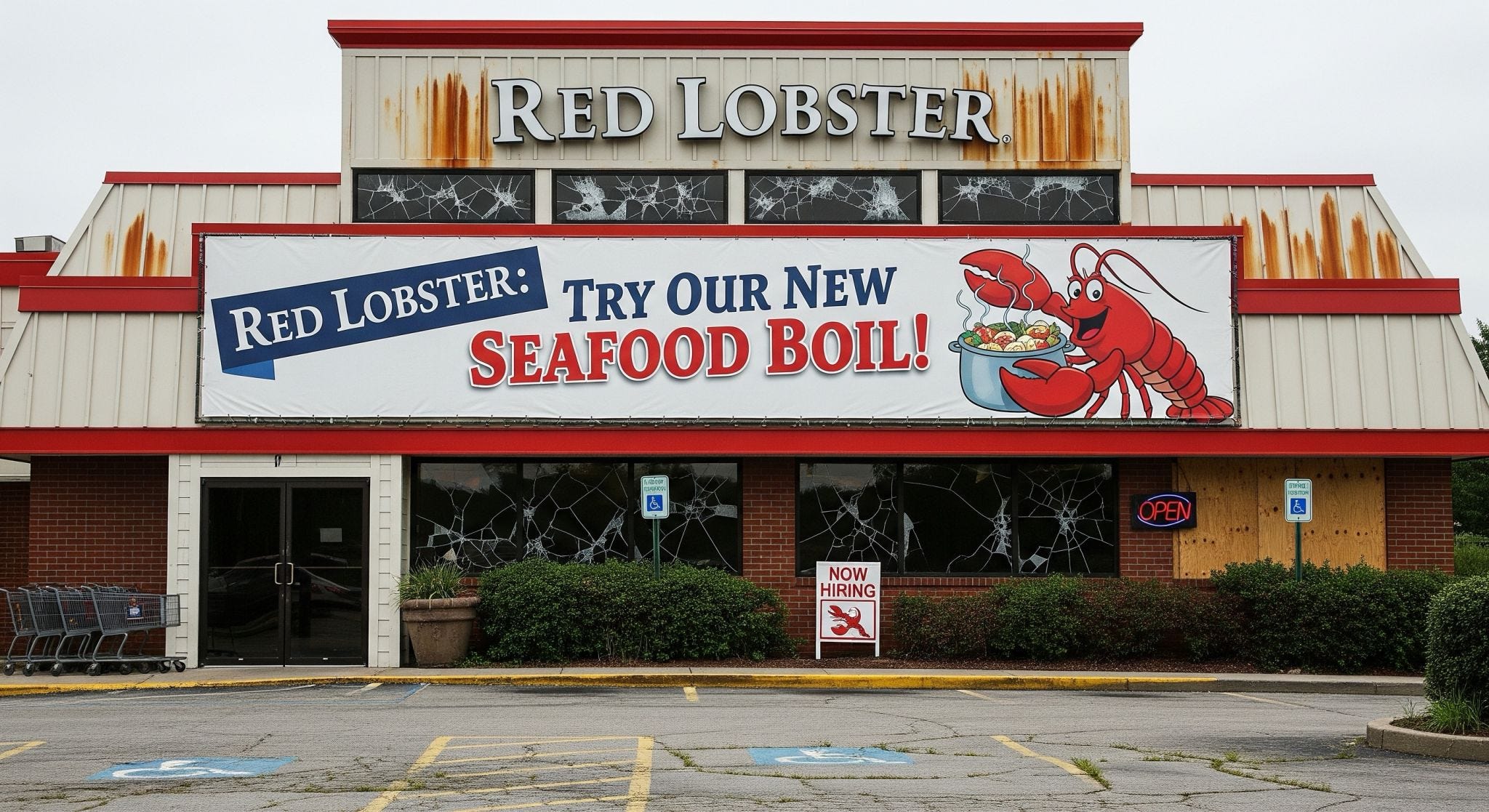
During the George W. Bush administration, the restaurant industry was booming. Chains like Red Lobster, Olive Garden, and TGI Fridays were mid-market darlings; reliable, affordable, and woven into the cultural fabric. Families gathered around cheddar biscuits. Parents let their kids pick dessert from laminated menus. You could show up, eat well, and not feel ripped off.
But that era is over. And not because people stopped liking seafood.
Red Lobster didn’t fail because of taste trends or weak marketing. It failed because private equity hollowed it out: stripped its assets, leased back its real estate at inflated rates, and handed the marketing team a mess to conceal with fake scarcity and “Endless Shrimp” gimmicks.
The result? A corpse with contouring.
“Most people aren’t mad at marketing. They’re angry at what it’s become: a performance of empathy masking a strategy of pressure. We say we’re solving problems, but we’re often selling cures to conditions we created.”
That line struck a nerve.
When I posted this take on LinkedIn, I wasn’t expecting over 122,000 views, 50+ comments, and a mix of applause, pushback, and exhausted agreement from CMOs, strategists, operators, and everyday customers. But it makes sense: marketing can no longer hide the structural failures of the businesses it's meant to support.
Red Lobster is the Canary
The restaurant industry is a case study in how systems unravel; quietly, then all at once. Red Lobster is just the loudest crash.
Let’s unpack the real collapse, starting with the system that killed it.
What Went Wrong
1. Financial Strip-Mining
Golden Gate Capital bought Red Lobster in 2014, then sold the underlying real estate to an investment trust and leased it back to the restaurant, raising rents and cashing out. It was profit extraction disguised as a strategy.
2. Self-Dealing Supply Chains
Thai Union, Red Lobster’s majority seafood supplier, became a majority owner. That means Endless Shrimp wasn’t just a marketing gimmick; it was a way to funnel revenue back to its own pockets. Red Lobster took the loss; Thai Union kept the supply deal.
3. No Operational Margin
By the time Damola Adamolekun took over as CEO, Red Lobster was hemorrhaging. He’s made strong moves; cutting unprofitable promotions, rebooting the menu, visiting restaurants in person, but he inherited a system designed to fail.
As one commenter put it: "No campaign can revive a business model that's been hollowed out."
The Broader Industry: A Sinking Tide
This isn’t just Red Lobster. The same macro forces are cracking the industry open:
Labor Costs: Average wages up 20% since 2020. Turnover over 70% annually. Operators can’t train fast enough.
Food Inflation: Beef, shrimp, and produce costs have all spiked. Restaurants either eat the margin or raise prices—both lose customer trust.
Leased Real Estate: More chains are leasing their own buildings, making rent higher than payroll.
Flat Foot Traffic: Dining out is now a luxury for the middle class. Casual dining has lost cultural relevance to fast casual or digital-first brands.
Burned Out Staff, Burned Out Marketers: Hospitality and marketing have become pressure valves for an economy that won’t invest in real value.
And the final straw? Customers feel it. They don’t say “the private equity firm ruined the experience.” They say: “the shrimp smells like fish and the server looks miserable.”
Marketing takes the blame. Again.
A Broken Menu in a Broken Economy
Let’s zoom in.
In Q2 2025, even the darlings of the fast-casual boom began to wobble.
Cava posted 2.1% same-store sales growth—down from 14.4% a year earlier. CFO Tricia Tolivar called it “a fog” of economic anxiety.
Chipotle saw same-store sales drop 4%. Execs blamed pullbacks from low-income consumers.
Sweetgreen had a “really, really rough quarter,” per CEO Jonathan Neman. They’re now increasing chicken and tofu portions to improve their perceived value.
Shake Shack stock is down 16% year-to-date. Even their burgers aren’t recession-proof.
This isn’t about taste. It’s about trust, fatigue, and inflation. The consumer is doing the math and often, they’re walking away.
Marketing Isn’t a Magic Wand
Some leaders believe in the comeback. I do too.
Damola Adamolekun is doing real work to fix Red Lobster’s broken bones, not just paint the exterior. His decision to visit stores, read reviews, kill bad promotions, and work outward from the customer is exactly what real marketing needs.
But let’s be clear: marketing needs operational alignment, not just budget.
Without that? It becomes theater.
“Marketing is the airbrush on the corpse.”
“It’s paint on operations.”
And that’s the crux: we’re asked to perform empathy while selling pressure. We’re asked to drive growth without levers. We’re asked to be the fix for what finance broke.
What Do We Do Now?
1. Stop pretending marketing is a cure-all.
It isn’t. It never was.
2. Insist on structural integrity.
If the business model’s busted, start there.
3. Redefine success.
No more fake dashboards. No more ad fraud. If turning off your ads doesn’t hurt sales, what were you buying?
4. Build trust from the inside out.
Start with operations. Then branding. Then promotion. Not the other way around.
We can’t keep pretending marketing is magic. It’s not a disguise. It’s a mirror. And it reflects whatever the business actually is.
Toward a Marketing That Respects Reality
We need a new marketing model. One that isn’t performance art. One that aligns with real conditions and doesn’t insult the intelligence of people just trying to make it through the month.
That means:
Ditching fake scarcity and urgency scams
Prioritizing customer insight over dashboards padded with attribution fluff
Refusing to patch over operational rot with polished copy
Standing up in leadership rooms and saying, “This won’t work - not without structural change.”
It also means building marketing departments that can say “no.”
No to bad promotions.
No to hollow content.
No to selling promises we can’t keep.
Because if Red Lobster taught us anything, it’s this: when marketing covers for a broken system, the brand becomes complicit. And when collapse comes, we’re the first blamed.
So, Where Do We Go From Here?
We start with clarity. We start with truth.
At the Marketing Accountability Council (MAC), we’re building not just a critique—but a set of tools to lead better.
We believe marketers must:
Have a seat at the strategic table
Be equipped with ethical data practices
Drive long-term value, not short-term dopamine
Act as customer advocates, not corporate megaphones
Marketing isn’t the problem. It’s a mirror. And right now, it’s reflecting an industry under pressure and a public that sees through the spin.
The fix isn’t better messaging. It’s better models.
Let’s be the ones to build them.
Tired of Marketing That Masks the Truth?
You’re not alone. And you’re not powerless.
At the Marketing Accountability Council (MAC), we’re building a new path forward — one where marketing isn’t used to spin lies, hide rot, or chase fake metrics. It’s used to create trust, tell the truth, and drive outcomes that matter.
MAC is for marketers who are:
Done with the dopamine treadmill of “more content, more clicks.”
Ready to connect strategy to structure — not just surface-level storytelling.
Looking for tools, frameworks, and allies to build integrity into every campaign.
Willing to say: “Marketing can’t fix broken business models — but it can help rebuild them.”
Inside MAC, you’ll find:
The Tool Stack – real-world resources for ethical, effective marketing
Accountability Metrics – beyond vanity, into value
Workshops + Strategy Sessions – led by top practitioners who’ve had enough, too
A Community – of truth-tellers, reformers, and those who give a damn
💬 If you read this article and thought, “finally, someone said it” — MAC was built for you.
Sources:
https://www.cnbc.com/2025/08/13/cava-chipotle-sweetgreen-report-slower-sales.html
https://martech.org/why-the-grift-economy-is-killing-both-marketing-and-marketers/
https://www.linkedin.com/feed/update/urn:li:activity:7362148986641653760/
While businesses complain about labor costs, Americans are watching their buying power continue to shrink as inflation outpaces wages by a mile. Can you blame anyone for not buying Chipotle anymore?
The whole issue at hand can be distilled down to one bullet point in this story, IMO:
"Have a seat at the strategic table."
Marketing does not mean "advertising and promotions." Anyone who knows the most basic marketing theory, knows "the 4 Ps."
Product
Place
Price
Promotion
When PE firms are making decisions - or even just Board or C Suites - that impact Marketing's ability to use its expertise to dial the knobs on these variables for optimum product-market fit and meet customers where they are, don't blame Marketing.
Nobody or no thing has a right to exist. Existing and thriving requires adapting to market conditions in any form of life. Strip away Marketing's resources to gather the information and have the autonomy to make the decisions that result in people buying or not, and you end up with failure.