

I debated not publishing this.
Then Optimum sent me an automated survey asking how I’d rate my recent onboarding experience, and I actually laughed out loud. As I sat there typing out every single detail of what went wrong, I realized I was practically writing an article just for their customer service feedback box. I paused, fed the whole sequence of events to an AI to see how big of a fail it was from a systems perspective, and it handed back a clinical 9 out of 10.
That’s when it clicked: if I’m going to spend the time laying out this entire operational disaster, why keep it trapped in a corporate feedback portal where it will probably just get buried? Why not actually publish it?
We have all lost a piece of our sanity to infinite phone trees, dead-end chatbots, and the quiet tax companies charge just for us to keep the rates we were already paying. I catch myself remembering a time when fixing a simple account issue didn’t feel like a high-stakes tactical mission, though maybe I’m just misremembering. What I do know is that I actually like my internet provider’s core product, which makes what happened next even harder to digest.
The story you are about to hear starts with a basic, everyday request to lower my bill—and devolves into a multi-hour operational nightmare that proved just how broken these systems really are.
The Customer-Service Maze
I called Optimum after a multi-day internet outage in my apartment coincided with a sudden, steep price increase on my bill. My introductory promotion had expired, and while the underlying service hadn’t changed, my rate had soared. Meanwhile, ads promised lower prices and gift cards to new subscribers. I couldn’t afford to pay significantly more simply because I hadn’t made a negotiation call at the right time.
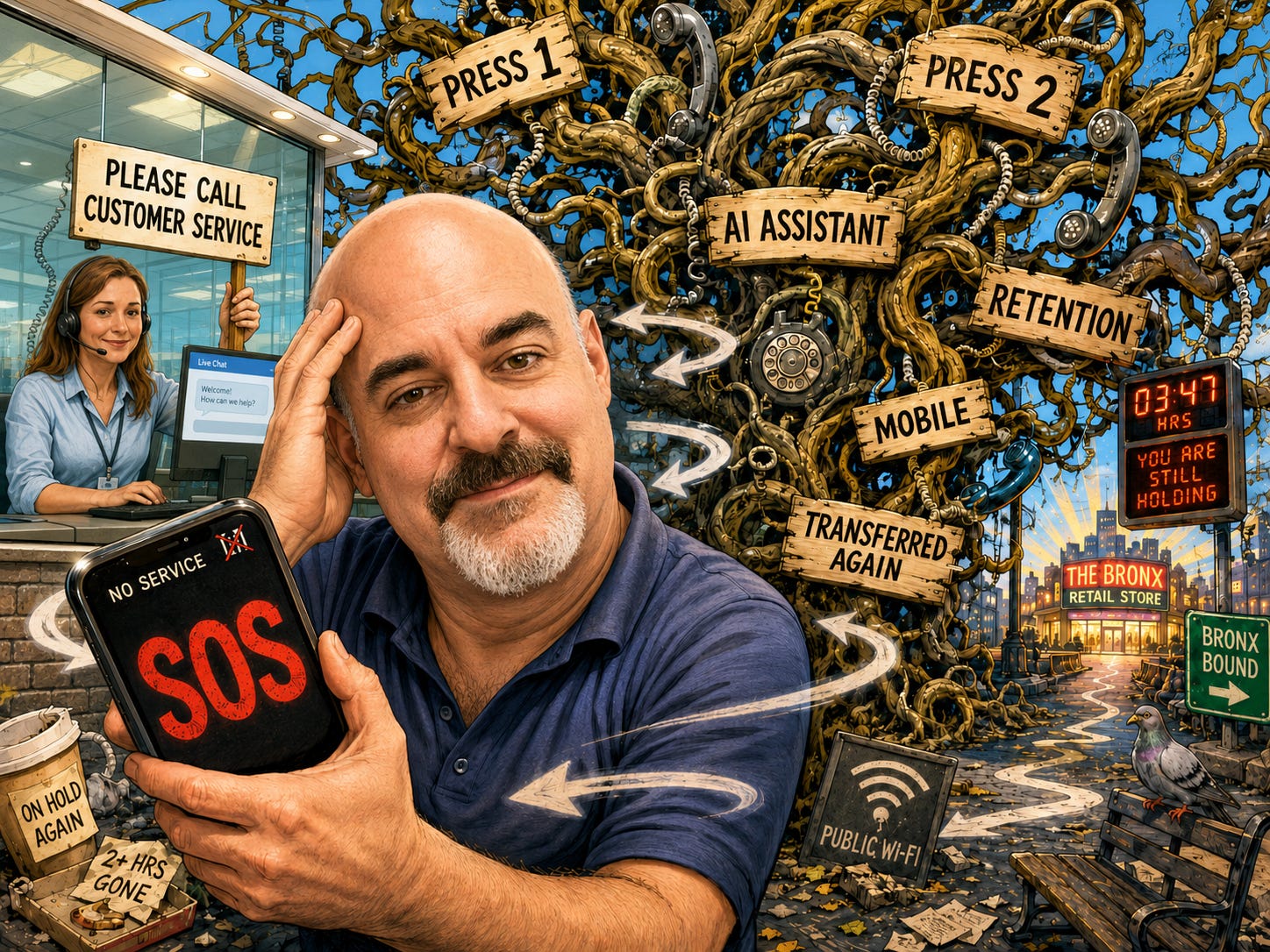
The frustration started in the automated phone maze. The options were built around the company’s internal workflow rather than my actual problem. I pressed buttons, repeated myself, and listened to prompts steering me toward online tools that had already failed to help.
When I finally reached a helpful representative, she spent 30 minutes reviewing my account before transferring me to the retention department. It says everything about modern corporate training: a person hired to help customers isn’t empowered to solve a basic pricing issue without escalating it to the retention department like a hostage negotiation.
The retention agent was polite, but instead of resolving the outage credit or reducing my rate directly, the conversation pivoted to a sales pitch for Optimum Mobile.
This shift from troubleshooting to cross-selling is driven by strict unit economics. In telecom, internet-only customers are a flight risk, but bundling mobile service creates a “sticky” account that cuts churn by making switching providers difficult. Support calls usually cost companies money, so scorecards are designed to turn retention into revenue, evaluating reps on cross-sell conversions. Instead of offering a promotional discount, the system uses your desire for a lower bill to sell a new line, leveraging service failures to boost long-term account value.
Promotional Pricing and Customer Inertia
The FCC requires broadband consumer labels to clearly disclose post-introductory rates, but disclosure doesn’t fix the customer experience. Busy consumers must notice the hike, research competitors, fight through a phone tree, reach retention, and negotiate under threat of cancellation.
Companies spend heavily to acquire new users while expecting existing customers to stage an operational showdown just to get a fair rate. This isn’t true customer loyalty; it’s leverage built on the pain of switching.
From Retention Call to Mobile Sale
The mobile offer sounded reasonable: bundle my service to lower my overall monthly spend with a quick activation. I agreed to save money, but a process promised to take “a few minutes” turned into a multi-hour crisis.
I explicitly warned the mobile representative that I was working on the road, completing time-sensitive deliveries, and relying on my cellular data for directions and job information. I asked specifically to hold off on switching the line until I was safely parked and ready. The representative ignored my warning and pushed the activation through anyway.
Seconds later, my phone dropped into SOS mode. My old carrier line was cut, my new service wasn’t configured, and I was stranded on the road without access to my work data or navigation.
A Support Catch-22
I drove to a local Michaels store, parked in the lot, and connected to their free Wi-Fi just to retrieve my delivery info and open a live support chat with Optimum.
When I explained that I was locked out of my account, the chat representative told me to sign in online. When I explained that my verification data wasn’t matching, her solution was simple:
“Please call customer support for assistance.”
I was chatting with a real human being who understood that Optimum had just deactivated my phone line, acknowledged that I had no service, and still offered a solution the company had made physically impossible.
Scripted empathy without the authority or tools to solve an off-script problem is just theatre.
The Bronx Store as the Emergency Room
With phone and chat support entirely paralyzed, I drove to an Optimum store in the Bronx that I often saw. The store manager recognized the issue immediately, noting: “You were in SOS. That happens all the time.”
The store team dug into my profile and found the root cause blocking chat support: despite my correctly providing my email address several times in previous calls, an agent had entered it incorrectly, missing a single period between my first and last name.
Where remote support saw a failed verification and hit a dead end, the retail team applied basic logic and treated the mismatch as a typo. They fixed the data-entry error their own system created and restored my service within minutes.
Systemic Failure Across the Industry
This operational pattern has become standard across subscription and service industries:
Inflexible Gatekeeping: Automation and AI act as demand containment, keeping customers away from agents rather than routing them to solutions.
Fragmented Accountability: Departments handle isolated tasks (sales, activation, support), leaving the customer to coordinate between them when things break.
Flawed Verification Systems: Simple data-entry errors created by the company are treated as customer authentication failures.
Misaligned Metrics: Agents are incentivized on transaction speed and sales conversion rather than risk prevention or issue resolution.
A Minimum Safe Activation Standard
Preventing these disruptions doesn’t require complex technology—it requires operational logic:
Pre-Check Constraints: Confirm the customer is stationary on Wi-Fi and not actively relying on the device for critical tasks like navigation or work before initiating a transfer.
Data Auditing: Verify identity details character by character before porting to avoid lockouts.
Active Support Window: Keep the agent line active until cellular data and voice signal are confirmed on the new network.
Bounded Authority: Train support agents to identify contradictions—like telling a disconnected user to call in—and equip them with escalation paths to override routine protocol.
I remain satisfied with Optimum’s internet speed; it serves my work well, and the mobile bundle will ultimately save me money. But a good core product does not excuse an onboarding failure that severely disrupted my workday.
Companies shouldn’t train employees merely to execute the next step in a script.
They need to train them to recognize when the next step no longer makes sense—and give them the authority to stop.