

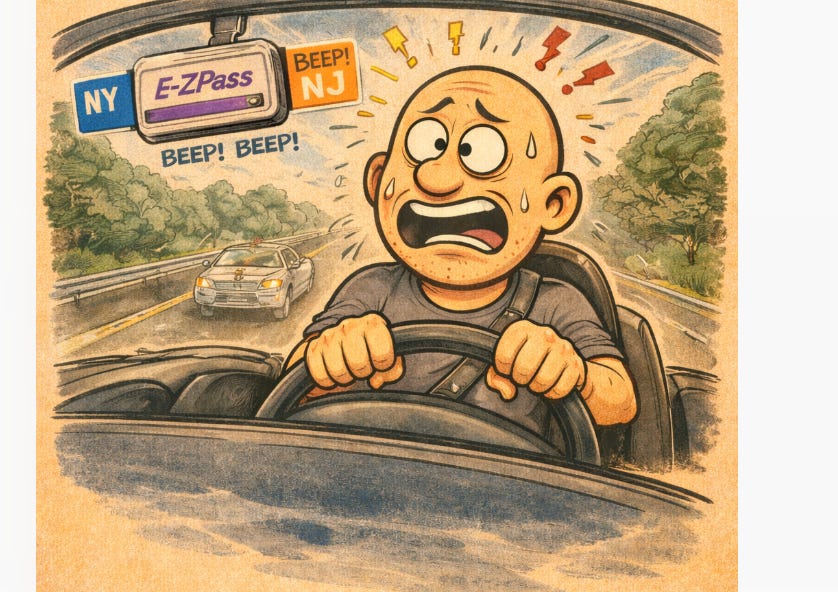
I have an EZ-Pass account in good standing, but there was an issue with the card on file. I drove from New York to visit my parents in New Jersey and made two round trips. The total tolls on the Garden State Parkway and the New Jersey Turnpike came to $19.
In New York, when a payment method expires or a transaction doesn’t process as expected (something that unfortunately happens from time to time to the best of us), EZ-Pass flags the account, prompts you to update the payment method, applies the tolls, and moves on; there are no fines or escalations.
My home state, New Jersey, handled it VERY differently.
Instead of treating this as an account maintenance issue, NJ EZ-Pass treated each toll as a violation. They added $50 fines per toll, turning a $19 balance into hundreds of dollars in penalties on ordinary highway travel, not bridge crossings or toll evasion.
I tried to fix it early and called the customer service center multiple times. Each attempt meant 30-minute hold times. When I did get through, I ran into a deeper problem; New Jersey told me to call New York, and New York told me to call New Jersey. No one owned the issue, and each agency deferred responsibility to the other. I was stuck in a closed loop where the customer served as the handoff point between two systems that presented themselves as one. While that back-and-forth continued, New Jersey sent the balance to collections. At that point, this stopped being a billing issue and became a stress issue.
There’s a deeper systems failure underneath all of this. As a New York resident driving to New Jersey, I don’t experience EZ-Pass as a different agency. I see the same purple sign on the Garden State Parkway that I see on New York highways. Same brand, promise, and system, or at least that’s what I thought from the driver’s seat. I didn’t sign up for jurisdictional boundaries or internal ownership charts. I signed up for EZ-Pass. And there is a lot of irony here that this experience is NOT EZ!
Systems should be judged from the user’s point of view, not the org chart. When something presents itself as unified, people reasonably expect unified accountability. They don’t expect to be told to mediate between two agencies that don’t coordinate.
The bright moment came later. I finally blocked off an afternoon and reached a super kind and empathetic woman at NJ EZ-Pass by the luck of the draw. She looked at the account and, within minutes, understood the situation and dropped every fine.
She pulled the account out of collections and charged me $19. Done.
That moment mattered because it proved the point. The system never needed to escalate this; the correct outcome was obvious once someone applied judgment. The frustration isn’t that a human fixed it; it’s that it had to get that far.
A well-designed system wouldn’t require persistence and stress just to reach common sense. It wouldn’t send people in circles. And it wouldn’t punish customers before giving them a fair path to resolution. What failed here wasn’t compliance; it was ownership. When systems optimize for enforcement instead of accountability, small problems become unnecessary ordeals until a person steps in and does what the system should have done from the start.
The cost wasn’t $19. It was time, stress, and trust, and all of it wasted for no reason.