

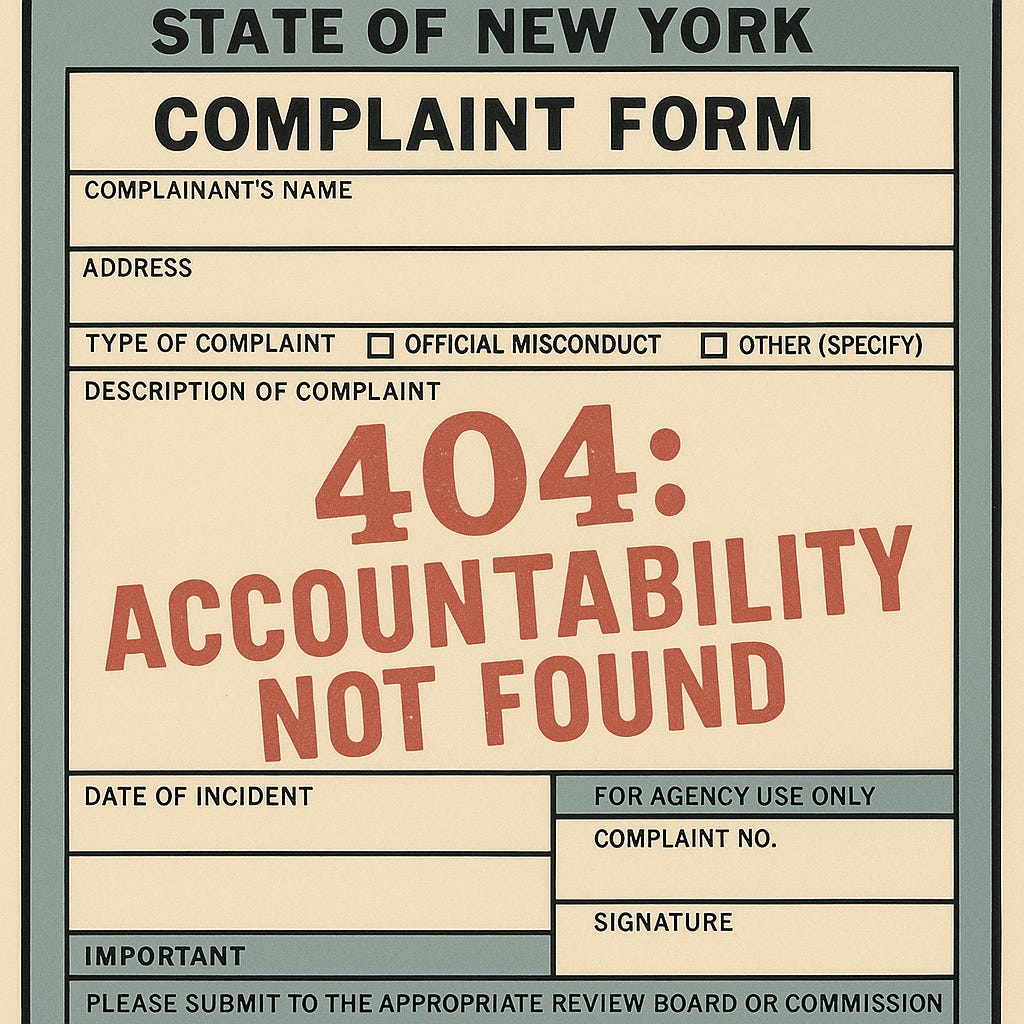
Reading Dan Gavartin’s The Great Delusion of UI/UX felt familiar, and not just because I just filed a professional misconduct complaint in New York State. And what hit me hardest wasn’t just the incident that led to the complaint. It was the system I had to navigate just to be heard.
Like Dan’s critique of modern UX, this system was performative. It looked official. It had a form. It had a process. But it was all surface; there was no real functionality, no empathy, and no user in mind.
This isn’t just about bad design. It’s about trust. It’s about systems that burn people out, wear people down, and then ask:
“Why didn’t you follow the process?”

What I Experienced
Someone in a position of trust failed to do their job, and I saw the fallout.
I didn’t rush to judgment.
I asked questions.
I brought my concerns to a supervisor.
And that supervisor didn’t just dismiss what happened; they covered it up.
Eventually, the silence and deflection became louder than any answer. Filing a complaint wasn’t about blame. It was about responsibility.
I wrote about the deeper experience in The Peril of Passive Therapy, where I explore the cost of therapeutic inaction. What I’ll say here is this: I wasn’t just filing paperwork. I was trying to stop a pattern of harm. I expected some resistance. But I didn’t expect the complaint process itself to feel like an extension of the problem I was reporting.
How can a system evaluate a therapist for being passive when the system itself is stuck in a time machine?

The NY State Complaint Process in 2025
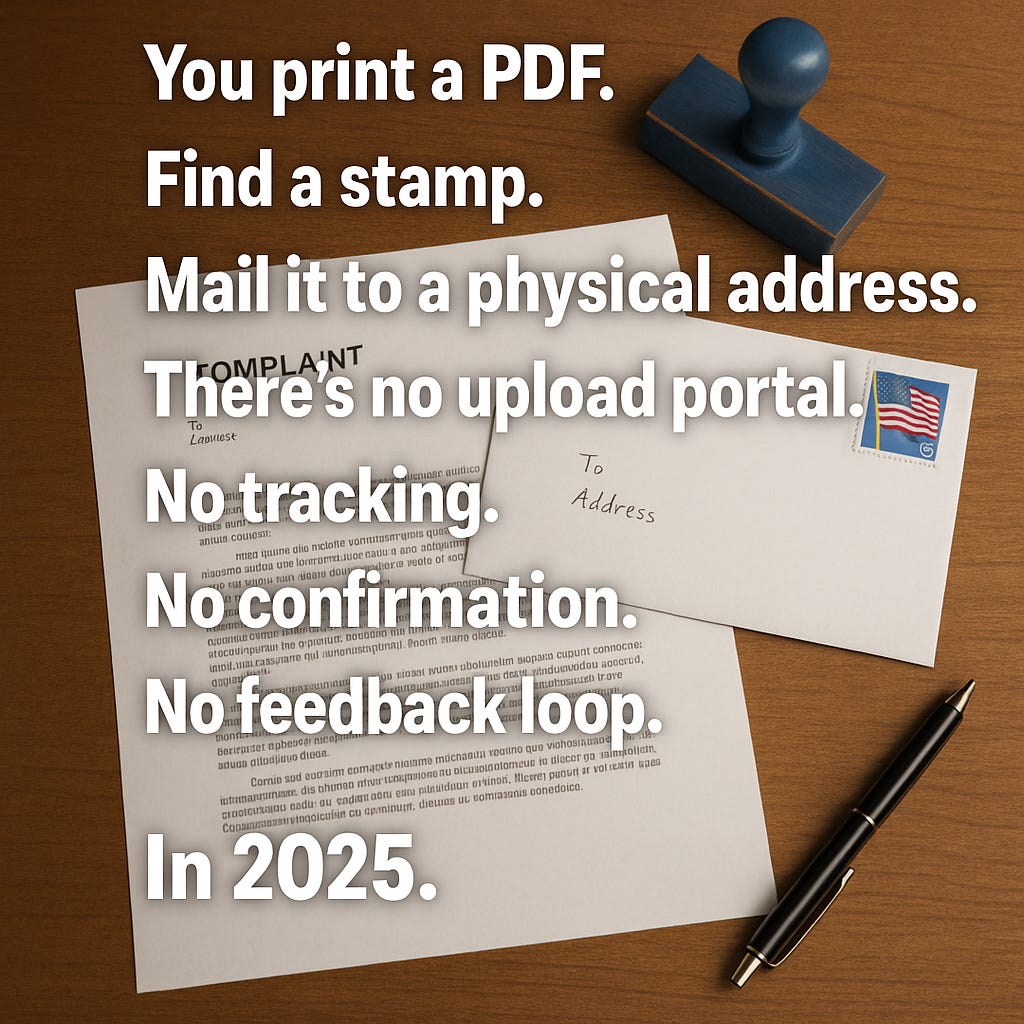
If you're thinking, “That can’t be right, it’s 2025,” yeah. I thought that too.
And while you’re jumping through these hoops, campaign ads flood your feed reminding you how “New York is the greatest place to live.” But when you need the state to function, when you’re trying to do the right thing, it fails you.
New York State is great, but not because of how it’s run. It’s great in spite of that. The people, the culture, the energy, they’re what keep it alive. Not the systems. Not the services.
And that’s the deeper issue: New York has built a system that pretends to support accountability but is structurally designed to avoid it. Just official enough to look legitimate. Just outdated enough to protect the status quo. Just difficult enough to keep most people from even trying.
And maybe that’s the point.
Step-by-Step: How New York Makes You Work for Accountability
Step 1: Find the Right Office
This alone is a test. I had to figure out which agency governs licensed therapists. After digging, I landed on the Office of the Professions (OP), a division of the New York State Education Department.
Their website is a UX case study in dysfunction:
Visually dated, like it hasn’t been updated since Netscape Navigator.
Poor navigation, overloaded with links, and no clear user pathways.
There is no complaint button on the homepage: you have to dig through PDFs and subpages to find the form.
No live chat, no intake portal, no transparency: just legal jargon and clunky dropdowns.
This is not a public-facing service site. It’s an internal bulletin board accidentally published to the internet. And it’s the only way to initiate a complaint that could seriously impact someone’s license or public trust.

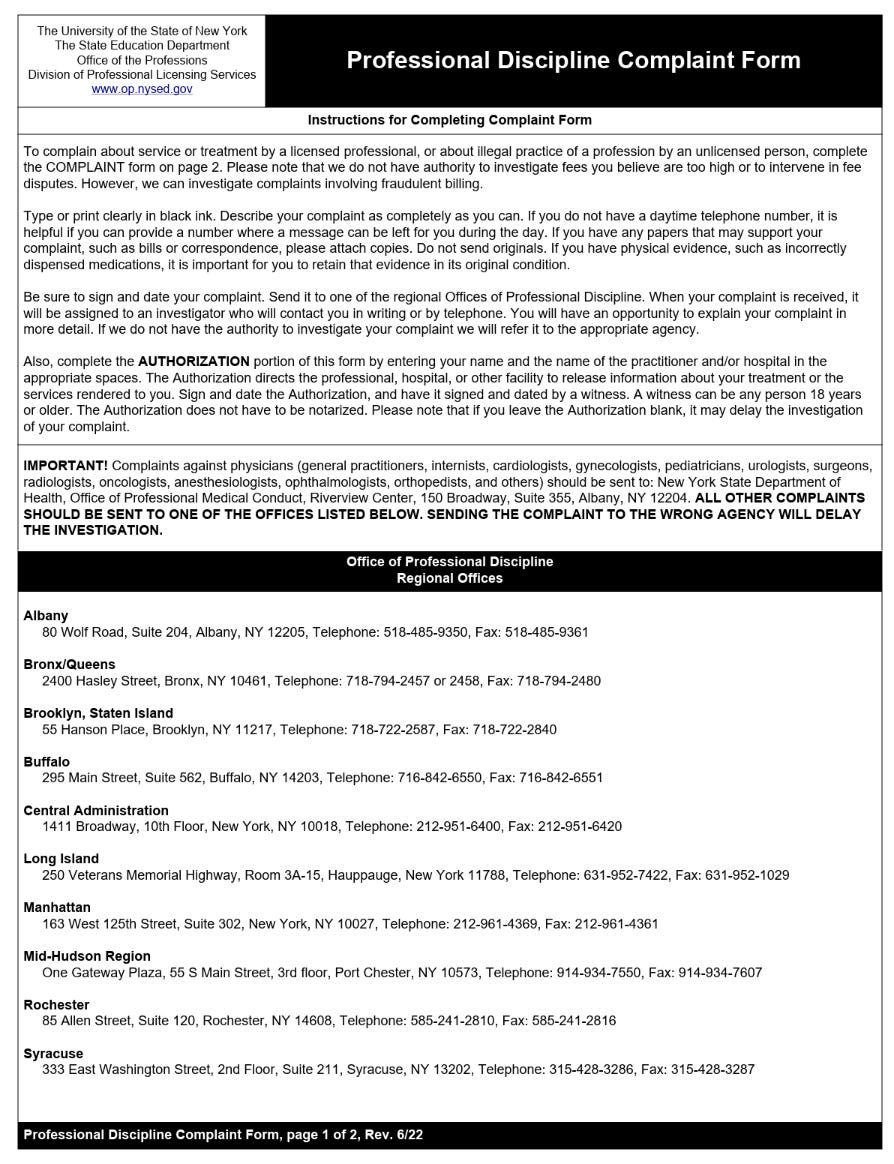
Step 2: Download the Form
No secure online form. Just a static PDF. Standard internet functionality from 2003—somehow still considered acceptable.
Step 3: Print It Out (Assuming You Can)
I don’t own a printer. Most people don’t. So now you’re making library trips, asking friends, and troubleshooting jammed inkjets. And don’t forget the envelope. Or stamps. All just to be heard. It starts to feel like a test of your patience, not a pathway to justice.
Step 4: Mail or Fax It
Yes, fax is still listed as an option. Who under 50 owns a fax machine?
And if you mail it, that’s it. There’s no confirmation. No tracking. No email follow-up. You drop it in the box and hope it doesn’t end up under someone’s lunch.
Step 5: Wait… Forever?
And here’s the thing: I haven’t even mailed mine yet.
Not because I’m unwilling, but because I already feel like I know how this ends.
After doing all the work to prepare it, I’m stuck asking myself: What’s the point?
I want to believe in the process. However, it’s challenging to invest faith in a system that appears to be designed to waste your energy and time.
It’s not that filing the complaint is hard. It’s that believing it will make a difference feels nearly impossible.
The Hidden Barrier Most People Never See
Here’s what’s worse: most people don’t even know this process exists.
There’s no awareness campaign. No reminders on professional websites. No “know your rights” section on agency pages. It’s buried in bureaucracy and written in legalese.
And that invisibility? It’s not accidental. It’s strategic.
Because when someone finally figures out how to file a complaint, they encounter a wall of friction that is so outdated and exhausting that most give up. Not because they’re wrong. But because they’re tired.
This isn’t just a bad user experience. It’s a form of institutional self-protection.
The more complicated the process, the fewer complaints are filed, the fewer complaints, the fewer investigations. Everyone benefits except the public.
Meanwhile, in Other States…
Let’s zoom out. New York isn’t the only state regulating professionals. So, how does it compare?
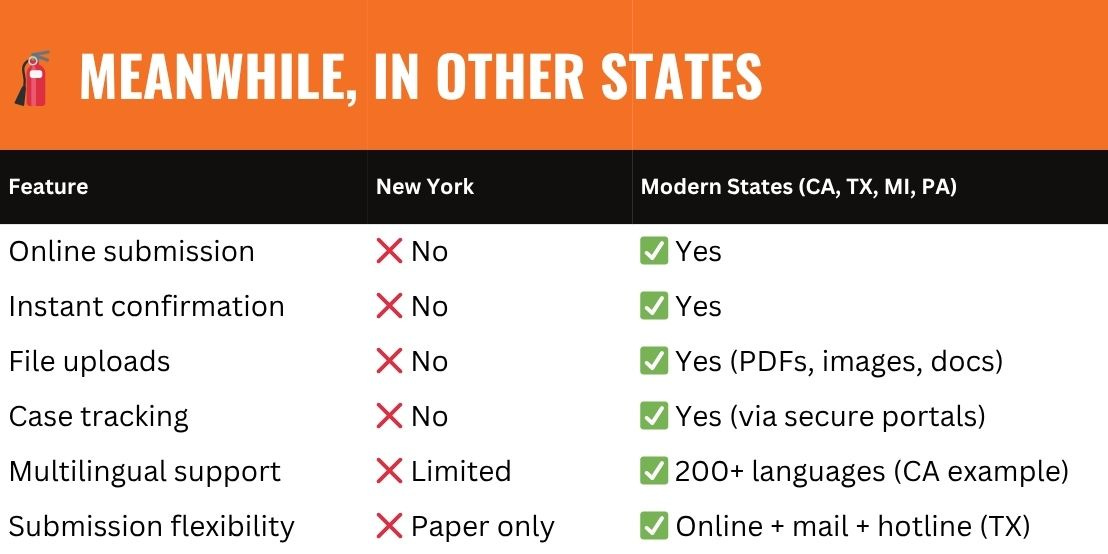
California allows you to file online, upload files, receive immediate confirmation, and even track IP addresses to prevent abuse.
Texas offers updates every 90 days and multiple filing options.
Michigan’s MiPLUS and Pennsylvania’s PALS systems are centralized and modern, with account-based portals and status visibility.
New York? Still acting like it’s 1996.
Conclusion: New York’s Complaint Process Is a Barrier, Not a Path to Accountability
Let’s stop pretending this is just old-fashioned bureaucracy. It’s not. It’s a structural defense mechanism disguised as a process.
When the complaint process is this painful, this clunky and outdated, it doesn’t just fail to serve the public. It actively protects bad actors. It benefits institutions by exhausting the people they’re supposed to protect. And it does so under the illusion of official protocol.
Meanwhile, states like California, Texas, Michigan, and Pennsylvania have moved on. They’ve acknowledged that online access, confirmation receipts, document uploads, and multilingual support are not luxuries. They’re the minimum standard for a legitimate, accessible accountability system in 2025.
New York’s system isn’t just inconvenient. It’s exclusionary. It assumes you have time, energy, access, and patience. It shrugs at equity. It leans into obsolescence.
It’s not just inefficient. It’s insulting.
And what about the state employee who receives your complaint in the mail? Imagine being that person in 2025, manually opening envelopes, deciphering handwriting, retyping everything into a slow, outdated system. It's miserable. It's inefficient. It's almost guaranteed to fail someone.
So yes, New York has systems. They just suck.
They are built on outdated workflows, inaccessible processes, and dead-letter mailboxes. They fail by design. And the failure is so consistent, so predictable, that it no longer looks like incompetence. It looks like intentional erosion of public access to justice.
We deserve better.
We deserve systems that meet people where they are, not ones that quietly dare us to give up.
We deserve real transparency.
Real accountability.
And real consequences for misconduct.
So fix it, New York.
Respect our time.
Modernize your process.
And stop pretending this is functional governance.
It’s not. And we see it.
And now others will too.
Want proof? Try it yourself:
MAC Compass Disclosure
This post was written in collaboration with ChatGPT-4o, using a combination of lived experience, first-hand documentation, and iterative drafting to clarify the systemic issues described. The emotional account, research, and conclusions reflect real events and opinions, with AI used strictly as a writing partner, not a ghostwriter. No facts were fabricated, no sources invented, and no accountability offloaded. Every word was reviewed and approved by the author.
This is what ethical, transparent collaboration with AI looks like.