

It started with the ultimate professional compliment.
“Your experience leading initiatives at Mastercard and IBM, along with your focus on rebuilding trust in marketing, could provide valuable insights for our program.”
The message came via LinkedIn from a verified recruiter for Udacity (an Accenture company) looking for Subject Matter Experts (SMEs) and Content Authors to build out Udacity’s upcoming AI for Marketing program.
For any seasoned marketing professional, it felt like an interesting collaboration. Udacity gets top-tier industry insights; the creator gets to shape the next generation of AI marketers.
We scheduled a call, hopped on Google Calendar, and dive-bombed into the process. I was handed a comprehensive Google Doc outlining the program scope and sent on my way to create.
I leaned in. I built slides. I spent hours scriptwriting and filming videos. On April 17th, I officially submitted my materials. The initial response from the recruiter was glowing: “Thanks Jay! I thought it looked great! I sent it to the team... Stay tuned my friend!”
And then, the line went completely dead.
For weeks, my messages sat in a professional black hole. On April 30th, I checked in. Silence. On May 6th, I checked in again. More silence.
Let’s be clear about what this is: it is deeply inconsiderate. When an organization solicits an industry executive’s time, energy, and proprietary knowledge to build custom audition materials, the absolute bare minimum requirement is basic professional communication. Disappearing after giving strong positive reinforcement (“Stay tuned my friend!”) isn’t just a symptom of a “busy team”—it’s bad manners.
It wasn’t until May 18th—when I finally lost patience and explicitly demanded a straightforward, candid update—
I’ll be candid. I’m not especially impressed with how this process has been handled.
The reason I followed up multiple times is because the communication at the beginning set a very different expectation. You were highly responsive, encouraging, and complimentary about the work. “Stay tuned my friend” and “I thought it looked great” communicates momentum and engagement. Then, after that, things effectively fell off a cliff.
I understand teams get busy. That happens. But disappearing after soliciting someone’s time and effort — especially after giving strong positive reinforcement — is not a good way to manage professional relationships.
If the priorities changed, the project stalled, the team lost interest, or the timing no longer works, I would much rather hear that directly than continue chasing updates.
At this point, I’m simply looking for a straightforward answer on where things actually stand.
Jay
After that, the recruiter suddenly materialized:
I apologize for the lack of response as I was still waiting on the feedback. Unfortunately, they decided to pass. The feedback was positive; however, there were a lot of submissions for this course topic so the competition was fierce. I will let you know if anything changes. Please let me know if you have any questions.
Again, I apologize for going dark.
Disappointing? Sure. But the real comedy began when I checked my personal inbox and realized that while the humans at Udacity couldn’t find two seconds to send a status update, their email servers were having an absolute, unhinged meltdown.
While I was waiting in total silence for feedback on my application, Udacity’s marketing engine was firing off emails with a level of frantic, erratic panic that screams desperation.
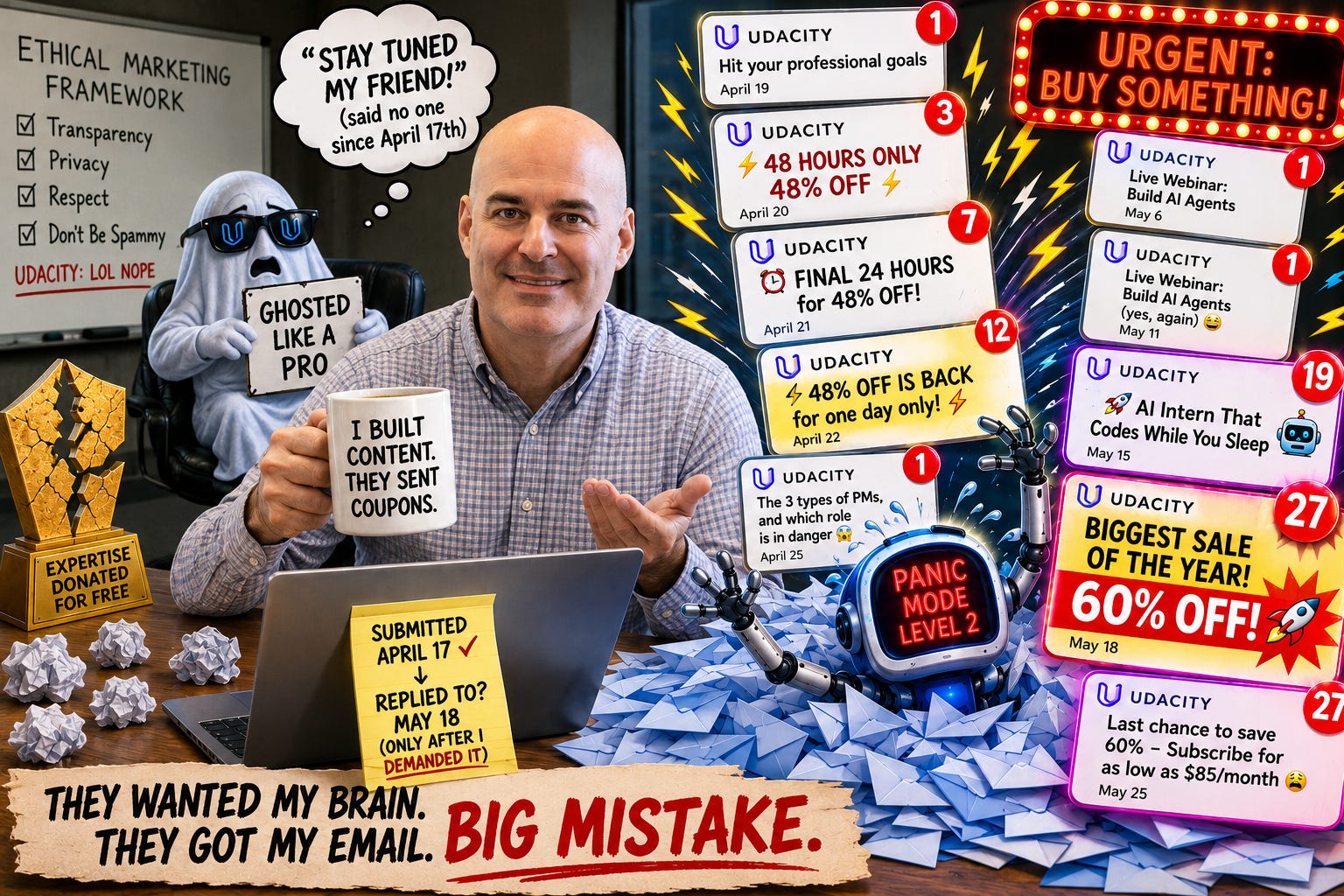
The barrage started politely enough on April 19th with a standard “Hit your professional goals with Udacity” welcome email. But by the very next day, April 20th, the system entered Panic Mode Level 1, screaming ⚡ 48 Hours Only, 48% OFF ⚡.
On April 21st, it doubled down on the fake urgency with a “Final 24 Hours for 48% OFF” warning. When I didn’t bite, the automated system immediately exposed its own lie on April 22nd by blasting ⚡ 48% off is back for one day only ⚡.
When the discounting failed, they pivoted to fear-mongering on April 25th with “The 3 types of PMs, and which role is in danger,” followed by a desperate cycle of recycling the exact same webinar pitches over and over again on May 6th and May 11th.
By mid-May, the desperation reached comical new heights. On May 15th, they blasted a live build event for an “AI Intern That Codes While You Sleep”—pitching automated interns to my inbox while completely ghosting the human creator who actually built content for them.
The absolute climax of this frantic meltdown happened on May 18th, the exact day I had to force a rejection out of my recruiter. The system shifted into Panic Mode Level 2, abandoning the 48% discount entirely to drop the “Biggest sale of the year: 60% off! 🚀” They spent the next week practically begging for attention, culminating on May 25th with a final, breathless plea: “Last chance to save 60% - Subscribe for as low as $85/month.” ---
The Ultimate Marketing Irony
The absolute peak of this experience is the sheer irony of the subject matter. I was being headhunted to build a curriculum for an AI for Marketing program—a course designed to teach modern professionals how to use AI strategically, effectively, and to build brand trust.
Yet, Udacity’s own internal marketing is a textbook example of what not to do. It is clueless, spammy, and aggressively transparent:
The Broken Countdown Loop: Sending a “Final 24 Hours” warning only to say “Just kidding, it’s back!” the next day is an amateur-hour tactic that immediately deletes a brand’s credibility.
Slashed Prices, Slashing Brand Value: Watching them desperately drop prices from standard, to 48% off, to a frantic 60% off reads like a digital mattress store permanently going out of business. They went from projecting high-value prestige to virtually begging for $85 a month.
Tone-Deaf Mirroring: While I was actively building and submitting high-level AI concepts for them, their automated system was frantically emailing me to buy basic courses on the exact same topics.
The Takeaway
There is a massive, embarrassing disconnect at the heart of this company. When they want your expertise, they act like an elite, white-glove institution. But the second you enter their ecosystem, their facade cracks, exposing a chaotic, desperate marketing machine that treats professionals like clicks.
If this is the kind of “clueless marketing” Udacity’s internal systems rely on, it makes you wonder if they have any business teaching the future of AI marketing at all.