

Forty years after being in the market, Listerine famously pivoted in the 1920s from a foot cleaning, gonorrhea removing, floor scrubbing disinfectant, into one of the most popular mouthwash brands on the planet.
The genius move came when the owner’s son came up with a new word for bad breath, “halitosis,” adapting the word from ‘halitus’ the Latin word for breath, and “osis” which sounds medical.
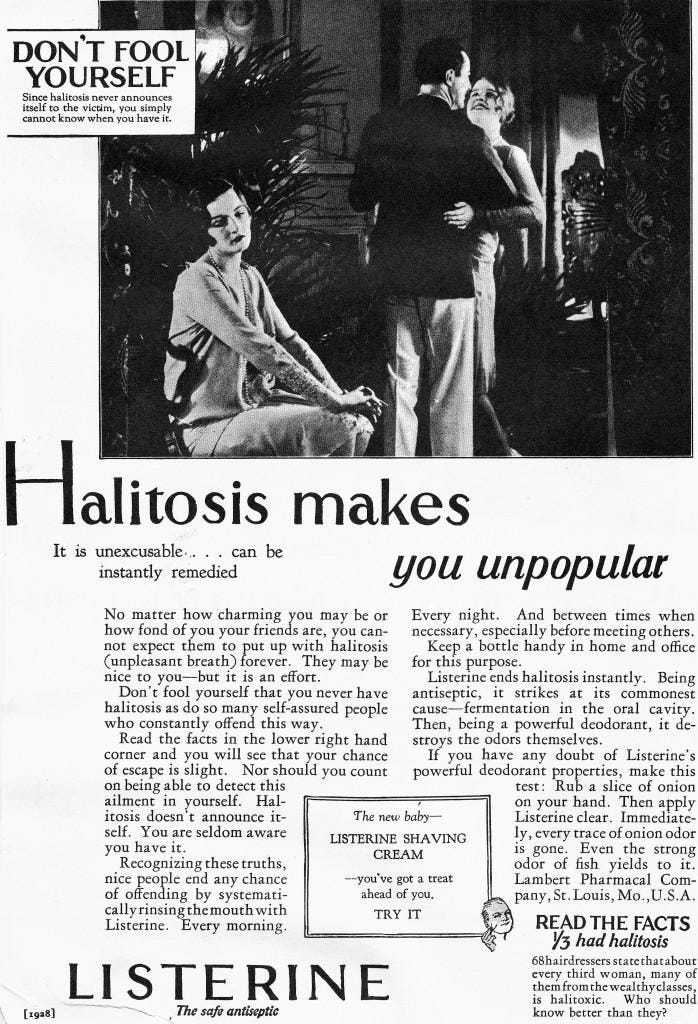
Listerine didn’t invent bad breath, for millenia people’s mouths were what they were, and teeth cleaning has been dated back to 3,000 BCE. We all knew about bad breath and did what we did to address it.

But Listerine did invent halitosis, and as a result of the groundbreaking campaign, people believed a naturally occurring flaw they might have, is in fact a medical condition which can be treated with an antiseptic.
And, since even “your closest friends won’t tell you about your halitosis” and you shouldn’t fool yourself like “so many self assured people who constantly offend in this way,” it’s hard to disregard the strong element of social shame, secretiveness, and grapevine tending in the copy.
You might not even know you have halitosis, so don’t even talk about it; solve it!
“Ultimately, the bad-breath campaign was so successful that marketing historians refer to it as the “halitosis appeal”—shorthand for using fear to sell product. And, while the modern advertising industry is no stranger to creating a problem to sell its solution, Listerine’s medicalization of mouth odors might just be one of the most successful iterations yet.” - The Smithsonian Magazine
Listerine’s reinterpretation of observation, giving form to something people experienced but couldn’t articulate, is lauded as one of the greatest positioning pirouettes in all of marketing history, along with Jobs’ “1,000 songs in your pocket”, and Ford’s “faster horses.”
The concern with “halitosis appeal” isn’t that it’s necessarily wrong to create awareness of unnamed needs, but that the terminology society uses can change what known evidence means.
The words we adopt, alter our response. Taxonomy is world-building through words.
Having fears clearly labeled can help identify them, but how would you know if the labels themselves aren’t the source of anxiety?
Marketing Is Full of Halitosis
Despite our personal hygiene habits or cleaning regiments, to polite business society, marketing has inexplicable halitosis.
Not because our breath simply stinks, but because marketers, apparently, suffer from known conditions, and a known condition means there’s a known cure.
But that isn’t the case in marketing, which smells weird for a myriad of reasons that are beyond our control. Marketing is maneuvering through manure, a probabilistic tango with the putrid ecosystem of reality, not a set of clean-smelling conditions to be met or a list of ills to be cured, or a cadre of well-defined goals to meet. Read more about The Delusion of Objectives.
In marketing, shit just…happens.
Campaigns fluctuate, algorithms undulate, attribution is imperfect, funnels are funhouses, customers churn and disappear and reappear, audiences alluviate, competitors move, categories shrink, technology changes, workflows contain friction, and organizations waste time.
These things have been happening since the dawn of marketing, but then someone arrives with a name:
Creative fatigue.
Signal loss.
Demand-generation.
AI readiness gap.
Attribution failure.
Data maturity.
Workflow inefficiency.
The marketing halitosis terminology above has all been newly minted since 2015, and maybe marketers and business leaders needed new terms to meet the new moment.
But tease out the underlying concepts and much of the new speak is old hat; uncertainty, fluctuation, inefficiency and imperfect information are a part of nature and cannot be disinfected or “cured.”
While naming a condition can provide a way to think about it, it also establishes an asymmetry.
How Halitosis Turns Into Harriedness
Just as Listerine was the sole master of curing halitosis, the vendor, platform, consultant, coach, agency or expert that introduces any diagnosis of marketing halitosis, is typically the only one in possession for the framework to establish, evaluate, and engineer its cure.
And what’s even more frustrating, as marketers fractalize into platform managers, technologists, and become entangled in workflow optimizations that know no end, we increasingly encounter claims about problems we can’t independently evaluate, and become ashamed of more and more instances of “halitosis” that should be “curable.”
A generalized claim of “creative fatigue” in ads, means there’s sub-halitosis events taking place in all of the nodes and interworking layers between a brand’s ad and an audience.
Planners get to feel ashamed about “saturation,” strategists become self-conscious about “positioning drift,” creatives develop a gag reflex to “declining hook rates,” clients start scrunching their noses at “brand erosion”, account managers cup their hands over their mouth to smell “expectation misalignment.”
The halitosis quickly turns into harriedness, and the busyness supersedes the business.
Once you’ve spotted “creative fatigue,” you need new creative. Once you’ve identified “audience saturation,” you need new audiences. Once you’ve found an “optimization opportunity,” leaving it alone looks irresponsible.
The industry becomes caught in a halitosis-poisoned loop:
Observation of term → term-based diagnosis → term-based accountability → term-based intervention → term-based measurement → new observations of term
Notice that while it does seem work is being done, this cycle never loops back to check if the original terminology is correct, or even based on actual evidence.
Everyone has a million ways to notice a million distinct stinks, but the truth is, addressing any smell has always required hard work, accountability, and a strong sense of what’s signal and what’s noise, what’s bad breath and what’s halitosis, what’s shit from shinola.
If we accept that “halitosis appeal” is real, and fear is often used to sell products or push agendas, then the next time someone points out a funky metric, we have to be able to ask; funky based on what?

The cure for marketing’s malodorous nature isn’t fixing halitosis, but properly adjusting our response to the claim that our breath smells.
Accountability Is A Response, Not A Reason To Answer
The reason the claims of a halitosis-like issue are so disarming to us, is that there is a missing baseline for “bad breath” that measures where things are and where they supposedly should be.
“Traffic is down,” is something typical to hear in a client meeting. And the typical response is that (before asking if it’s even meaningful) someone owns that dip, and something must have caused it, i.e. there must be an accountable answer.
So a range of possible responses begins to rattle around in the marketer’s mind (seasonality, targeting, misaligned budget, competition, algorithm changes, changing consumer behavior, macroeconomic trends) mixed with an unknown fear if this is natural bad breath or halitosis.
So instead of asking…
Is that movement meaningful?
Compared to what?
What evidence says marketing caused it?
Could anyone have reasonably controlled it?
What would happen if we did nothing?
…we decide to stay in the halitosis-loop..
When every negative movement requires explanation, marketers learn to provide explanations whether the evidence supports them or not. If every problem has a metric and an owner, people become accountable for forces they have little control over.
Typically, we are reactive in ways that relieve organizational and social anxiety, when we should choose to respond only when there’s evidence action is required.
But that is a frosty proposition.
Marketing and business culture treats any intervention as managing a problem, even when doing nothing, or simply waiting for more information, is the sensible play.
So action and accountability get mutated and misused, because rather than providing the grounding for rational responses, accountability becomes “answerability” - even in instances where there is no answer.

Marketing’s anxiety does not come only from uncertainty about its smell. It comes from an industry that treats the halitosis of uncertainty as evidence that someone has failed to exercise control.
To question this at the identity level, everyday marketers need to ask themselves; “am I trying to influence or change the outcomes, or prove that I’m the kind of professional who controls them?”
When we immediately explain and intervene, are we trying to improve marketing, or trying to make uncertainty feel manageable? On whose behalf?
The performance of control is much more dangerous than simple overconfidence, particularly when actual control is impossible. Read more about the “Illusion of Control and Rewriting the Myth of Blame and Shame in Marketing.”
If we accept marketing’s bad breath over halitosis, we get to shift the blame to where it belongs, which might not even be anywhere.
When we accept halitosis over bad breath, we lose our ability to respond to nature’s problems, and we become responsible for supernatural solutions and outcomes.
This isn’t to say we don’t have to address the smell, but if the diagnosis for the “problem” is manufactured, what exactly are marketers responsible for fixing, and would those fixes ever hit below the gumline?
I was eating garlic hummus while reading this. Then I thought, “I need to gargle.” Then I thought, “Do I really want to?” Thanks, Jake.
But seriously, this gets at one of marketing’s worst habits: giving ordinary uncertainty an impressive-sounding diagnosis, then selling a framework, platform, or consultant as the cure.
Naming a problem can help us address it. It can also manufacture anxiety, trigger pointless action, and make someone money. The better question is the one Jake asks: funky based on what?