

For the past fifteen years, marketing has tried to win by fixating on the little things.
Miniscule details in layout, dimensions, word choice, timing, frequency.
Things most people don’t notice.
And we’ve tried to create an incremental edge through cataloging, manipulating, and statistical optimization of these details.
You might think I’m talking about performance marketing, but all marketing is performance marketing now. Our entire profession is obsessed with playing every percentage possible, including elements not normally labeled as performance marketing.
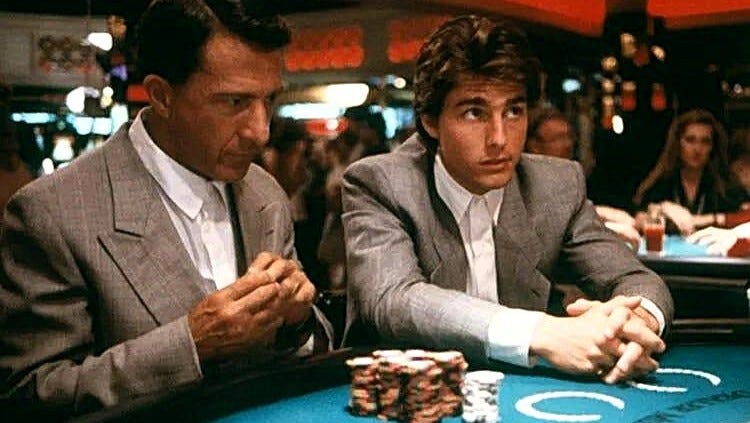
So instead, let’s use a convenient gambling metaphor to explain what we’ve been doing: card counting.
Marketing is now in the card counting business.
We’re so obsessed with how many LinkedIn comments we should make before we post, what time we should make them, and the best format to use, we no longer give thought to what we actually say.
So we let AI make it up.
The film Moneyball helped give legitimacy to card counting as a way of doing knowledge work, but card counting (or any system like it) has three big weaknesses.
One, counting cards is about the odds. It guarantees nothing.
Two, as we saw in Moneyball, counting cards can convey a big advantage when you’re the only person doing it. But when everyone at the table is doing it, it conveys no relative advantage. In fact, it hurts you, because synchronization makes your manipulation obvious.
And then you’ve got the third weakness to deal with, which is that the house always gets wise.
Individually, they knock your teeth out and leave you in an alley.
Collectively, they either shut down the game or change the rules or conditions for playing it, and then you’re left with nothing.
You’re an expert in a system that no longer works.
You either need to learn a new system or find some other way to win.
Too many marketers are content to hop from system to system. It’s a big reason why the Internet has been reduced to flaming dogshit.
When your idea of marketing is hopping from system to system, you’re not a marketer.
Marketers win through attraction, persuasion, big ideas, strategy, and empathy with real people, not through clever accounting, micromanaging, or otherwise fixating on beating the house.
If you always have a system, if you’re always looking for an edge, if you’re always trying to cheat (even when it technically isn’t), you’re not a marketer, you’re a grifter.
Marketing today has devolved into grift, through and through.
We grift customers. We grift channels. We even grift each other (including our employers).
Then we complain about not having a seat at the table.
But would you let a grifter have a seat at yours? Even if they were working you?
No, you wouldn’t. You wouldn’t trust their nature.
Marketers must give up the grift, or we’re all going to get replaced by AI (which has far more grift potential than any person).
And this includes our obsession with optimizing trivial details.
We’re devaluing ourselves with it.
The performance marketing mindset treats “fuck around and find out” like it’s a good thing, valuing experimentation over expertise.
But here’s the thing, marketing aspires to be disciplined and scientific.
And in science, experts run the experiments.
And experts know that what’s statistically optimal often isn’t useful at all, because correlation isn’t causation.
The optimal length for a book might be 90,000 words, but adding or subtracting 10,000 words from a book you’ve already written probably won’t help it one bit.
The optimal length for a film might be 92 minutes, but would Gone With the Wind be better if it were cut down to that length?
Some many of the little details marketers fixate on are meaningless.
We’re boxing ourselves in and creating no real-world advantage.
And when we all box ourselves in the same way, we hurt ourselves.
Marketing is a “when others zig, you zag” business.
Marketers need to think different again. Think big again.
The house wins by optimizing a million smaller bets, but marketers aren’t the house, we’re the gamblers.
Gamblers win by knowing when to bet big and be bold.
And by understanding human nature and behavior.
Counting cards can help you win in blackjack, but life isn’t like blackjack (a game played against the house).
Life is like poker, a social game, and so is marketing.
Where knowing the odds is important, but knowing people is essential.
