

I wanted to go fishing for one day.
I do not know if fishing will become a hobby. That is the point of trying something: you spend a modest amount, stand beside some water, and find out if you enjoy it.
New York State turned that simple experiment into a bureaucratic endurance test involving deer, unexplained acronyms, an annual license I didn't need, a printer I don't own, an app that wouldn't let me log in, and fishing rules scattered across separate websites.
Then, after creating all that confusion, the state reserves the right to scrutinize me beside the water and penalize me if I misunderstood something.
The state made collecting the money easy. It made understanding the rules and proving I had paid much harder.
Welcome, fisherman. Here is an enormous deer.
I went to New York’s sporting-licence homepage looking for a fishing licence.
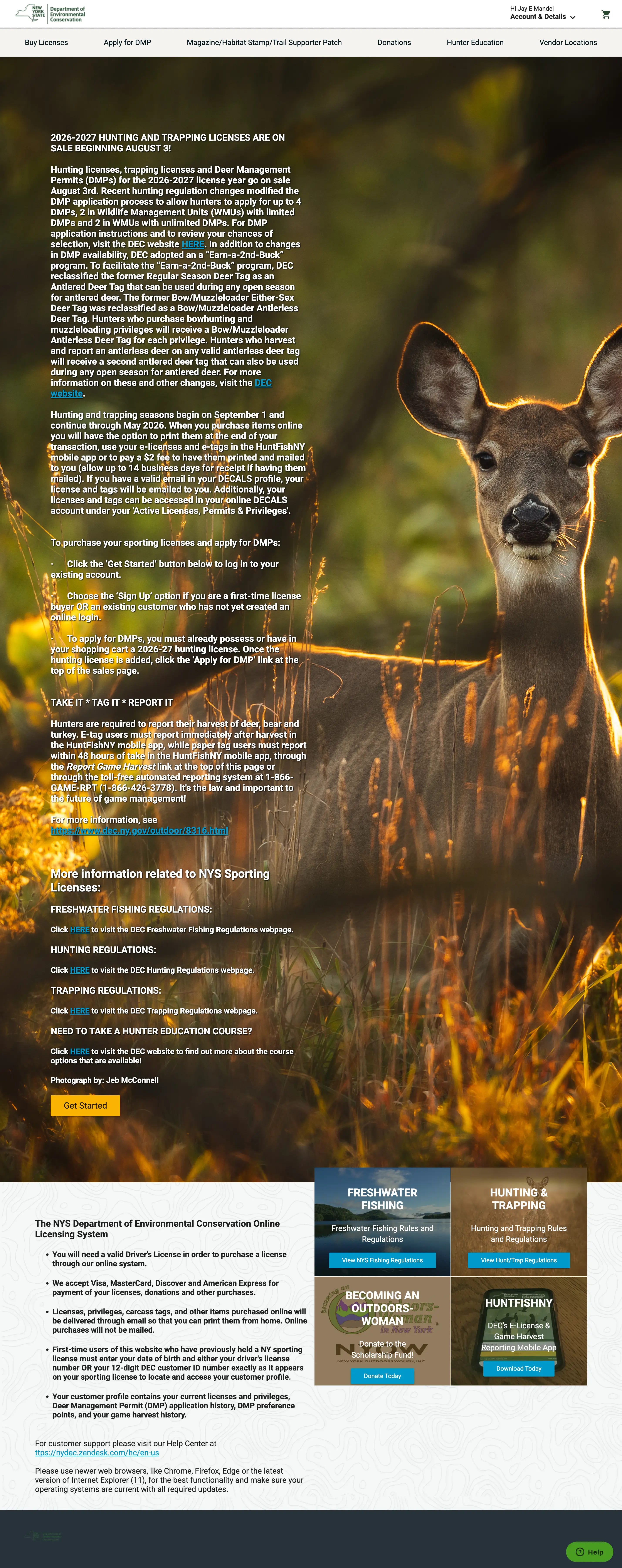
New York State responded with a giant photograph of a deer.
The navigation bar does contain a link labelled “Buy Licenses.” That sounds promising. Click it, however, and the main announcement is:
2026–2027 HUNTING AND TRAPPING LICENSES ARE ON SALE BEGINNING AUGUST 3!
Not fishing.
Hunting. Trapping. Deer Management Permits. Wildlife Management Units. Antlered tags. Antlerless tags. Bow privileges. Muzzleloader privileges.
There is even an “Earn-a-2nd-Buck” program.
I am trying to catch a trout.
I do not know what a DMP is. I am not interested in earning another buck. I am not carrying a muzzleloader. Yet New York has decided that all of this must stand between me and the button that lets me buy a fishing licence.
Keep scrolling, fisherman
The homepage is a wall of white text dropped over wildlife photography.
It explains deer-tag classifications. It explains how many DMPs a hunter may request. It explains Wildlife Management Units and how to report harvested animals. It explains that printed tags can be mailed for another $2 if the customer allows up to 14 business days.
Eventually, the page says:
Click the “Get Started” button below.
“Below” is doing heroic work in that sentence.
The button is buried under enough hunting information to qualify as a short course.
Then the page explains that new users should select “Sign Up.” Existing customers who have never created an online login should also select “Sign Up.”
You may already exist in the state’s system. You may already have a state identification number. You may already be a customer. But if you have not created the correct type of digital existence, you must sign up to prove that you exist.
That is New York State in one paragraph.
New York is also experimenting with time travel
The page announces that 2026–2027 hunting and trapping licences are available.
A few paragraphs later, it says hunting and trapping seasons begin September 1 and continue through May 2026.
Apparently, the 2026–2027 season ends before it begins.
Nobody caught this. Nobody fixed it. The sentence remains on the official licensing page in enormous white type.
This would merely be funny if the same government did not expect citizens to read its dates, understand its rules, and comply with them precisely.
The citizen’s mistake may produce a ticket.
The state’s mistake remains on the homepage.
Fishing eventually makes a guest appearance
Far down the page, after the deer, tags, DMPs, and hunting instructions, New York finally acknowledges fishing.
It does not provide a beginner’s checklist.
It does not explain the basic rules.
It says:
FRESHWATER FISHING REGULATIONS: Click HERE.
Hunting regulations? Click HERE.
Trapping regulations? Click HERE.
Hunter education? Click HERE.
This is not information architecture. It is a collection of escape hatches.
The site’s organizing principle seems to be that if a citizen keeps clicking “HERE,” eventually that citizen becomes another department’s problem.
The fee is clear. Everything after the fee is my problem.
New York offers a resident one-day fishing licence for $5 and an annual resident licence for $25, according to the Department of Environmental Conservation’s fee page.
I intended to fish once.
The licence I received is an annual Resident Fishing licence, valid for 365 days.
Maybe I selected the wrong option. But that does not rescue the system. It demonstrates the problem. I entered the site as a complete beginner trying to fish for one day, and I emerged with five times the licence I needed.
A well-designed service would begin with one question:
How long do you want to fish?
One day: $5
Seven days: show the available short-term option
All year: $25
New York begins with a deer.
Calling this a money grab does not mean the state has no legitimate reason to charge licence fees. Fish populations, public access and conservation enforcement cost money.
The money grab is in the imbalance.
Payment is mandatory and processed immediately. Clear instructions are optional. Reliable proof is the customer’s problem. The state protects the transaction much better than it protects the person completing it.
“Print your licence.” I do not own a printer.
After taking my money, the system told me I could print the licence.
I do not have a printer.
The page offered a second solution: use the HuntFishNY app.
So I downloaded the app.
I logged in.
It asked me to log in again.
I logged in again.
It asked me to log in again.
New York promotes HuntFishNY as the convenient way to carry an electronic licence and obtain location-specific fishing information. When I checked, the official app had a 2.1 out of 5 rating from 328 users. Reviews reported loading loops, account-switching problems, broken functions and failed purchasing attempts. See the HuntFishNY App Store listing.
A 2.1 rating is not a minor software problem awaiting refinement. It is the public begging the state to stop pretending the software works.
The licensing page also says customers can pay another $2 for printed documents and wait up to 14 business days.
I want to go fishing for a day. I do not want to establish a document-fulfillment relationship with Albany.
Here is the most absurd part: New York’s own help page says an angler may provide a 12-digit DEC ID, a paper or PDF copy, or the HuntFishNY app as proof of a licence. That simpler DEC ID option appears in a separate help article.
The state already has a printer-free, app-free solution.
It simply failed to place that solution where a confused customer would see it.
Even my fishing licence is about hunting
I finally received the licence.
It correctly says:
Resident Fishing
Then much of the document tells me how to report harvested deer, bear and turkey.
A large section announces:
TAKE IT, TAG IT, REPORT IT
Take what?
Tag what?
I bought a fishing licence.
The document knows the exact licence I purchased. The state has my identity, customer record, purchase information and licence dates. Yet it still fills the page with hunting instructions while omitting the basic fishing information that could keep me from accidentally breaking the law.
It warns that false statements can be punished as a Class A misdemeanor. It supplies information for reporting environmental violations.
It does not tell me:
Where I may legally fish
Which fish I may keep
How large or small a trout may be
How many fish I may take
Which bait is allowed
Which waters have special rules
Which locations require another permit
What I should show an officer if the app fails
New York found room for deer-harvest reporting on a fishing licence.
It could not find room for fishing information.
A licence that teaches nothing
Usually, the word “licence” suggests that a person has been authorized to do something.
A driver’s licence means the driver has demonstrated some knowledge and ability. A professional licence normally comes after training or an examination.
A fishing licence is different. It is principally paid legal permission.
I paid, and the state declared me licensed without requiring me to read the rules, answer one question or acknowledge a basic summary.
That creates a strange arrangement:
New York certifies that I may fish while giving me no reason to believe I know how to fish legally.
The licence does not mean I understand trout-size restrictions, daily limits, bait rules, seasons or location-specific regulations. It proves only that the payment went through.
Now imagine the enforcement encounter
New York law requires a licence holder to exhibit the licence on demand to authorized officials. That obligation appears in Environmental Conservation Law §11-0705.
So imagine what happens beside the water.
I have paid.
I do not own a printer.
The state’s app has trapped me in a login loop.
The simplest alternative—the DEC ID—is buried in a separate help page.
The fishing regulations are somewhere behind another “Click HERE.”
An officer approaches and asks for proof, checks my bait, measures a fish or questions the specific water where I am standing.
Conservation officers have a legitimate job. Poaching and deliberate violations should be enforced.
But aggressive scrutiny of a confused, paid, first-time angler would be deeply unfair after the state failed to provide clear instructions and a dependable proof system.
The government cannot reasonably create the confusion, sell the permission, hide the instructions, provide defective software and then behave as though every mistake demonstrates bad intent.
If New York expects exact compliance, New York owes citizens clear notice.
Other states have already solved parts of this
No state licensing system is perfect. But nearby states demonstrate that the experience does not have to begin with irrelevant hunting material.
Pennsylvania’s Fish and Boat Commission puts “Know Before You Go” information on its main page and directs anglers to regulations, seasons, minimum sizes, daily limits and specific waterways. Its regulations page plainly describes the information as covering where and when to fish, permits, seasons and sizes. See Pennsylvania’s fishing homepage and regulations page.
Pennsylvania also tells anglers directly that they may present proof on paper or on a digital device when an officer requests it. The proof requirement appears on the licence-purchase page.
Connecticut says online licences are electronically signed and may be kept on a smartphone without printing. It also provides a page specifically for people who are new to fishing licences and calls it a “simple summary.” See Connecticut’s licence information and beginner summary.
That is the difference.
Pennsylvania begins with what the angler needs to know.
Connecticut acknowledges that beginners exist.
New York begins with an Earn-a-2nd-Buck program and hopes the trout fisherman keeps scrolling.
Is this really how New York runs everything?
It would be impossible to prove that every New York State service operates this badly.
But I do not need to make that claim. New York’s own government has already documented the broader problem.
In 2023, Governor Kathy Hochul announced a plan to make government work better by reducing bureaucratic barriers, modernizing agency websites and applications, and developing a single sign-on system. The announcement acknowledged that residents face technological obstacles and difficult interactions across state services. Read the state’s announcement.
New York then appointed its first chief customer experience officer. The state’s announcement acknowledged that obtaining government services can be challenging, painful and frustrating. Read the appointment announcement.
In 2024, New York launched its first statewide Customer Experience Strategy. One of its stated goals is reducing the “time tax” imposed by lengthy processes, unnecessary steps and bureaucratic hurdles. Read the New York State Customer Experience Strategy.
In July 2026, the governor issued an executive order directing state agencies to reform outdated regulations and policies that waste New Yorkers’ time and money. Read Executive Order 61.
That is the proof of the broader pattern.
New York State itself admits that its residents face unnecessary steps, outdated processes, fragmented technology, bureaucratic hurdles and wasted time across government agencies.
The fishing-licence experience is not an isolated annoyance. It is a working demonstration of the “time tax” the state says it is trying to remove.
The state has written the strategy.
It has appointed the officer.
It has issued the executive order.
It has apparently not told the deer.
What the page should say
The entire experience could begin with this:
I want to fish in New York.
Choose one day, seven days or one year.
Enter the waterbody where you plan to fish.
See the fish, size, season, bait and daily-limit rules for that location.
Buy the correct licence.
Save the licence or DEC ID to your phone.
Receive a one-page fishing summary with emergency and enforcement contacts.
That would answer the citizen’s actual question:
I want to fish for one day. What do I need to do?
Instead, New York’s answer is:
Read about deer.
Learn several unexplained acronyms.
Scroll through hunting instructions.
Enter a separate licensing system.
Create an account.
Risk buying a longer licence than you need.
Find a printer.
Download a 2.1-star app.
Become trapped in a login loop.
Search another website for fishing rules.
Work out which additional permit may apply.
Accept full responsibility if any part of this goes wrong.
New York does not make this public service understandable. It makes every technical component available somewhere and calls the result a system.
It is not a system.
It is a pile of links wearing a deer photograph.
And somewhere behind that deer, I assume, is a trout.