


When former New York City Mayor Michael Bloomberg banned trans fats, forced chain restaurants to post calorie counts, and prohibited smoking in bars and public parks, critics declared it the death of business. They warned of economic collapse and nanny-state overreach.
Instead, national restaurant chains realized it was cheaper to reformulate their menus nationwide than to run separate systems just for New York. National hotel and hospitality brands voluntarily adopted smoke-free policies to match the new cultural baseline.
This is the “New York Effect.” Because of the sheer size of its economy and its cultural gravity, New York City doesn’t just pass local laws; it establishes the default standards for the entire nation.
Mayor Zohran Mamdani is reaching for that very same Bloomberg-era playbook. Alongside former Federal Trade Commission (FTC) Chair Lina Khan, the administration has introduced a municipal crackdown targeting “subscription traps” and “junk fees.”
This municipal-level policy bypasses federal gridlock to establish a powerful local precedent:
If a company can sign up a New Yorker with one click, they must let them cancel in one click.
The Resilient Momentum of Lina Khan
To understand how we arrived here, you have to look at Lina Khan’s federal trajectory. As the head of the FTC under the Biden administration, Khan built historic momentum. She took on corporate giants, protected the “right to repair,” fought to lower insulin and inhaler prices, and drafted the federal click-to-cancel rule.
But when the political tides shifted and a new federal administration took office, Khan was sidelined from her federal post. Corporate lobbyists celebrated, believing the regulatory threat of a consumer-first market was buried; They were wrong. Her return to the public arena as a key advisor to Mayor Mamdani proves that truly consumer-centric ideas are too powerful to be sidelined for long.
If the federal courts and Washington gridlock won’t protect the American consumer, Mamdani and Khan have shown that a city with an $80 billion local economy gladly will.
The New Marketing Accountability Shift
For decades, marketers have operated under a “buyer beware” framework, relying on fine print and convoluted exit loops to sustain monthly recurring revenue (MRR). This new rule shifts the burden of accountability entirely onto the business through three strict pillars:
Click-to-Cancel: The cancellation path must be as quick and simple as the sign-up flow. No phone trees, chat-bot loops, or in-person visits required. Violators face a minimum fine of $525 per violation, plus potential restitution of historical fees to the consumer.
All-In Upfront Pricing: Advertised prices must include all mandatory fees up-front. “Boiler fees,” “lifestyle fees,” and hidden service charges are banned, backed by escalating civil penalties and active enforcement by the DCWP.
No-Cost Free Trials: Companies cannot require consumers to pay to return a “free” trial item, nor can they hide renewal terms. Violations of this rule will trigger direct civil action by the city.
The “1-to-1” Rule: If you use a single-tap sign-up via Apple Pay or Stripe, your platform must provide an equally accessible, un-monetized single-tap cancel button inside the user portal.
Why Consumer-Centricity is the Ultimate Competitive Advantage
For years, growth marketers and product managers have relied on “friction-based retention.” The logic was simple: if we make it 10 times harder to cancel a subscription than to sign up, our churn rate will drop, and our customer lifetime value (LTV) will artificially rise.
But this is a short-sighted strategy built on a house of cards. True consumer-centricity—building products and services that customers stay with out of genuine utility and delight, rather than contractual entrapment—ultimately wins in the marketplace.
Trust is the Highest-Converting Currency: In a crowded digital economy, the brands that remove friction at every stage of the customer journey, including the exit, build massive brand equity.
Cleaner Data, Better Products: When you remove subscription traps, your churn metrics reflect genuine consumer dissatisfaction rather than administrative exhaustion. This forces product teams to actually improve the core offering instead of hiding behind artificial retention.
Word-of-Mouth over Dark Patterns: A customer who cancels easily is a customer who leaves with a positive impression. They are highly likely to return when their budget or needs change. A customer who has to fight a chatbot to cancel will never return and will actively warn others away.
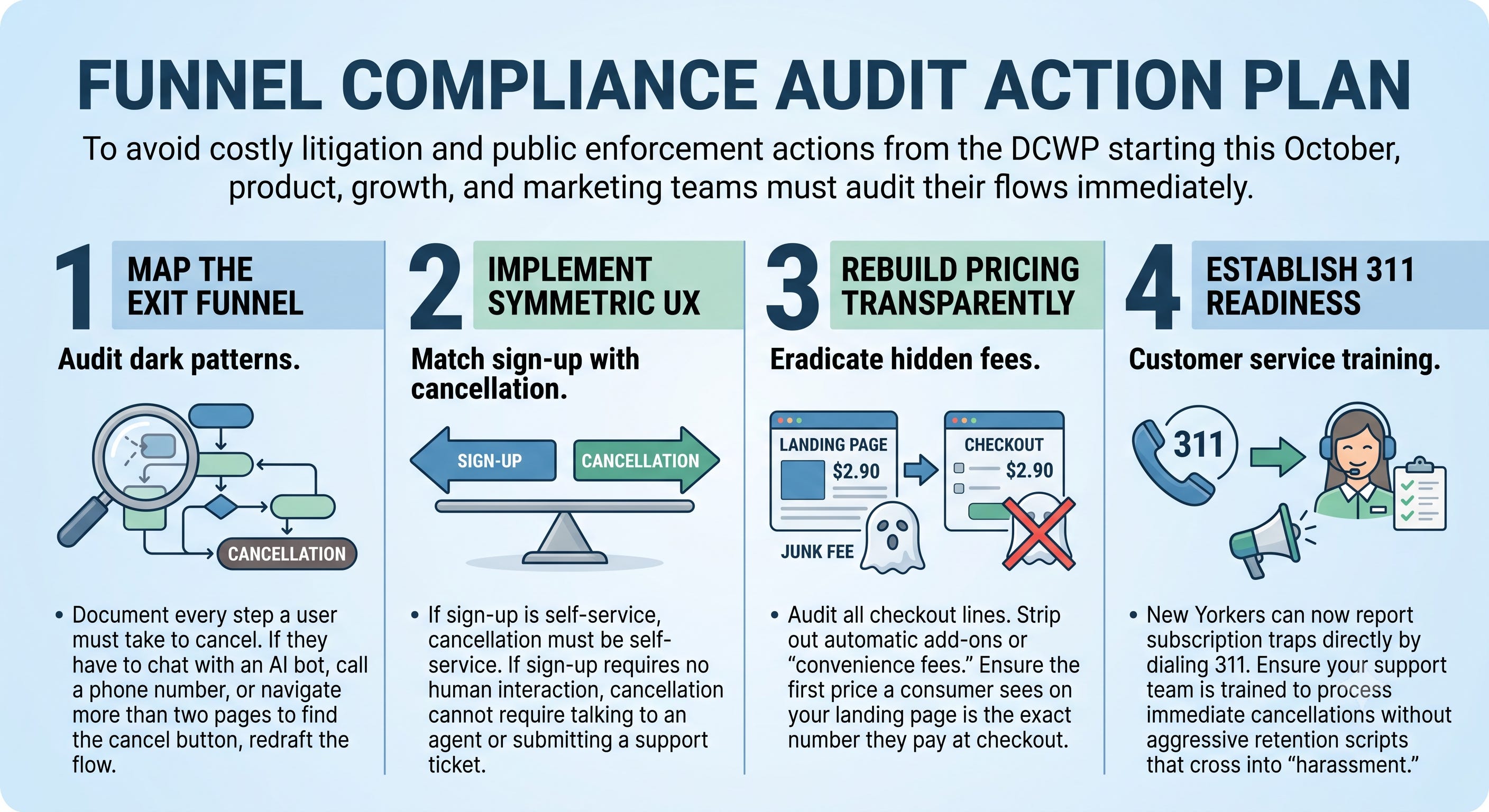
Action Plan: Auditing Your Funnel for Compliance
To avoid costly litigation and public enforcement actions from the DCWP starting this October, product, growth, and marketing teams must audit their flows immediately.
The Bottom Line
The era of inflating retention metrics through friction is coming to a close. Brands that rely on consumer inertia and confusing user experiences to maintain active subscriber bases will face compounding fines and public relations damage.
Ultimately, true marketing accountability means building products so valuable that customers want to stay—not creating traps they can’t escape.
I run a "no refund" policy for my digital products. I can't take it off their devices once downloaded. They must physically acknowledge this policy in order to buy it. Or they don't have to buy it. Give a consumer an inch they'll take a mile, I've seen this happen and it's pathetic.