

Is the decay of customer support happening because corporations have grown lazy, corporate greed is rampant, and AI is being deliberately deployed to starve us of human connection?
When I ran that draft by Jake Perry, a colleague at the Marketing Accountability Council (MAC) who has spent years running P&Ls and calculating cost-per-contact models, his feedback shifted the frame:
“Companies aren’t choosing cruelty over kindness. They’re running a cost equation—and mostly, they’re just getting the math wrong.”
Jake was right. The reality isn’t a cartoon conspiracy to isolate humans; it’s worse. It’s an algorithm optimized for a balance sheet that remains completely blind to real-world friction.
AI hasn’t fundamentally changed the objective of customer support—it has simply made a deeply flawed, pre-existing system exponentially cheaper to run. Whether you’re a consumer trying to reclaim an overpayment or a gig worker dealing with an in-transit crisis, we are all dealing with the fallout of an algorithm designed to deflect responsibility rather than solve unpredictable problems.
To understand why this model is failing—and why corporate balance sheets are blind to the damage—we have to look at how friction operates in the wild.
This article explores the future of AI and customer service. We’re tracking two questions on Cauldron as they unfold:
Will Uber reverse its customer support layoffs before 2027?
Will AI customer service bots outnumber human agents at a major US company by the end of 2026?
Read the analysis below, then predict what happens next.
1. A Field Study in Friction Strategy
To test Jake’s thesis that operational friction is a deliberate cost-control strategy rather than a technological glitch, I tracked a personal transaction over seven months.
In January, I visited a dentist in Manhattan for a routine cleaning. Despite having active insurance, I was asked to pay $128.80 upfront and was assured that once insurance cleared, any overpayment would be settled.
Six months passed with no refund check, no follow-up email, and no updated statement.
When I proactively reached out in July, the office emailed back: “It is our policy to request that patients call us within a month to check on their claim so we can issue a refund.” Insurance confirmed my actual responsibility was $74.00, meaning they owed me $54.80. Their solution? I could trek in from Yonkers to pick up a physical paper check at their Manhattan office during business hours.
By defaulting to keeping overpayments unless a customer manually triggers an inquiry, a business relies on the statistical probability that most people will simply give up. It is an operational design built on consumer fatigue to absorb unearned capital.
(Note: Shortly after I filed formal inquiries with NY State, my credit card was credited—without me ever having to step foot in Manhattan).
2. Synthetic Empathy and Unpredictable Reality
Driven purely by analytical curiosity as a founder obsessed with market mechanics, I decided to run this exact billing anomaly through two traditional resolution pipelines: legal intake and public regulatory oversight.
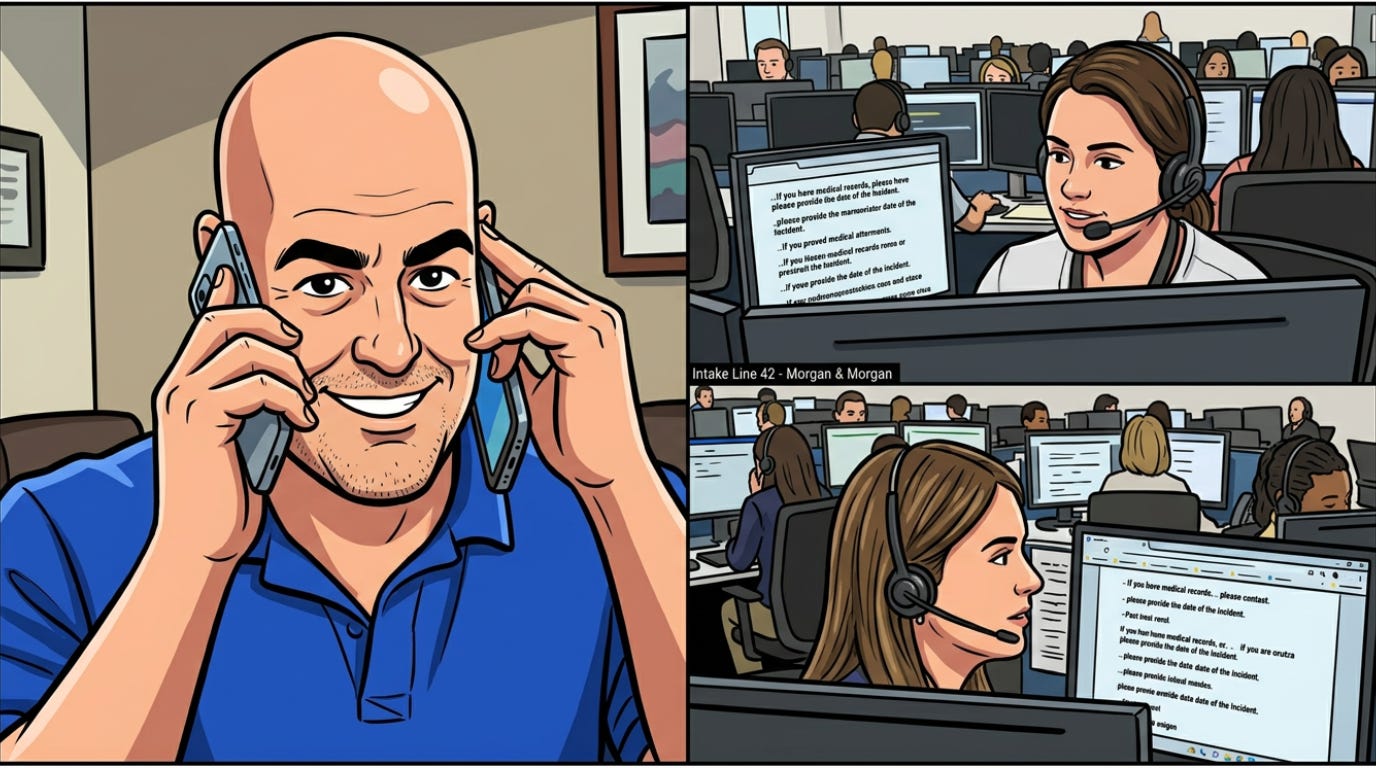
First, I called Morgan & Morgan, a massive personal injury firm—to see if this “forgot-to-ask” refund policy triggered their class-action consumer fraud filters. I laid out the operational pattern plainly. But the offshore intake agent, bound to a rigid sentiment-analysis script, caught the keywords “dentist” and “unlawful” and immediately dropped into a somber, pre-programmed tone:
“Oh, Mr. Mandel... I am so, so sorry for your loss.”
It was a striking example of synthetic empathy. The system was incapable of processing the logic of systemic billing friction; it was hardcoded to perform emotional cues while filtering for high-value personal injury torts. Once the software calculated that my $54.80 problem wasn’t a multi-million-dollar lawsuit, I was filtered out.
Next, I tested public sector accountability by filing a complaint with the New York State Attorney General’s Consumer Frauds Bureau. The result? Total digital silence. Regrettably, this is the exact behavior I have grown to expect from New York—it happens all the time, and frankly, it is an embarrassment for the state. Over the years, I’ve documented how New York’s public infrastructure relies on this exact model of systemic friction.


Whether it’s a government agency managing call queues or a private business forcing you to pick up a physical check, public and private operations have converged on the same flawed model: deflection.
3. Uber Double Down on Automated Downsizing
When a state government ignores your complaint, it’s maddening. But when a private multi-billion-dollar platform uses AI to digitize that exact same wall of silence, it becomes dangerous.
On July 22, 2026, Uber Technologies Inc. announced it was laying off approximately 10% of its Community Operations team—the exact frontline workforce responsible for managing customer support for riders, drivers, and delivery partners. To enforce this shift, Uber simultaneously eliminated remote roles within the unit, ordering remaining customer support employees to relocate to physical hub offices.
In an internal memo, Megha Yethadka, Uber’s Vice President of Global Community Operations, explained that AI presents “a massive opportunity for us to accelerate output, improve quality, and scale customer solutions at pace.” She noted that while the department had made strides, Uber needed a simpler structure because “we cannot scale frontier technology on top of fragmented processes.”
According to corporate trackers, it is the first time Uber has directly linked workforce reductions to AI efficiency pushes, joining companies like Block, IBM, and Snap.
To an executive looking at a balance sheet, firing 10% of your support staff to “scale frontier technology” looks like disciplined capital management. But to anyone on the ground, it begs an urgent question: What actually happens to the humans on both sides of the app when you delegate real-world support to an algorithm?
4. High-Stakes Friction: Automated Deactivations vs. Human Trauma
In March 2026, Uber launched a nationwide campaign celebrating its new “Women Preferences” feature with a crisp corporate slogan: “Women asked for choice, and we listened.”
Uber didn’t build this feature out of progressive altruism. They built it because a decade of systemic safety failures left them no choice.
Uber’s own safety reports logged a sexual assault or misconduct report roughly every 8 minutes in the U.S. between 2017 and 2022. The feature rollout only happened after Uber was cornered by a federal Multi-District Litigation wave of over 3,000 survivor lawsuits—and weeks after a federal jury hit them with a landmark $8.5 million rape verdict that shattered their defense of being “just a tech platform.”
Even worse, turning safety into a consumer toggle switch cleverly shifts the legal burden: if an assault happens now, the corporate defense is pre-baked into the app design: “Well, we gave you the option to filter.”
True responsibility isn’t handing customers a digital shield to survive a toxic ecosystem. It’s fixing the ecosystem. Instead, Uber is delegating crisis support to AI—creating a hostile dead end for everyone inside the car:
It Crushes Drivers: Ride-hailing is a livelihood, not a game. Yet drivers are routinely deactivated by automated code over false claims or glitches, stripped of any human appeal process. An AI bot trained on low-stakes refunds breaks completely when faced with real-world chaos like detours, threats, or locked accounts.
It Destroys Rider Safety: AI models rely on rigid decision trees meant for missing order refunds, not physical emergencies. Imagine a traumatized assault survivor opening the app for urgent help, only to be met by a bot offering canned options: “A) Driver was rude, B) Unsafe route taken, C) Fare issue.”
Forcing a victim through an algorithmic decision tree isn’t innovation—it’s grotesque, dismissive, and dangerous. When an enterprise replaces human crisis teams with LLM sentiment analysis, it isn’t eliminating risk. It is outsourcing physical, emotional, and legal liability directly onto the humans inside the vehicle.
Will Uber reverse its customer support layoffs before 2027?


5. What If Everyone Actually Won?
Look at the counterexample of Chewy, the online pet retailer.
When a customer’s pet passes away, they often call to return an unopened $80 bag of prescription food. A standard cost-per-contact algorithm calculates the transaction like this: Demand the physical return, charge return shipping, inspect the box, issue a partial refund.
Chewy does the opposite. Their agents instantly refund the money, ask the customer to donate the food to a local shelter, and follow up with a handwritten condolence card or flowers.
Chewy isn’t being soft; they have solved the unit economics. They recognized that pet supplies carry a low fraud upside relative to the massive lifetime value (LTV) of a loyal customer. The cost of trusting the customer is drastically lower than the customer acquisition cost (CAC) required to replace someone you alienated over a rigid return policy.
When you apply this positive-sum logic across the entire enterprise exchange, everyone wins:
Respecting Human Agency: In a world where people feel like line items to be squeezed, treating users and workers as partners gives them a reason to stay. Drivers who are compensated fairly for unpredictable risk deliver better service; customers who are treated with respect remain loyal.
High-Fidelity Insights: Instead of fragmented, legally grey data or alienated customers, enterprise buyers get high-fidelity insights and loyal relationships that drive real long-term returns without regulatory time bombs.
Profitability shouldn’t come from hiding refund mechanisms, sneaking opt-out buttons into fine print, or replacing support teams with automated chatbots that choke on real-world edge cases. Profitability comes from the scale and health of the ecosystem itself.
The Accountability Standard
Customer service is deteriorating not because AI is inherently evil, but because corporate executives are using AI to turbocharge an obsolete, extractive financial model.
Automating backend workflows is smart business. But using AI as an impenetrable gatekeeper to starve customers and workers of human resolution is operational suicide.
Data and human labor should never be weaponized against the people creating them. Ethical architecture isn’t altruism—it’s long-term market survival. When a platform’s success is directly tethered to its providers’ prosperity and its customers’ satisfaction, you build an enterprise that actually lasts.
It’s time to stop designing algorithms that exploit human output, and start building ecosystems where everyone gets to win.
The distinction between empathy and resolution is central here.
A system can become very good at recognizing emotional language while remaining structurally incapable of taking responsibility.
That may be the most dangerous form of synthetic empathy: not that it feels artificial, but that the performance of care helps conceal the absence of agency, judgment, and accountability behind it.
The technology did not create the extractive model. It made the model cheaper to scale and harder to challenge.