

Ryan Cohen, the current CEO of GameStop, began his entrepreneurial journey at age 15 by collecting fees from e-commerce site referrals. He is best known as the co-founder and former CEO of the online pet supplies retailer Chewy, which he launched in 2011 and grew to $3.5 billion in annual revenues before selling it to PetSmart for $3.4 billion in 2017. Following this massive success, Cohen shifted his focus to activist investing and purchased a 13% stake in GameStop in late 2020 for approximately $76 million. He aggressively pushed the company’s board to abandon its outdated brick-and-mortar model and emulate Chewy’s success by building a robust e-commerce ecosystem.
Cohen joined GameStop’s board in January 2021, and his net worth skyrocketed as he became the central figurehead of a massive, Reddit-fueled “meme stock” trading frenzy. His reputation as a controversial “meme king” was further cemented in 2022 when he bought a nearly 12% stake in the struggling retailer Bed Bath & Beyond, publicly criticized the company’s strategy, and then abruptly sold his shares for a $70 million profit as the stock price popped. Though he was accused of walking away with “short-swing” profits while leaving other investors to suffer dramatic losses, a judge recently dismissed the shareholder lawsuit against him due to the retailer’s subsequent bankruptcy.
However, while Cohen’s early career was defined by legitimate e-commerce success, his recent tenure at the helm of GameStop suggests that corporate leadership has hit a new, embarrassing low. Once upon a time, CEOs were expected to actually, you know, run companies. Today, if you look at Cohen, the new business model seems to be treating a multi-billion dollar publicly traded corporation like a burner Reddit account.
This shift from retail visionary to internet troll is painfully obvious in Cohen’s current attempt to mastermind an unsolicited $56 billion takeover of the e-commerce giant eBay. His strategy to achieve this? Going on national television to aggressively dodge basic arithmetic regarding a $16 billion gap in funding, listing his old video games on eBay with secret “clues” for his cult followers, and ultimately getting permanently banned from the very platform he is trying to purchase. It turns out that running a company via “trolling” is not just obnoxious—it’s a fundamentally disastrous business strategy.
Step 1: Pretend Math Doesn’t Exist
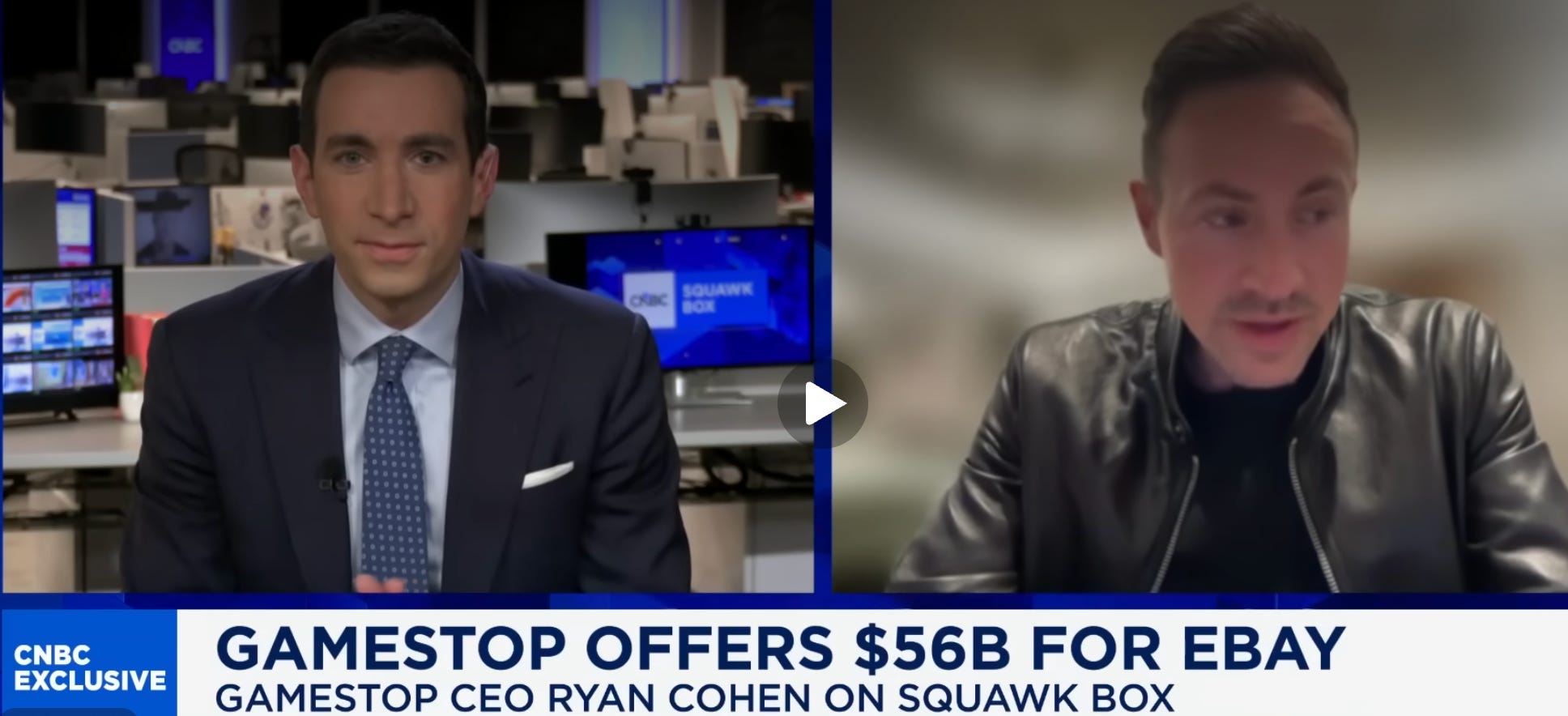
If you are going to launch a $56 billion takeover bid when your own company’s market cap is only $11 billion, people are going to ask questions. During a disastrous and combative interview on CNBC, Cohen was asked the incredibly basic question of how he planned to cover the $16 billion shortfall in his financing.
Instead of offering a cohesive financial strategy, Cohen opted for the strategy of a broken pull-string toy, repeating “It’s on our website. Half cash, half stock” over and over again. When the hosts pointed out that the math still left him $16 billion short, his response was simply, “I don’t understand your question”. This isn’t 4D chess; it’s a billionaire throwing a tantrum because someone asked him to show his work.
Step 2: Empower a Conspiracy-Obsessed Cult
Because GameStop’s actual core business of selling physical video games is in “secular decline,” Cohen has pivoted to selling Pokémon cards and leaning into his rabid fanbase. After his disastrous CNBC interview, Cohen listed 36 personal items on eBay to purportedly “pay for eBay”.
Rather than evaluating the company’s declining revenue, his retail investors are now spending their days decoding his eBay listings for “tinfoil” conspiracy theories. They are convinced that a listing for a Sumo Fighter game represents the “Japan Carry Trade,” and a Splinter Cell statue is a sign of an impending “covert operation”. They are even analyzing the exact number of emojis he uses in his social media posts to predict stock market movements. Fostering an online cult that treats your every typo like the Da Vinci Code is certainly a distraction from poor earnings, but it isn’t a sustainable business model.
Step 3: Get Banned by Your Acquisition Target
In what might be the most hilarious backfire in modern M&A history, Cohen’s trolling resulted in eBay permanently banning him from its platform. The e-commerce giant stated that his hostile takeover stunts and the resulting frenzy put the eBay community “at risk”. It is truly a revolutionary business tactic to get yourself banned for terms-of-service violations on the website you are actively trying to buy.
Step 4: Gut Your Core Business to Chase a Payout
Back in 2020, Cohen wrote a sternly worded letter to GameStop’s board, demanding they pivot from a “twentieth-century focus on physical stores” to a “technology-driven vision”. Flash forward to today, and his grand technological vision apparently consists of selling graded sports cards and trolling financial networks.
But the trolling masks a much darker reality. While Cohen plays the lovable internet troll to artificially inflate GameStop’s stock towards a $100 billion valuation—which would unlock a staggering $35 billion personal payout for him—his actual employees are paying the price. In early 2026, GameStop abruptly shuttered hundreds of stores with almost zero notice. Employees arrived to find closure signs taped to the doors, leaving workers feeling like “cattle... disposed of at their whim”.
The Bottom Line
Trolling the financial markets might generate media buzz and a temporary surge from Reddit day-traders, but it is a facade. Cohen has a history of these stunts, having previously pumped Bed Bath & Beyond stock only to sell his entire stake for a $70 million profit, leaving his own fans holding the bag.
Treating corporate governance like a massive shitpost is a phenomenal way to secure a permanent ban from eBay and ruin the livelihoods of hundreds of retail workers. But as a long-term strategy for a struggling brick-and-mortar retailer? It’s nothing more than a bad joke.