

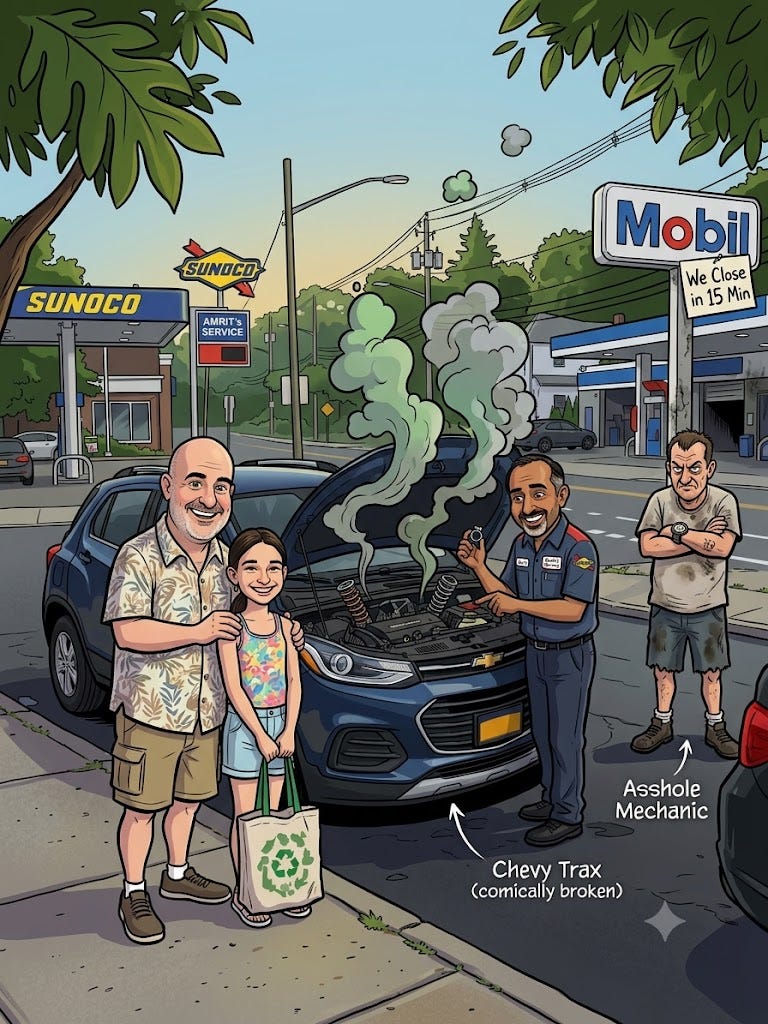
Last weekend, my car engine started steaming and smoking in Tuckahoe, New York.
As luck—or fate—would have it, I managed to pull into a parking lot directly across the street from a Mobil gas station. With smoke curling out from under the hood, I walked across the street, found the attendant, and explained my situation. I asked if he could take two minutes to walk across the street, look at the car, and tell me if I was going to destroy my engine by driving it any further.
It was 12:45 PM on a Saturday.
His response? “We close in 15 minutes. I can’t look at it until Monday, and I can’t walk across the street because I have to supervise the shop.”
Zero empathy, zero effort; Just a wall of bureaucratic excuses delivered by someone who couldn’t care less.
So, I took a gamble. I got back into my smoking, high-mileage car and risked driving a quarter-mile down the road to a Sunoco station.
There, I met the owner, Amrit.
I was honest with Amrit. I told him I was scared, didn’t have a lot of money, and was facing a potential $3,000 catalytic converter repair that other shops said I needed just to pass inspection. Amrit listened, calmed me down, and took a look. He immediately found the root cause—a simple broken hose—and fixed it.
Then he went above and beyond. Knowing I couldn’t afford a massive repair on an old car, he added high-octane fuel and an emissions cleaner, then personally drove my car nearly 300 miles over the next few days to clear out the system until the check engine light turned off. He got the car to pass inspection cleanly, saved me thousands, and handed me the keys with a smile and preventative maintenance tips for the future.
Two gas stations. A quarter-mile apart. Two vastly different human experiences.
The Incentive Trap of the Low-Level Employee
It’s easy to look at the Mobil attendant and get angry. But if we analyze the mechanics of the situation, his reaction makes complete economic sense to him.
He is an hourly wage worker. He likely isn’t empowered by management. He isn’t trusted to make judgment calls. He receives zero commission on repair work, zero upside if the station thrives, and zero credit for being a Good Samaritan.
In his mind:
“I make $X per hour. My job description is to sit behind this glass until 1:00 PM. Walking across the street carries risk; staying inside carries none. Going above and beyond pays me $0.00 extra.”
He doesn’t lose out personally if the business loses a customer. The station owner loses. The brand loses. But the employee gets paid the exact same rate for those 15 minutes whether he saves my day or tells me to kick rocks.
Amrit, on the other hand, is an owner-operator. He understands lifetime customer value. He understands that a desperate driver today is a loyal customer for the next ten years. His incentive structure is directly tied to the reputation and revenue of his business.
What Happens When “Not My Job” Endangers the Business?
This brings up a fundamental question for business owners and frontline workers alike: Is keeping your job enough incentive to care?
In a traditional model, managers assume the threat of getting fired is enough to enforce good service. But in low-wage, high-turnover roles, the threat of losing a job isn’t the deterrent owners think it is. If a worker can walk down the street and get the exact same hourly wage at a fast-food counter or a retail store by Monday, they hold zero emotional or financial stake in preserving their current role.
However, the modern business landscape has shifted:
Reputation travels instantly: A single dispassionate worker driving away a customer in an emergency doesn’t just lose one sale—they trigger a 1-star review that lives on Google forever.
The downside eventually trickles down: When a business bleeds customers due to terrible service, hours get cut, shifts get reduced, and eventually, the shop closes. The lack of care does eventually affect the employee’s paycheck—it just happens slowly enough that they rarely connect the dots.
How Owners Can Fix the “Mobil Problem”
If you own a service business, you cannot rely on finding “Amrits.” Amrit acts like an owner because he is an owner. If you want frontline employees to display basic empathy and problem-solving, you have to build an environment that creates it:
Empowerment: Give employees explicit permission to break minor rules for customer emergencies (e.g., “You are allowed to step away for 3 minutes to help someone in distress if the store is empty”).
Incentives: Share the upside. If an employee brings in a new repair job or receives a positive named review, reward them directly.
Culture Over Policy: If your training consists entirely of what employees can’t do, don’t be surprised when they do nothing at all.
Amrit gained a customer for life, a glowing reputation, and the satisfaction of genuinely helping someone in need. The Mobil station gained a 1-star review and a lost customer.
In business, empathy isn’t just a moral choice—it’s the ultimate competitive advantage.
The empathy difference is real, but the operating-design difference is even more important. One person had neither authority nor upside tied to solving the customer’s actual problem. The other owned the outcome. If organizations want ownership behavior, they have to design for agency, incentives, and discretion rather than simply ask employees to care more.